
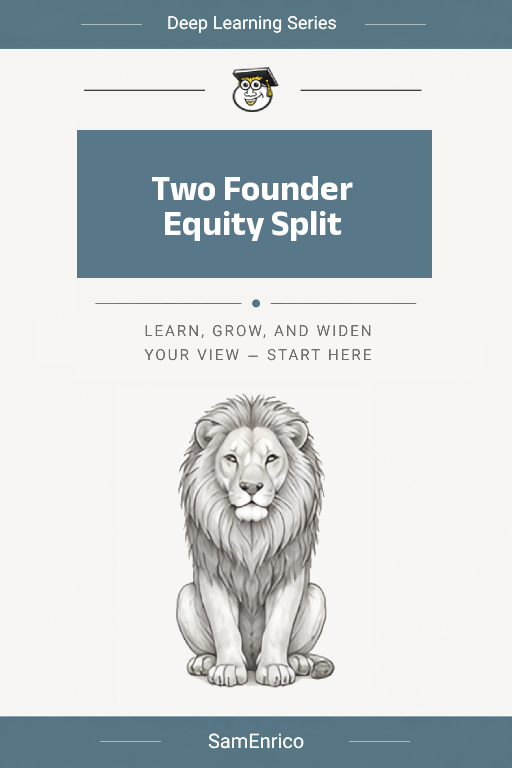
Non-FictionStartup GuideVesting Schedules
Two Founder Equity Split eBook
Fair equity split for two co-founders. 50/50, 60/4
Fair equity split for two co-founders. 50/50, 60/40, and other models for partnerships.
Formats
Free sample
Chapter 1: The Equity Illusion--It begins, as these things always do, with a handshake.Two founders sit across a kitchen table, a coffee shop, or a half-empty We Work. They have just agreed to change the world together. One says, "We should split it 50/50. Equal partners." The other nods. It feels right.
It feels fair. It feels like the beginning of something noble.Six months later, one founder has worked eighty-hour weeks, emptied their savings account, and missed their child's first steps. The other has worked twenty-hour weeks, kept their day job, and taken a vacation to Costa Rica. The fifty-fifty split that felt so virtuous on day one now feels like a trap. But they signed the paperwork.
The shares are issued. And now, the only way out is through a painful conversation that will likely end the friendship.This book exists because that story plays out thousands of times every year. And it does not need to.The data is staggering. Noam Wasserman, after a decade of studying ten thousand founders at Harvard Business School, found that seventy-three percent of startups split equity in the first month—often before the company has a bank account, a product, or a single customer. Those early, emotion-driven splits are a primary predictor of later founder conflict and departure.
Not product-market fit. Not competition. Not running out of cash. The handshake.This chapter dismantles the most dangerous assumption in entrepreneurship: that equal means fair. It will show you why fifty-fifty is structurally broken, why the data condemns it, and why the alternative models you are about to learn are not just better—they are the difference between survival and failure.The Romantic Phase of Partnership There is a reason founders split equity so early.
It is the same reason people get married on a beach in Mexico after knowing each other for six weeks. The romantic phase of any partnership—whether romantic or commercial—is characterized by optimism, trust, and a profound underestimation of future conflict.When you first agree to start a company together, you are not evaluating your co-founder. You are celebrating your reflection in their eyes. You see your own ambition, intelligence, and work ethic mirrored back at you. This is not cynicism; it is psychology.
The honeymoon effect is real, and it is dangerous.Here is what you do not know about your co-founder on day one:You do not know how they react under sustained pressure. You do not know if they will take the cheap flight at 6 AM or the convenient flight at 10 AM when it is the company's money. You do not know if they will tell the investor the truth about the missed milestone or fudge the numbers. You do not know if they will work through the stomach flu or take three days off. You do not know if they will blame you when things go wrong.And yet, on day one, you are supposed to assign them half of a company that does not yet exist.This is not wisdom.
This is gambling.The MIT research is explicit on this point. In a study of startup governance failures, the number one structural cause was not bad markets or bad products—it was the fifty-fifty deadlock. When two founders have equal ownership and equal voting rights, neither can fire the other. If one founder stops contributing, becomes toxic, or makes catastrophic decisions, the other has no recourse. The only legal remedy is to sue for dissolution of the company, which is expensive, slow, and almost always kills the business.Think about that.
The most common equity structure in startups makes it impossible to remove a bad co-founder.The Death Spiral Explained Let me walk you through the mechanics of the fifty-fifty death spiral, because it is important to understand exactly how good intentions become company-killers.Stage one: The Split Founders A and B agree to fifty-fifty. They file their incorporation papers, issue shares, and sign a standard Founders' Agreement. Everyone feels good.Stage two: The Divergence Over the next six months, Founder A works full-time, makes the introduction to the first investor, writes the business plan, and hires the first employee. Founder B works part-time, misses three deadlines, and starts to feel less engaged. The company is not yet generating revenue, so there are no objective metrics to measure contribution.Stage three: The Resentment Founder A begins to feel taken advantage of.
They are doing seventy percent of the work for fifty percent of the equity. But they cannot simply take more equity, because the shares are already issued. They cannot fire Founder B, because Founder B owns half the company. They cannot sell the company, because Founder B will veto any deal that does not overpay them.Stage four: The Conversation Founder A finally raises the issue. "I think we need to renegotiate the equity split.
I'm doing more work." Founder B, who feels criticized and defensive, says, "We agreed on fifty-fifty. You're just trying to screw me over." The conversation goes nowhere. Trust erodes.Stage five: The Spiral Founder A reduces their effort to match Founder B's output. The company stagnates. The investor who was interested backs out.
The product launch is delayed. Both founders blame each other. Eventually, one leaves. The remaining founder is now running a company with a ghost partner who still owns half the equity. Raising money becomes impossible, because no investor will put money into a company with a fifty-percent shareholder who does nothing.Stage six: The Death The company runs out of cash.
Both founders walk away with nothing but bitterness.This is not a hypothetical. I have seen this pattern play out in over a hundred startups. The fifty-fifty handshake is the single most predictable path to failure.The Data You Cannot Ignore Let me put some numbers on this, because founders love data until the data contradicts their feelings.Wasserman's study of ten thousand founders found that startups with equal equity splits had a significantly higher rate of founder departure than startups with asymmetric splits. The reason is intuitive: asymmetric splits force a conversation about value. They require founders to articulate why one person deserves more than the other.
That conversation, however uncomfortable, surfaces expectations and assumptions that would otherwise remain buried.The MIT research adds another layer. In a controlled simulation of startup decision-making, fifty-fifty teams took longer to make critical decisions, made more conservative (and often worse) decisions, and reported lower satisfaction with their partnership than teams with a clear 60/40 or 70/30 split. The mere presence of a tie—the possibility of deadlock—created decision paralysis.And here is the part that founders hate to hear: the startups that actually succeed—the ones that raise venture capital, achieve exit, or become profitable—overwhelmingly have asymmetric splits. Not because asymmetry causes success, but because successful founders are willing to have the hard conversation. They are not afraid to say, "I deserve more than you," and they are not so fragile that they cannot hear, "You deserve less than me."The romantic phase of partnership is a luxury you cannot afford.Why Equal Feels Fair (And Why That Feeling Lies)The psychology of fairness is fascinating and dangerous.…
This is the end of the free sample. Get the eBook to keep going. Buy now
About this book
Details
- Author
- Beaulieu Flossie
- Publisher
- SamEnrico
- Language
- English
- Genre
- Non-Fiction, Startup Guide, Vesting Schedules
- Released
- 2026-05-29
- Pages (approx.)
- 151
- Available as
- eBook, Audiobook

Read better in the ZLOADR app
Your eBooks on your phone or tablet. Sign in with your SamEnrico account and start reading.
More by Beaulieu Flossie
 Remote Law GuideBeaulieu Flossie$11.99
 Daily Meditations for RecoveryBeaulieu Flossie$11.99
 New Zealand South Island LeaderBeaulieu Flossie$11.99
 Boulder Socialite Christmas PartyBeaulieu Flossie$11.99
 Learn to Play the CornamuseBeaulieu Flossie$11.99Learn to Play the CornamuseBeaulieu Flossie$11.99
 How to Start a Caravans (wholesale) Business (Beginners Guide)Beaulieu Flossie$11.99
 Box Office RepresentativeBeaulieu Flossie$11.99
You may also like
 Hong Kong Handover 1997Dunn Johnnie$11.99
 Zumba For Postnatal Recovery CourseNeal Christian$11.99
 Zumba for BeginnersLadner Nikia$11.99
 YouTube Comment Mining GuideHumes Pandora$12.99
 Worry Box MeditationCarlin Rudy$11.99
 Workplace Stress MeditationNguyen Lynn$11.99
 Workplace Stress and Sleep RepairHawley Ivory$11.99
 Workplace Perfectionism CureDelaney Jeffry$11.99
 Workplace Injustice Anger GuideWallen Isabelle$11.99
 Work Addiction and Burnout LinkGreenwood Ester$11.99
 Women in Yoga and WellnessBeattie Galina$11.99
 Women in Stand Up ComedyChun Evangeline$11.99