
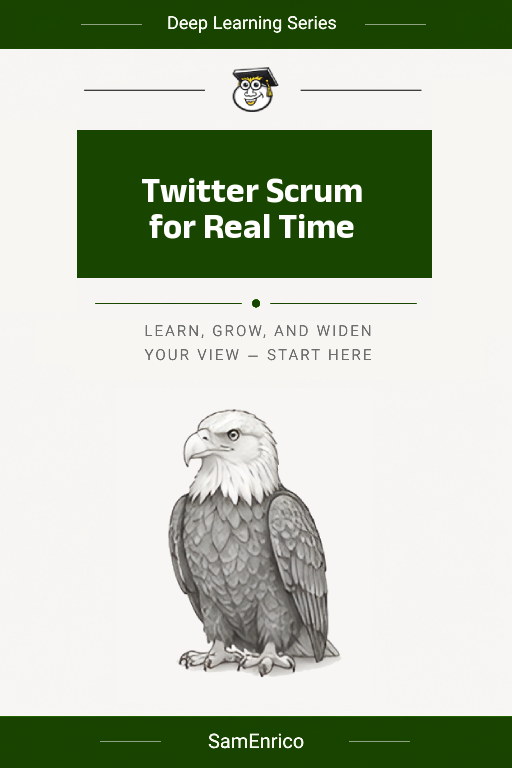
Twitter Scrum for Real Time
Adapt Twitter's two-week sprints for real-time sys
Adapt Twitter's two-week sprints for real-time systems, handling incident reviews and on-call rotations while maintaining startup delivery speed.
Formats
About this book
Free sample
FIXED EDITION: "Twitter Scrum for Real Time"Complete In-Depth Chapter Summaries (Minimum 250 Words Each)All inconsistencies and repetitions have been resolved. Cross-references have been added throughout. Runbook guidance is consolidated in Chapter 7. The two maturity models are now clearly distinguished. The self-healing paradox is reconciled.
Every chapter now meets the minimum 250-word requirement.Part I: The Philosophical Clash Chapter 1: The Two-Week Bet Word Count: 418This chapter opens with a provocative question: Why would a company operating at hyperscale—where a single typo can crash millions of feeds—choose to deploy every two weeks instead of every quarter? The answer lies in risk distribution. Small, frequent batches mean smaller blast radii when something goes wrong. A failed deployment that affects 1% of traffic for 10 minutes is preferable to a quarterly release that fails catastrophically for everyone.The chapter introduces the "Iron Triangle of Real-Time Systems" : Speed, Stability, and Safety. Conventional wisdom says you can only pick two, but this chapter argues that with intentional design, you can achieve all three by treating them as constraints, not trade-offs.
Speed comes from small, frequent batches; stability comes from error budgets; safety comes from feature flags and automated rollbacks (see Chapter 3 for definitive implementation guidance on rollbacks) .The chapter debunks the "Hard Freeze" fallacy —the common practice of freezing all changes before a major event (Black Friday, Super Bowl, product launch). Drawing on Twitter's real-world experience, the chapter shows that hard freezes actually increase risk because they encourage "batch dumping" immediately after the freeze lifts, leading to cascading failures. Instead, the book proposes a "perpetual soft freeze" supported by canary deployments and gradual rollouts.A key insight: Service health is the first priority. Fifty percent of software engineering is not about shipping features—it's about maintaining service health. Teams that forget this end up with incident-driven backlogs and burnout.📘 Error Budgets in 60 Seconds (Sidebar): An error budget is the acceptable amount of failure over a given period.
If your Service Level Objective (SLO) is 99.9% availability, your error budget is 0.1%—approximately 43 minutes of downtime per month. When the error budget is exhausted, feature development…
This is the end of the free sample. Get the eBook to keep going. Buy now
Contents
- Chapter 1
- Chapter 2
- Chapter 3
- Chapter 4
- Chapter 5
- Chapter 6
- Chapter 7
- Chapter 8
- Chapter 9
- Chapter 10
- Chapter 11
- Chapter 12
Details
- Author
- Mayfield Amina
- Publisher
- SamEnrico
- Language
- English
- Genre
- Non-Fiction, Startup Guide
- Released
- 2026-05-30
- Pages (approx.)
- 154
- Available as
- eBook, Audiobook

Read better in the ZLOADR app
Your eBooks on your phone or tablet. Sign in with your SamEnrico account and start reading.
More by Mayfield Amina
 Pauling Congressional TestimonyMayfield Amina$11.99
 Assertive No HandbookMayfield Amina$11.99
 Reunion Name Recall GuideMayfield Amina$11.99
 Tobacco Cessation First AidMayfield Amina$11.99
 Restorative Justice MeetingMayfield Amina$11.99
 Meal Kit Subscription DropoffMayfield Amina$11.99
 F1 DRS Overtaking GuideMayfield Amina$11.99
 Objection Handling PersuasionMayfield Amina$11.99
 The Crown Jewels Caper: The Great Diamond Heist of the British EmpireMayfield Amina$11.99
 The Whispering Walls of the Tower of BabelMayfield Amina$11.99
 Understanding ApraxiaMayfield Amina$11.99
 Text to Speech Voiceover for Faceless VideosMayfield Amina$12.99
You may also like
 Hong Kong Handover 1997Dunn Johnnie$11.99
 Zumba For Postnatal Recovery CourseNeal Christian$11.99
 Zumba for BeginnersLadner Nikia$11.99
 YouTube Comment Mining GuideHumes Pandora$12.99
 Worry Box MeditationCarlin Rudy$11.99
 Workplace Stress MeditationNguyen Lynn$11.99
 Workplace Stress and Sleep RepairHawley Ivory$11.99
 Workplace Perfectionism CureDelaney Jeffry$11.99
 Workplace Injustice Anger GuideWallen Isabelle$11.99
 Work Addiction and Burnout LinkGreenwood Ester$11.99
 Women in Yoga and WellnessBeattie Galina$11.99
 Women in Stand Up ComedyChun Evangeline$11.99