
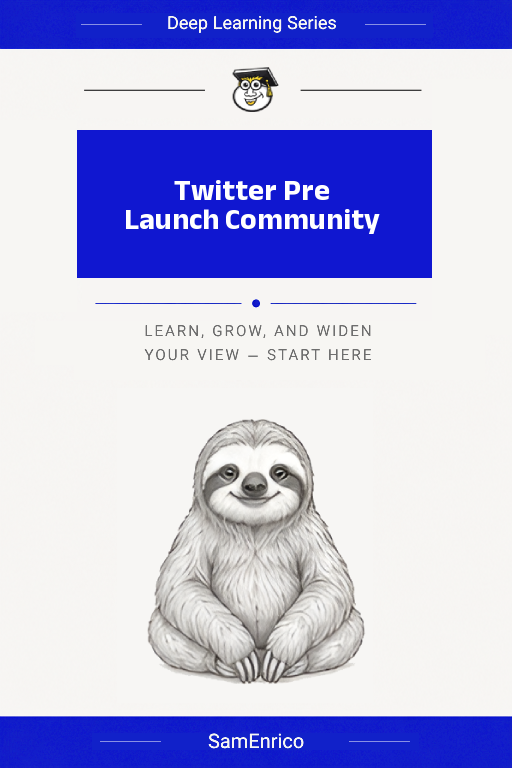
Non-FictionStartup GuideWaitlist Strategy
Twitter Pre Launch Community eBook
Build community on Twitter before launch. Threads,
Build community on Twitter before launch. Threads, spaces, and engagement strategies.
Formats
Free sample
Chapter 1: The Anti-Chase Manifesto--–- Most founders wake up on launch day with a spreadsheet of 10,000 Twitter followers and a knot in their stomach. They have spent six months posting daily, chasing likes, retweeting influencers, and watching their follower count climb. They have done everything the growth gurus told them to do. And yet, when they finally drop the link, the silence is deafening. Three sales.
Four if you count their mother. The knot tightens.This book exists because that scenario is not a failure of effort. It is a failure of strategy. You have been trained to chase the wrong metric. You have been told that "reach" is the goal, that followers are the currency of influence, that a bigger audience is always a better audience.
That lie has cost thousands of founders their launches, their confidence, and their communities.Welcome to the Anti-Chase.This chapter will dismantle everything you think you know about building an audience on Twitter before a launch. You will learn why millions of followers can be a liability, why "going viral" before you have a feedback loop is brand suicide, and how a tribe of 500 true believers will outperform 100,000 strangers every single time. By the end of this chapter, you will have performed an audit of your current Twitter presence using the Brand Debt Calculator. You will know your Minimum Viable Audience. And you will understand the single principle that separates successful pre-launch builders from everyone else: Resonance over Reach.The Follower Trap Let us name the enemy.
The enemy is not Twitter's algorithm. The enemy is not your competitors. The enemy is the Content Hamster Wheel—the exhausting, low-ROI cycle of posting daily, chasing likes, and watching your engagement metrics flatline while you burn out.The Content Hamster Wheel has a seductive promise: post more, get more followers, sell more products. It is a lie wrapped in a vanity metric. Followers do not buy products.
Followers do not give feedback. Followers do not defend you in the comments when the trolls arrive. Followers are spectators. They clicked a button and moved on with their lives.Here is the hard truth that no growth guru will tell you: a large, cold audience creates engagement debt. Every follower who ignores your tweets signals to the algorithm that your content is not valuable.
When 90 percent of your followers scroll past your posts without liking, replying, or retweeting, Twitter learns one thing: this account is not worth showing to others. Your reach collapses under the weight of your own follower count.I have seen this play out dozens of times. A founder spends six months running follow-unfollow bots, buying retweets from shady services, and posting low-effort "quote of the day" graphics. They hit 50,000 followers. They feel like a celebrity.
Then they launch their product. Six sales. They blame the product. They blame the market. They never blame the audience they built—because they never built an audience at all.
They built a list of usernames.The Anti-Chase Manifesto rejects the follower trap entirely. You are not looking for followers. You are looking for the 100 True Fans who will defend you, plus the 1,000 Edge Users who will pay you. Everyone else is noise.Resonance Over Reach: The Core Principle The single most important sentence in this book is this: reach without resonance is noise; resonance without reach is a movement waiting to happen.Resonance is the quality of connection between you and another human being. It is the feeling of being seen, heard, and understood.
When you write a tweet that makes someone say "finally, someone gets it," that is resonance. When you reply to a stranger's question with a thoughtful answer that solves their problem, that is resonance. When you host a Twitter Space where two people have a genuine conversation about a painful problem, that is resonance.Reach is the number of eyeballs that see your content. Reach is easy to buy, easy to fake, and easy to obsess over. Resonance is hard.
Resonance requires vulnerability, specificity, and patience. Resonance cannot be faked.Here is the counterintuitive truth: when you focus on resonance, reach eventually follows. When you focus on reach, resonance dies. The algorithm is designed to reward engagement, not impressions. A tweet that gets fifty replies from passionate, angry, or grateful people will outperform a tweet that gets five thousand likes from passive scrollers.
Replies are the algorithm's favorite signal because replies require effort. Likes require a single tap.Throughout this book, every tactic, framework, and checklist will serve one master: resonance. When you learn the Engagement Grid in Chapter 2, you will use it to find fifty accounts to reply to—not to follow, not to like, but to reply. When you learn the Hook, Hold, Hang structure in Chapter 4, you will design threads that demand saves and screenshots, not passive consumption. When you learn the 5-to-1 Rule in Chapter 6, you will spend five times more energy hunting conversations on other people's turf than you spend broadcasting your own opinions.Resonance is not a tactic.
It is a mindset. And it begins by shrinking your focus.The 5/25/500 Rule: Finding Your Minimum Viable Audience You cannot resonate with millions of people. You do not need to. The 5/25/500 Rule is a framework for identifying your Minimum Viable Audience (MVA)—the smallest group of people who share the exact pain point your product solves.Here is how it works.The 5. There are five people in the world who know you intimately.
They are your spouse, your best friend, your mentor, your co-founder, your sibling. These five people will support you no matter what. They will buy your product even if it is broken. They will defend you even if you are wrong. You do not need to market to them.
They are already yours.The 25. There are twenty-five people in your professional network who trust your judgment. These are former colleagues, clients, industry peers, and active community members. They have worked with you, learned from you, or watched you deliver value over time. They will buy your product if it solves a problem they have.
They will give you honest feedback because they want you to succeed. These twenty-five people are your launch squad.The 500. There are five hundred people in your broader niche who share the exact pain point your product solves. You may not know them personally. They may not follow you yet.
But they are searching for solutions. They are complaining about competitors. They are asking questions in public that your product answers. These five hundred people are your Minimum Viable Audience. If you cannot find five hundred people who desperately need what you are building, you do not have a product problem.
You have a targeting problem.The 5/25/500 Rule is not a suggestion. It is a hard constraint. You will not build resonance with five thousand people during your pre-launch phase. You will not build resonance with fifty thousand people. You will build resonance with five hundred people.
And that is enough.Let me prove it to you.If five hundred people each pay you fifty dollars, you have made twenty-five thousand dollars. That is a successful launch by any reasonable standard. If fifty of…
This is the end of the free sample. Get the eBook to keep going. Buy now
About this book
Details
- Author
- Epperson Nickolas
- Publisher
- SamEnrico
- Language
- English
- Genre
- Non-Fiction, Startup Guide, Waitlist Strategy
- Released
- 2026-06-01
- Pages (approx.)
- 126
- Available as
- eBook, Audiobook

Read better in the ZLOADR app
Your eBooks on your phone or tablet. Sign in with your SamEnrico account and start reading.
More by Epperson Nickolas
 Francis Vernacular PrayersEpperson Nickolas$11.99
 The Beginner's Mindfulness JournalEpperson Nickolas$11.99
 Remote Focus EnvironmentEpperson Nickolas$11.99
 Remote Work Loneliness CureEpperson Nickolas$11.99
 The Hypnosis Listening Environment GuideEpperson Nickolas$11.99
 Shredding the Southern Skies: The Rise of Australia & New Zealand’s Skateboarding LegendsEpperson Nickolas$11.99
 Learn to Play the Accordina (Instrument)Epperson Nickolas$11.99
 How to Start a Fish and Chip Shop Business (Beginners Guide)Epperson Nickolas$11.99
 Blockchain MOOC CertificatesEpperson Nickolas$12.99
You may also like
 Hong Kong Handover 1997Dunn Johnnie$11.99
 Zumba For Postnatal Recovery CourseNeal Christian$11.99
 Zumba for BeginnersLadner Nikia$11.99
 YouTube Comment Mining GuideHumes Pandora$12.99
 Worry Box MeditationCarlin Rudy$11.99
 Workplace Stress MeditationNguyen Lynn$11.99
 Workplace Stress and Sleep RepairHawley Ivory$11.99
 Workplace Perfectionism CureDelaney Jeffry$11.99
 Workplace Injustice Anger GuideWallen Isabelle$11.99
 Work Addiction and Burnout LinkGreenwood Ester$11.99
 Women in Yoga and WellnessBeattie Galina$11.99
 Women in Stand Up ComedyChun Evangeline$11.99