
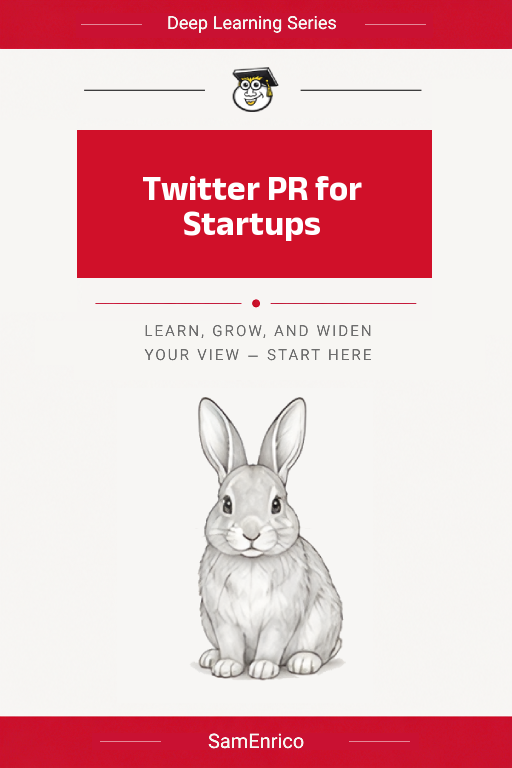
Non-FictionStartup GuideMedia Outreach
Twitter PR for Startups eBook
Use Twitter to connect with journalists and get fe
Use Twitter to connect with journalists and get featured. Follow lists and engagement tactics.
Formats
Free sample
Chapter 1: The Vanity Trap--–- Most founders wake up to the same lie every morning. They check their phone. They see that a tweet went viral overnight. Three thousand likes. Four hundred retweets.
A hundred and twenty new followers. Dopamine spikes through their system. They feel like they are winning at public relations. Then they look at their press mentions for the month. Zero.
No journalist called. No article was written. No backlink was earned. The viral tweet did absolutely nothing for their business.This is the Vanity Trap. It is the single most expensive mistake that startup founders make when they attempt to do their own public relations.
They confuse noise with signal. They measure what is easy to measure instead of what actually matters. And they waste months—sometimes years—chasing metrics that will never, under any circumstances, lead to a single journalist putting their startup in print.Why Your Follower Count Is Lying to You Let us be brutally honest about what Twitter PR actually is. It is not about going viral. It is not about building a massive following.
It is not about getting retweeted by an influencer. Those things feel good. They feed the ego. They make for great screenshots to post in founder group chats. But they do not pay the rent.
They do not drive qualified traffic to your website. And they certainly do not convince a Tech Crunch reporter to pick up the phone and call you for a quote.The only metrics that matter in Twitter PR are three. Backlinks from reputable publications to your startup's domain. Actual features, interviews, or quotes in target outlets that your ideal customers actually read. And relationships with journalists who now know your name, recognize your handle, and reply to your direct messages within twenty-four hours.
Everything else is theater.Consider this. A startup with two thousand followers but ten quality backlinks from tier-one publications will outrank, outsell, and outlast a startup with fifty thousand followers and zero backlinks. Followers are rented attention. Backlinks are owned authority. You do not control the Twitter algorithm.
You do control your search engine ranking. One is a casino. The other is an asset.How the Modern Newsroom Actually Works Most founders have never stepped inside a modern newsroom. They do not understand how the sausage is made. They imagine a calm environment where reporters spend weeks meticulously researching a single story, triple-checking sources, and carefully crafting prose.
That image is from 1995. The modern newsroom is closer to an emergency room during a mass casualty event than a university library.Deadlines have collapsed. A reporter who had three days to file a story a decade ago now has three hours. Staffing has been gutted. A beat reporter who used to cover only artificial intelligence now covers AI, cybersecurity, cloud computing, and sometimes crypto if no one else is available.
The pressure to produce volume has never been higher. The time to verify sources has never been lower.What does this mean for you as a founder trying to get press? It means that journalists are desperate for credible, ready-to-publish sources who can speak in complete sentences and provide data that does not need to be fact-checked six ways from Sunday. It means that a journalist who finds a reliable source on Twitter will come back to that source again and again, not out of loyalty, but out of sheer survival. When you have three hours to file a story, you do not have time to hunt for a new expert every single time.
You call the person who has already proven themselves useful.This is the opportunity that most founders miss entirely. They spend their energy trying to be loud. They should be spending their energy trying to be helpful.The Seven Words That Will Change Your PR Strategy The loudest accounts on Twitter are almost never the ones journalists follow. Think about your own experience. When you see an account that tweets hot takes every hour, that replies to every trending topic with a forced opinion, that never seems to sleep or log off—do you respect that account?
Or do you mute it? Journalists are no different. They have muted hundreds of accounts that shout into the void. They have followed dozens of accounts that quietly provide value, share unique data, and engage with genuine curiosity rather than desperation.The core thesis of this entire book can be stated in seven words. Stop trying to be loud.
Start trying to be helpful. Every single tactic, every single strategy, every single template that follows in the next eleven chapters exists to serve that one sentence. If a tactic does not make you more helpful to journalists, discard it. If a strategy does not reduce the friction between a reporter's question and your answer, it is worthless. If a template does not make the journalist's life easier, delete it and start over.Why Journalists Actually Use Twitter Before we dive into the tactics, we need to understand the anatomy of a journalist's relationship with Twitter.
Why do they stay on a platform that is often chaotic, toxic, and algorithmically unpredictable? The answer is simple. Twitter is where the news breaks first. It is where sources announce themselves. It is where experts publish raw data before it gets sanitized into a press release.
A journalist who ignores Twitter is a journalist who gets scooped. A journalist who gets scooped too many times is a journalist who gets fired.Twitter serves three specific functions for working journalists.First, it is a monitoring tool. They follow other reporters, industry experts, companies, and competitors to see what is happening in real time. When a story breaks, they want to see it on Twitter before it hits the wires.Second, it is a sourcing tool. They post questions, use hashtags like #Journo Request, and scan replies to find credible voices for their stories.
A single tweet can generate fifty potential sources in under an hour.Third, it is a distribution tool. They share their finished articles, drive traffic, and build their personal brand so that sources come to them instead of the other way around. A journalist with a strong Twitter presence receives inbound pitches from experts who want to be quoted.Notice what is not on that list. Journalists do not use Twitter to read press releases. They do not use Twitter to find companies that tweet about themselves incessantly.
They do not use Twitter to discover startups that have mastered the art of the humble brag. If your entire Twitter strategy revolves around tweeting about your own product, your own funding, your own hiring, and your own awards, you are invisible to journalists. You are not even on their radar. You are background noise.The Counterintuitive Truth About Self-Promotion The startups that succeed at Twitter PR understand a counterintuitive truth. The less you talk about yourself, the more journalists will talk about you.
This is not a moral position. It is not about being humble or virtuous. It is a practical reality of how attention works on a platform where everyone is screaming. The journalist who hears a hundred pitches a day…
This is the end of the free sample. Get the eBook to keep going. Buy now
About this book
Details
- Author
- Orellana Isidro
- Publisher
- SamEnrico
- Language
- English
- Genre
- Non-Fiction, Startup Guide, Media Outreach
- Released
- 2026-05-29
- Pages (approx.)
- 118
- Available as
- eBook, Audiobook

Read better in the ZLOADR app
Your eBooks on your phone or tablet. Sign in with your SamEnrico account and start reading.
More by Orellana Isidro
 Step Zero Prelude GuideOrellana Isidro$11.99
 The Autistic Child Parent AngerOrellana Isidro$11.99
 HIIT For Dads GuideOrellana Isidro$11.99
 Empathy Role Play ScenariosOrellana Isidro$11.99
 The Competitive Pricing Analysis GuideOrellana Isidro$11.99
 The Last Oath of the GorgonOrellana Isidro$11.99
 MBE Certification MasteryOrellana Isidro$12.99
 The Breeder's Guide to Midget White TurkeysOrellana Isidro$11.99
 How to Start a Blow-out Prevention Apparatus Business (Beginners Guide)Orellana Isidro$11.99
 Lead ConsultantOrellana Isidro$11.99
You may also like
 Hong Kong Handover 1997Dunn Johnnie$11.99
 Zumba For Postnatal Recovery CourseNeal Christian$11.99
 Zumba for BeginnersLadner Nikia$11.99
 YouTube Comment Mining GuideHumes Pandora$12.99
 Worry Box MeditationCarlin Rudy$11.99
 Workplace Stress MeditationNguyen Lynn$11.99
 Workplace Stress and Sleep RepairHawley Ivory$11.99
 Workplace Perfectionism CureDelaney Jeffry$11.99
 Workplace Injustice Anger GuideWallen Isabelle$11.99
 Work Addiction and Burnout LinkGreenwood Ester$11.99
 Women in Yoga and WellnessBeattie Galina$11.99
 Women in Stand Up ComedyChun Evangeline$11.99