
Non-FictionSelf-HelpDigital Culture
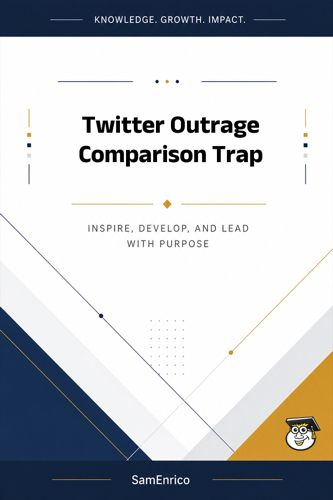
Twitter Outrage Comparison Trap eBook
Examines how virtue signaling and performative opi
by Barbour Ozie
Examines how virtue signaling and performative opinions fuel inadequacy.
Formats
Free sample
Chapter 1: The Dopamine Ledger...--The first time I watched someone trade their integrity for a like, I was sitting in a coffee shop in Chicago, half-reading a book and half-scrolling Twitter. A woman at the next table—late twenties, expensive headphones, a cold brew that cost more than my lunch—suddenly grinned at her phone with the specific, slightly manic joy of a gambler who has just hit a small jackpot. She showed the screen to her friend. “Three hundred likes already,” she whispered. “And I didn’t even mean it.”I pretended not to listen.
But I couldn’t stop. Over the next twenty minutes, I watched her compose three more tweets. Each one was sharper, more dismissive, more certain than the last. She was replying to a political argument she claimed to find exhausting. But her thumbs moved with the rhythm of someone who was anything but exhausted.
She was energized. She was chasing something.What she was chasing, and what you have chased if you have ever posted anything even mildly controversial on this platform, was not justice. It was not truth. It was not even agreement. She was chasing the specific, neurochemical reward that comes from trading nuance for outrage and cashing in the difference.
She was keeping a ledger that most of us do not even know we maintain. Call it the Dopamine Ledger.On one side of this ledger, you deposit complexity. You deposit doubt. You deposit the admission that you might be wrong, that the other side might have a point, that the situation is messier than a hashtag can capture. On the other side, you withdraw rewards: likes, retweets, quote tweets, the algorithmic validation that says you are right, you belong, you are safe.
The transaction is simple. You trade a piece of your intellectual honesty for a hit of social currency. The platform’s architecture ensures that this trade feels not like a loss, but like a win. Every notification is a receipt. Every like is a signature.This chapter is about that ledger.
It is about how Twitter transformed moral reasoning from a private struggle into a public performance sport. And it is about the specific psychological mechanism—the Addiction Economy—that keeps you scrolling, posting, and comparing long after the outrage has stopped feeling like yours.The Slot Machine in Your Pocket To understand the Addiction Economy, you have to forget everything you think you know about why you use Twitter. You probably tell yourself you use it for news, for community, for professional networking, for activism. Those are the stories we tell ourselves to avoid admitting the truth: we use it because it feels good, then bad, then good again, in a cycle that closely resembles the one experienced by a person pulling the lever of a slot machine.B. F.
Skinner, the behavioral psychologist, discovered something now famous as the principle of variable rewards. In experiments with pigeons and rats, Skinner found that animals would press a lever most frantically not when every press produced a pellet of food, but when the rewards were unpredictable. A pellet sometimes. A pellet never. A pellet after one press, then after ten, then after three.
The uncertainty, Skinner discovered, was more addictive than the certainty. The animal kept pressing because the next press might be the big one.Twitter is a variable reward machine designed by people who read Skinner. When you post something, you do not know if it will receive zero likes or ten thousand. You do not know if a stranger will quote-tweet you with praise or with a dunk. You do not know if your followers will ignore you or elevate you.
That uncertainty is not a bug. It is the engine. Every time you refresh and see a notification, your brain releases a small pulse of dopamine—the neurotransmitter associated with anticipation, reward, and craving. The notification itself is almost beside the point. The anticipation of the notification is the drug.Now layer morality on top of this architecture.
When the reward you are chasing is not just attention but moral approval, the stakes feel higher. A like on a photo of your breakfast is pleasant. A like on a take about a humanitarian crisis feels meaningful. It feels like you are not just popular, but good. This is the genius of the Addiction Economy as applied to morality: it converts your deepest human need—to be a good person—into a currency that can be earned, spent, and compared.The Two Drives: Belonging and Safety Here is where the ledger becomes more complicated than Skinner’s pigeons.
You are not just chasing pleasure. You are also fleeing pain. The Addiction Economy runs on two distinct psychological engines, and most of the time, you cannot tell which one is accelerating.The first engine is positive reinforcement: the pursuit of belonging, status, admiration, and the warm glow of being on the right side of history. This is the engine that fires when you post something you genuinely believe and watch the likes roll in. It feels like being seen, being held, being welcomed into a tribe.
The platform monetizes this engine by showing you exactly how many people agree with you, and exactly how many people are still waiting to be convinced.The second engine is negative reinforcement: the avoidance of shame, cancellation, exclusion, and the cold dread of being found out as insufficiently pure. This engine fires when you post not because you want the reward, but because you cannot bear the punishment of silence. You have watched friends get ratioed. You have seen the screenshots circulate. You know that a single failure to perform can cost you followers, friendships, and in extreme cases, your career.
So you post. Not for the joy of it. For the relief of safety.Here is the trap: these two engines often produce the same behavior. A person seeking belonging and a person fleeing shame will both retweet the same dunk, use the same hashtag, perform the same outrage. But they are in completely different psychological states.
One is approaching a reward. The other is avoiding a threat. The platform does not care which. It collects the engagement from both.The Addiction Economy exploits this ambiguity. Because you cannot always tell whether you are posting from conviction or from fear, you lose the ability to trust your own motives.
Was that retweet an act of solidarity or an act of self-protection? Did you really care about that issue, or did you just not want to be the only one who stayed silent? The ledger does not ask these questions. The ledger only tracks the transaction: complexity out, reward in. The rest is noise.The Pain of Nuance and the Euphoria of the Dunk Spend an hour on Twitter and you will notice a pattern so consistent it might as well be a law of physics.
A nuanced take—one that acknowledges trade-offs, admits uncertainty, or grants the opponent a partial point—will receive minimal engagement. A dunk—a sharp, dismissive, morally certain attack on an individual or an idea—will receive orders of magnitude more.This is not because the world hates nuance. It…
This is the end of the free sample. Get the eBook to keep going. Buy now
About this book
Details
- Author
- Barbour Ozie
- Publisher
- SamEnrico
- Language
- English
- Genre
- Non-Fiction, Self-Help, Digital Culture
- Released
- 2026-06-06
- Pages (approx.)
- 131
- Available as
- eBook, Audiobook

Read better in the ZLOADR app
Your eBooks on your phone or tablet. Sign in with your SamEnrico account and start reading.
More by Barbour Ozie
 Loneliness During Holidays GuideBarbour Ozie$11.99
 CrossFit Rope Climb ProgressionsBarbour Ozie$11.99
 Teen Self Advocacy GuideBarbour Ozie$11.99
 Stalking Dating App Danger CasesBarbour Ozie$11.99
 The Unlikely Alliance: How a Hip-Hop Mogul and a Conservative Senator United to Save Music EducationBarbour Ozie$11.99
 Echoes of Ice and Stone: Decoding Antarctica’s Forgotten LanguagesBarbour Ozie$11.99
 Understanding Duodenal Atresia Tetralogy of FallotBarbour Ozie$17.99
 Cinematic LightingBarbour Ozie$11.99
 Retail Union Collective BargainingBarbour Ozie$12.99
 AI Data Backup GuideBarbour Ozie$12.99
 How to Become a Carpet SewerBarbour Ozie$11.99
You may also like
 Hong Kong Handover 1997Dunn Johnnie$11.99
 Zumba For Postnatal Recovery CourseNeal Christian$11.99
 Zumba for BeginnersLadner Nikia$11.99
 YouTube Comment Mining GuideHumes Pandora$12.99
 Worry Box MeditationCarlin Rudy$11.99
 Workplace Stress MeditationNguyen Lynn$11.99
 Workplace Stress and Sleep RepairHawley Ivory$11.99
 Workplace Perfectionism CureDelaney Jeffry$11.99
 Workplace Injustice Anger GuideWallen Isabelle$11.99
 Work Addiction and Burnout LinkGreenwood Ester$11.99
 Women in Yoga and WellnessBeattie Galina$11.99
 Women in Stand Up ComedyChun Evangeline$11.99