
Non-FictionSelf-HelpMetricsInfluence
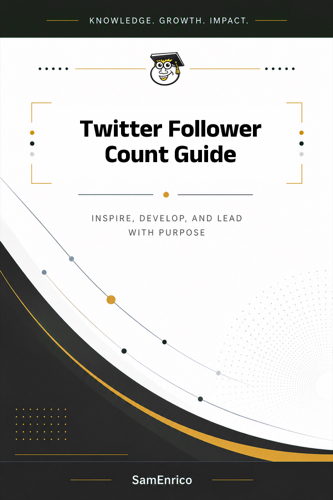
Twitter Follower Count Guide eBook
Stop measuring your influence and worth by followe
Stop measuring your influence and worth by follower count and retweet numbers.
Formats
Free sample
Chapter 1: The Dopamine Trap--–- You are standing in front of a slot machine. You cannot see the reels, but you can hear them spinning. You insert a coin – not a metal coin, but a piece of yourself. A thought. An observation.
A joke you spent ten minutes crafting. You pull the lever by tapping a blue button that says "Tweet." Then you wait. The reels spin. Three seconds. Five seconds.
Ten. Your heart rate increases slightly. Your pupils dilate. Your thumb hovers over the screen, ready to refresh. Then – the machine pays out.
Or it doesn't. A number appears: 2 likes. 47 likes. 1,240 likes. 0 retweets.
The number is never predictable. That unpredictability is not a flaw in the machine. It is the entire point.Welcome to Twitter. Welcome to the dopamine trap.If you have ever posted something and then refreshed the page thirty seconds later – and you have, because every single person reading this has – you have experienced the most precisely engineered behavioral loop in human history. Not accidentally engineered.
Not incidentally engineered. Designed, tested, optimized, and deployed by some of the smartest attention engineers in the world, working inside a company that makes money not from your tweets but from your compulsion to check them. Every time you refresh, Twitter shows you an ad. Every time you feel that tiny spike of anticipation before the numbers load, Twitter's servers log another millisecond of your attention. You are not the customer.
You are the product. And the product's primary feature is its ability to keep you pulling the lever.This chapter is going to hurt a little. Not because it is complicated – the neuroscience here is actually quite simple – but because it requires you to see something you have probably been avoiding: your own brain has been hacked, and you have been complicit in the hacking. That is not a moral failure. It is a design failure.
Humans did not evolve to resist variable rewards any more than fish evolved to resist hooks. The hook is shaped like food. Twitter's hook is shaped like connection, status, and the terrifying possibility that you might be forgotten. Before we can talk about follower counts – before we can even begin to discuss whether 10,000 followers means anything at all – we have to understand what is actually happening inside your skull every time you open this application.Let us begin with dopamine.The Molecule of More Dopamine has been wildly misrepresented in popular culture. Most people think dopamine is the pleasure chemical.
It is not. When you eat a delicious meal, your brain releases endorphins and endogenous opioids – those are the pleasure chemicals. When you have an orgasm, your brain releases oxytocin and prolactin – bonding and satisfaction chemicals. Dopamine does something much stranger and much more dangerous: it is the chemical of anticipation. Of wanting.
Of more.Here is the classic experiment, replicated dozens of times across four decades. A researcher places a rat in a box with a lever. When the rat presses the lever, a pellet of food drops into a tray. At first, the rat's dopamine spikes after it eats the food. That makes intuitive sense: the reward causes pleasure.
But after a few repetitions, something shifts. The rat learns to associate the lever with the food. Now the dopamine spike moves. It no longer happens when the rat eats. It happens when the rat presses the lever.
The anticipation of the reward becomes more neurologically potent than the reward itself.Then the experiment gets cruel. The researcher modifies the box so that the lever now produces a pellet randomly – sometimes one press works, sometimes ten presses produce nothing, sometimes three presses produce two pellets. This is called a variable ratio reinforcement schedule. It is the same schedule used by slot machines, loot boxes in video games, and, as we will see, Twitter's notification system. Under this schedule, the rat's dopamine levels go haywire.
They spike highest not when the pellet arrives, but in the moments before the result is known. The uncertainty amplifies the anticipation. The rat presses the lever more frequently, for longer periods, even when it is not hungry. It will ignore food sitting openly in the box to press the lever. It will cross an electrified grid to press the lever.
It will press the lever until it collapses from exhaustion.You are the rat. Twitter is the box. The tweet button is the lever. And the numbers – the likes, the retweets, the new follower notifications – are the pellets that arrive on no predictable schedule.The reason you refresh is not because you are weak. It is because your brain is doing exactly what it evolved to do: seek patterns, anticipate rewards, and release dopamine to motivate the next action.
The problem is that the environment has changed faster than your brain can adapt. Your ancestors needed this anticipation system to find fruit trees, track prey, and remember where water sources were located. The uncertainty of "is there fruit on this tree today?" was a life-saving motivator. The uncertainty of "did my tweet about traffic get any likes?" is not. But your brain cannot tell the difference.
To your limbic system, a retweet is a berry. A follower is a水源. A viral thread is a feast.This is the dopamine trap. You are not addicted to Twitter. You are addicted to the possibility that the next refresh will show a number that makes you feel, for one fleeting second, that you matter.Status Anxiety: The Older, Deeper Driver Dopamine is only half the story.
The other half is older, more primal, and more dangerous because it operates below the level of conscious awareness. It is called status anxiety, and it is not a modern invention. It is not a social media pathology. It is a survival instinct that evolved in small tribal groups where your social standing literally determined whether you would eat, mate, or be protected.Here is the evolutionary logic. For the 300,000 years that humans have existed as a species – and for the 50 million years before that, in our primate ancestors – living outside a social group meant death.
A lone hominid in the savanna was eaten. A solitary primate in the jungle starved. Your ancestors survived because they were embedded in groups that shared food, defended against predators, and cared for injured members. But group membership was not automatic. You had to be valued.
You had to be seen as useful, likable, or at least not dangerous. The consequence of low status was not just embarrassment. It was death.Your brain therefore evolved an exquisitely sensitive system for tracking your status relative to others. This system uses a neuromodulator called serotonin, which fluctuates based on perceived social rank. When you believe your status has risen, serotonin increases and you feel calm, confident, and secure.
When you believe your status has dropped, serotonin plummets and you feel anxious, vigilant, and desperate to recover your standing. This system is not rational. It does not care whether the status signal is real or virtual. It does not distinguish between being chosen for a hunting party in 10,000 BCE and being retweeted by an influencer in 2026. The feeling is…
This is the end of the free sample. Get the eBook to keep going. Buy now
About this book
Details
- Author
- Lerma Hipolito
- Publisher
- SamEnrico
- Language
- English
- Genre
- Non-Fiction, Self-Help, Metrics, Influence
- Released
- 2026-06-09
- Pages (approx.)
- 144
- Available as
- eBook, Audiobook

Read better in the ZLOADR app
Your eBooks on your phone or tablet. Sign in with your SamEnrico account and start reading.
More by Lerma Hipolito
 Fentanyl Crisis Family Rescue GuideLerma Hipolito$11.99
 Irish SEAI Home Energy GrantsLerma Hipolito$11.99
 Customer Win Back EmailLerma Hipolito$11.99
 The Timbuktu Calculators: How African Scholars Revolutionized MathematicsLerma Hipolito$11.99
 The Great Train Robbery: The Untold Heist That Shook 1963Lerma Hipolito$11.99
 Remote Work Lease Impact ManualLerma Hipolito$12.99
 Gamified Learning PlatformsLerma Hipolito$12.99
 Understanding Hypothalamic Hamartoblastoma SyndromeLerma Hipolito$17.99
 Giant Jenga Block MakerLerma Hipolito$11.99
 Ultimate Handbook Guide to Tyneside : (United Kingdom) Travel GuideLerma Hipolito$11.99
You may also like
 Hong Kong Handover 1997Dunn Johnnie$11.99
 Zumba For Postnatal Recovery CourseNeal Christian$11.99
 Zumba for BeginnersLadner Nikia$11.99
 YouTube Comment Mining GuideHumes Pandora$12.99
 Worry Box MeditationCarlin Rudy$11.99
 Workplace Stress MeditationNguyen Lynn$11.99
 Workplace Stress and Sleep RepairHawley Ivory$11.99
 Workplace Perfectionism CureDelaney Jeffry$11.99
 Workplace Injustice Anger GuideWallen Isabelle$11.99
 Work Addiction and Burnout LinkGreenwood Ester$11.99
 Women in Yoga and WellnessBeattie Galina$11.99
 Women in Stand Up ComedyChun Evangeline$11.99