
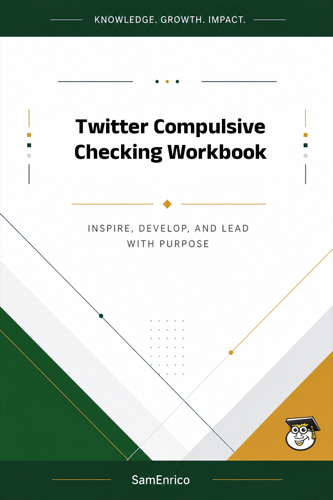
Non-FictionSelf-HelpSocial Media Addiction
Twitter Compulsive Checking Workbook eBook
Breaks the cycle of constant refresh and notificat
by Hooks Ethan
Breaks the cycle of constant refresh and notification checking.
Formats
Free sample
Chapter 1: The Dopamine Trap--–- Your thumb hovers over the blue bird icon. You were supposed to be checking a single notification. That was thirty-seven seconds ago. Now you are scrolling through a heated argument about a topic you do not care about, between two people you have never met, while the report due in forty-five minutes remains untouched. And here is the disturbing question that keeps you up at night: Why do you keep doing this even when you know exactly what is happening?Welcome to the dopamine trap.
This is not a matter of weak willpower, a character flaw, or a lack of discipline. Those explanations feel true because they carry moral weight—they make you feel guilty, and guilt feels like accountability. But guilt without mechanism is just shame, and shame has never broken a single compulsive habit. What you are experiencing is a neurobiological hijacking so precise, so elegantly designed, that calling it “addiction” misses the point. Addiction implies a substance or behavior you fell into.
What Twitter has done is build a slot machine in your pocket, and the jackpot is not money—it is relevance, outrage, belonging, and the terrifying fear that you might miss the one tweet that changes everything.This chapter has one job: to show you exactly how the machine works so you can stop blaming yourself and start seeing the levers being pulled. By the time you finish these pages, you will understand why your thumb hits refresh even when you are bored, even when you are anxious, even when you are supposed to be sleeping. More importantly, you will complete the first real tracking exercise that turns vague discomfort into actionable data. No shame. No moralizing.
Just the cold, clear mechanics of a system designed to capture your attention and sell it to the highest bidder.The Variable Reward That Hijacked Your Brain Let us start with a pigeon. In the 1950s, the psychologist B.F. Skinner placed a hungry pigeon in a box with a food dispenser connected to a small lever. When the pigeon pecked the lever, food appeared. Every single time.
Predictable. Reliable. Boring. The pigeon pecked only when hungry and stopped when full. Nothing compulsive happened.Then Skinner changed the rules.
He made the reward unpredictable. Sometimes a peck produced food. Sometimes two pecks produced food. Sometimes ten pecks produced nothing, and then the eleventh peck produced a double portion. The pigeon went wild.
It pecked constantly, frantically, even when it was not hungry. It developed superstitious rituals—turning in circles before pecking, pecking a specific corner of the lever, bobbing its head in a particular rhythm. The bird was not crazy. It was responding to a variable reward schedule, the most powerful behavioral reinforcement mechanism ever discovered.Twitter is Skinner’s box, and you are the pigeon.Every time you pull to refresh, you are pulling a lever. What loads next is unpredictable.
Sometimes you see a witty joke that makes you laugh out loud. Sometimes you see a breaking news alert that spikes your cortisol. Sometimes you see an infuriating political take that makes your blood pressure rise. Sometimes you see absolutely nothing—just the same three tweets from six hours ago. And sometimes, very rarely, you see the thing you were hoping for: a notification that someone validated you.
A like. A retweet. A reply. A follow.That unpredictability is not a bug. It is the engine.Your brain releases dopamine not when you receive a reward, but when you anticipate a reward that might arrive.
The uncertainty is the drug. A guaranteed reward produces a small, predictable dopamine hit and then habituation—you stop caring. But an uncertain reward? The brain releases dopamine at two to three times the baseline level, and it keeps releasing it as long as the uncertainty continues. This is why you can refresh Twitter fifty times in an hour and feel a tiny spike of anticipation every single time.
You are not seeking information. You are seeking the possibility of information. Your brain has learned that the next pull might be the big one.This is also why “bad tweets” feel as urgent as good ones, sometimes more so. Negativity bias is baked into the human nervous system. From an evolutionary perspective, missing a threat was more dangerous than missing an opportunity.
A rustling bush might be food, or it might be a predator. The brain that assumed “predator” survived. Twitter weaponizes this ancient circuitry. Outrage travels faster than joy. Fear spreads wider than hope.
A tweet that makes you angry will keep you scrolling longer than a tweet that makes you happy, because your brain is scanning for the next threat. You are not being dramatic when you say Twitter makes you feel worse. It is supposed to. Feeling worse keeps you engaged.The Three Loops: Boredom, Anxiety, and FOMONow let us get personal. Not everyone checks Twitter for the same reason.
Some people refresh because they are bored and their brain craves any input at all. Some people refresh because they are anxious, and checking feels like doing something, even when it is not. Some people refresh because they are afraid of missing out—FOMO—and the thought of being the last to know a piece of news or a cultural reference feels unbearable.These three loops look identical from the outside: thumb down, pull, release, scan. But they feel completely different on the inside, and the solution for one is not the solution for another.The Boredom Loop. This is the most common and the most underestimated.
You have forty-five seconds between finishing an email and starting a meeting. You are standing in line at the grocery store. You are waiting for a webpage to load. In these micro-moments, your brain experiences a tiny spike of discomfort. Not pain, exactly.
Just the absence of stimulation. Historically, humans daydreamed in these gaps. They stared at walls. They noticed the texture of a ceiling tile. They let their minds wander, which is exactly how the default mode network produces creative insights and autobiographical planning.Twitter has trained you to see those gaps as emergencies.
Forty-five seconds of nothing feels like forty-five seconds of drowning, so you reach for the life raft. The tragedy is that the life raft is actually an anchor. The boredom loop teaches your brain that gaps are intolerable, which makes you more anxious about gaps, which makes you check Twitter more often, which makes the gaps feel even larger when they appear. You are not solving boredom. You are making yourself less tolerant of it.The Anxiety Loop.
This one is sneakier. You have a difficult task ahead—a performance review, a difficult conversation, a creative project with a tight deadline. The task produces a low hum of anxiety. Checking Twitter offers immediate relief. Not because Twitter is relaxing, but because it is different.
Switching to Twitter allows you to escape the anxiety source without solving it. This is called experiential avoidance, and it works beautifully in the short term. The anxiety drops. You feel better. Your brain learns: anxiety → check Twitter → relief.But here is the poison pill.
The task is still there when you return, and now you have less time to complete it. The anxiety returns…
This is the end of the free sample. Get the eBook to keep going. Buy now
About this book
Details
- Author
- Hooks Ethan
- Publisher
- SamEnrico
- Language
- English
- Genre
- Non-Fiction, Self-Help, Social Media Addiction
- Released
- 2026-06-05
- Pages (approx.)
- 124
- Available as
- eBook, Audiobook

Read better in the ZLOADR app
Your eBooks on your phone or tablet. Sign in with your SamEnrico account and start reading.
More by Hooks Ethan
 Proxemics Personal Space GuideHooks Ethan$11.99
 Mindful Retirement MBSR GuideHooks Ethan$11.99
 Nutrition and Teen Self EsteemHooks Ethan$11.99
 Handling Micromanagement GracefullyHooks Ethan$11.99
 Whispers of the Crystal Forest: The Last Glowworms of WaitomoHooks Ethan$11.99
 How to Start a Building Boards Made of Paper Business (Beginners Guide)Hooks Ethan$11.99
 Influencer Brief GenerationHooks Ethan$12.99
 Understanding Microcephaly With Normal Intelligence, ImmunodeficiencyHooks Ethan$17.99
 Perfect Your ProsodyHooks Ethan$11.99
You may also like
 Hong Kong Handover 1997Dunn Johnnie$11.99
 Zumba For Postnatal Recovery CourseNeal Christian$11.99
 Zumba for BeginnersLadner Nikia$11.99
 YouTube Comment Mining GuideHumes Pandora$12.99
 Worry Box MeditationCarlin Rudy$11.99
 Workplace Stress MeditationNguyen Lynn$11.99
 Workplace Stress and Sleep RepairHawley Ivory$11.99
 Workplace Perfectionism CureDelaney Jeffry$11.99
 Workplace Injustice Anger GuideWallen Isabelle$11.99
 Work Addiction and Burnout LinkGreenwood Ester$11.99
 Women in Yoga and WellnessBeattie Galina$11.99
 Women in Stand Up ComedyChun Evangeline$11.99