
Non-FictionSelf-HelpCreator Economy
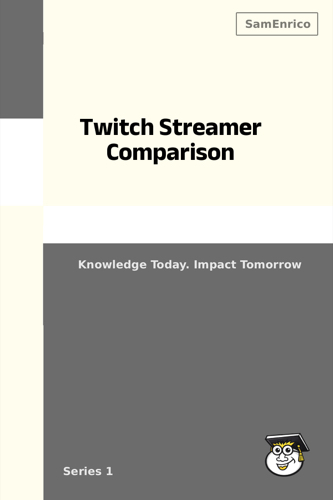
Twitch Streamer Comparison eBook
Examines how viewer counts and subscriber numbers
by Vinson Pei
Examines how viewer counts and subscriber numbers create competitive pressure among creators.
Formats
Free sample
Chapter 1: The Scoreboard is Live--The number glows green in the corner of the screen. It changes every second. Sometimes it climbs. Sometimes it falls. Sometimes it sits perfectly still for so long that the streamer forgets to breathe.
This number is not a viewer count. It is a judgment. It is a score. It is the difference between a good day and a bad day, between validation and worthlessness, between the belief that this might work and the certainty that it never will.For the thirty thousand people streaming on Twitch at this exact moment, the green number is the first thing they check when they wake up, the last thing they see before they go to sleep, and the only thing they think about while they are live. It dictates their mood, their energy, their performance, and their sense of self.
It is the scoreboard of a game they did not know they were playing until they were already losing.This book is about that number. It is about what happens when human worth is reduced to a real-time metric. It is about the anxiety of the zero-viewer streamer, the grind of the mid-tier partner, and the paranoia of the top one percent. It is about the comparison trap—the relentless, exhausting, and ultimately futile practice of measuring your success against the green numbers of everyone else on the platform. And it begins with a simple question: what does it feel like to perform for a scoreboard that never stops updating?The Dashboard Effect Imagine standing on a stage in front of an audience that can appear or disappear at any moment, without warning, without explanation.
Now imagine that there is a large digital display hanging above the stage showing exactly how many people are in the room, updated every second. Now imagine that you are the only person on stage who can see this display. Now imagine that your rent depends on that number staying high. Now imagine that you have no control over when people walk in or walk out.This is the reality of the Twitch streamer.The dashboard—the broadcaster’s control panel that shows viewer count, chat activity, and technical metrics—is a marvel of real-time data presentation. It is also a psychological torture device.
The effect is so consistent across streamers of all sizes that it deserves a name: the Dashboard Effect. It refers to the cascade of emotional and behavioral responses triggered by watching one’s own viewer count fluctuate in real time.When the number goes up, the streamer experiences a dopamine hit. Their posture improves. Their voice becomes more energetic. They engage more with chat.
They feel validated, successful, and hopeful. This is the high.When the number goes down, the streamer experiences a cortisol spike. Their shoulders slump. Their voice flattens. They become quieter, less engaging, sometimes sullen or defensive.
They feel rejected, failing, and hopeless. This is the low.The oscillation between these states can happen dozens of times within a single hour-long stream. The result is emotional exhaustion, decision fatigue, and a growing certainty that the number is not a measurement of the stream but a measurement of the self.One streamer interviewed for this book described the experience as “being waterboarded with data.” Another called it “the worst performance review in the world, because it never ends and you never get feedback on why the score changed.” A third, who had been streaming for five years, said simply: “I hate it. I hate it so much. But I can’t stop looking.”This is the Dashboard Effect.
And it is only the beginning.From Hobby to Hunger There was a time when streaming did not feel this way. In the early days of Justin.tv, which would eventually become Twitch, broadcasting live video was a novelty rather than a career path. People streamed because they thought it was fun, because they wanted to share their gameplay with a few friends, or because they were curious about the technology. The viewer count was a curiosity—interesting to glance at, but not something that kept anyone up at night.The shift from hobby to hunger happened gradually, then all at once. As Twitch grew from a niche gaming site to a cultural juggernaut, the stakes changed.
People began making real money from subscriptions and donations. Sponsors entered the space. Full-time streaming became a plausible career. And with that plausibility came pressure.The first wave of professional streamers in the early 2010s still operated in a relatively low-stakes environment. Fewer than fifty thousand people streamed regularly.
The concept of “making it” on Twitch was so unlikely that most people did not bother trying. Those who did succeed often did so by accident—they were good at a game, or funny, or charming, and the audience found them organically.By the mid-2010s, that had changed. The platform had exploded. The number of streamers doubled, then doubled again, then doubled a third time. Suddenly, everyone knew someone who knew someone who had quit their job to stream full-time.
Success stories circulated like urban legends. The dream became tangible, and with tangibility came desperation.By 2020, the platform had reached critical mass. Millions of people were streaming. Millions more were watching. And the green number—once a curiosity—had become the single most important metric in the lives of hundreds of thousands of broadcasters.
It determined partnership status, sponsorship rates, ad revenue, and social standing. It determined whether you were a “real” streamer or a “fake” one. It determined whether your friends and family took you seriously or told you to get a real job.The transformation was complete. Streaming was no longer a hobby. It was a hunger.
And hunger, as anyone who has ever been truly hungry knows, is not a pleasant feeling.The Lurker Problem There is a complication that makes the green number even more maddening: most of the people it counts are not actually participating. They are lurkers—viewers who watch without typing in chat, without following, without subscribing, without any form of engagement whatsoever. They are ghosts in the machine. They are counted but not present.Industry data suggests that approximately 95 percent of Twitch viewers are lurkers at any given time. Only five percent actively chat.
This means that when a streamer sees “100 viewers” on their dashboard, only about five of those people are likely to be typing. The other ninety-five are watching silently, invisibly, without leaving any trace of their presence except the number itself.This creates a strange psychological paradox. On one hand, the lurker number provides validation: people are watching. The streamer is not alone. The time and effort are not being broadcast into an empty void.
On the other hand, the lurker number provides no feedback at all. Are those ninety-five people enjoying the stream? Are they bored? Are they tabbed out, listening in the background while doing something else? Are they even real people, or are they bots?The streamer cannot know.
And not knowing is torture.One mid-tier streamer described the experience this way: “The lurkers are the worst part, honestly. At least when someone chats, I know they’re there. I…
This is the end of the free sample. Get the eBook to keep going. Buy now
About this book
Details
- Author
- Vinson Pei
- Publisher
- SamEnrico
- Language
- English
- Genre
- Non-Fiction, Self-Help, Creator Economy
- Released
- 2026-06-07
- Pages (approx.)
- 142
- Available as
- eBook, Audiobook

Read better in the ZLOADR app
Your eBooks on your phone or tablet. Sign in with your SamEnrico account and start reading.
More by Vinson Pei
 Influencer Disclosure For GamblingVinson Pei$11.99
 Digital Assets Estate Planning GuideVinson Pei$11.99
 Affirmations for CreativityVinson Pei$11.99
 Early Menopause Causes and Care GuideVinson Pei$11.99
 The Vanishing Billionaire: The Untold Story of Carlos Slim’s DisappearanceVinson Pei$11.99
 Tech Investment Regional GuideVinson Pei$12.99
 TikTok Scroll Interruption PlanVinson Pei$12.99
 Understanding Jorgenson–lenz SyndromeVinson Pei$17.99
 Material Handling Shop TechnicianVinson Pei$11.99
 How to Become a Dowel PointerVinson Pei$11.99
You may also like
 Hong Kong Handover 1997Dunn Johnnie$11.99
 Zumba For Postnatal Recovery CourseNeal Christian$11.99
 Zumba for BeginnersLadner Nikia$11.99
 YouTube Comment Mining GuideHumes Pandora$12.99
 Worry Box MeditationCarlin Rudy$11.99
 Workplace Stress MeditationNguyen Lynn$11.99
 Workplace Stress and Sleep RepairHawley Ivory$11.99
 Workplace Perfectionism CureDelaney Jeffry$11.99
 Workplace Injustice Anger GuideWallen Isabelle$11.99
 Work Addiction and Burnout LinkGreenwood Ester$11.99
 Women in Yoga and WellnessBeattie Galina$11.99
 Women in Stand Up ComedyChun Evangeline$11.99