
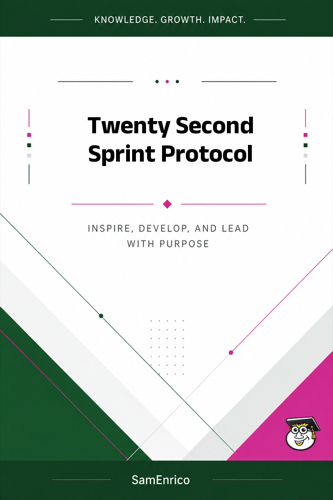
Twenty Second Sprint Protocol Audiobook
Go all out for 20 seconds, recover for 10, repeat
Go all out for 20 seconds, recover for 10, repeat for 4 minutes.
Formats
Free sample
Chapter 1: The Four-Minute Lie--–- The first lie is the most comfortable one. It whispers to you as you lace up your shoes for another sixty-minute jog on the treadmill, as you drive to the gym for an hour of elliptical monotony, as you check your watch and realize you have spent one hundred and fifty-six hours this year doing slow, steady cardio. The lie says: More time equals more results.It feels true. It looks true. Every fitness magazine, every personal trainer behind a front desk, every infomercial for a new piece of exercise equipment sells the same underlying assumption: you must pay with your time to earn your health.
An hour here. An hour there. The implicit contract is simple—sweat longer, live better.But what if the contract was built on a foundation of sand? What if the most effective workout known to modern exercise science takes less time than brewing a pour-over coffee, less time than scrolling through your social media feed, less time than waiting for a traffic light to turn green?This chapter will dismantle the hour-long cardio myth with a single, uncomfortable question: what if you could get ninety percent of the benefits of a sixty-minute jog in just four minutes?Dr. Izumi Tabata asked that question in 1996.
The answer changed exercise science forever—and then, strangely, almost no one talked about it. The fitness industry had too much invested in the hour. Gyms sell memberships based on access, not efficiency. Personal trainers bill by the session, not by the result. The four-minute truth was inconvenient, so it was buried beneath a mountain of marketing.This chapter is the excavation.The Study That Should Have Broken Everything In 1996, Dr.
Izumi Tabata was a researcher at the National Institute of Fitness and Sports in Kagoshima, Japan. He was not looking for a revolution. He was trying to answer a practical question: what is the most efficient way to improve both aerobic capacity (endurance) and anaerobic capacity (power and speed) in elite athletes?At the time, conventional wisdom held that these two systems were trained separately. You built endurance with long, slow distance. You built power with short, explosive intervals.
You could not train both at the same time—or so everyone believed.Tabata designed a controlled experiment with two groups of Olympic speed skaters. These were not sedentary beginners or weekend warriors. They were world-class athletes…
This is the end of the free sample. Get the Audiobook to keep going. Buy now
About this book
Details
- Author
- Pinkston Alex
- Publisher
- SamEnrico
- Language
- English
- Genre
- Non-Fiction, Health & Wellness, Tabata Method
- Released
- 2026-06-07
- Pages (approx.)
- 126
- Available as
- eBook, Audiobook

Listen in the VoxFlicks app
Audiobooks and audio dramas wherever you go. Sign in with your SamEnrico account and press play.
More by Pinkston Alex
 Veteran Combat TriggersPinkston Alex$11.99
 Organizational Burnout SolutionsPinkston Alex$11.99
 No Phone Morning RulePinkston Alex$11.99
 MMA Fighter Hypnosis GuidePinkston Alex$11.99
 EQ for CouplesPinkston Alex$11.99
 Pressure Garment GuidePinkston Alex$11.99
 Persuasion For Difficult PeoplePinkston Alex$11.99
 The Shot Heard Around the World: How a Photographer and an Athlete Changed Sports ForeverPinkston Alex$11.99
 The Navigator’s Lullaby: The Music of the Portuguese VoyagesPinkston Alex$11.99
 How to Produce Sandwich MakersPinkston Alex$11.99
 How to Produce Fishing Reel Bags and CasesPinkston Alex$11.99
 Cost Plus Variable Inflation GuidePinkston Alex$12.99