
Non-FictionMental WealthCognitive Behavioral
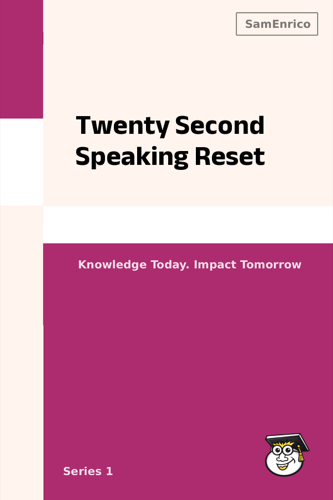
Twenty Second Speaking Reset eBook
Deploy instant grounding anchors before any high-s
Deploy instant grounding anchors before any high-stakes verbal presentation.
Formats
Free sample
Chapter 1: The Hijack Before Hello--The senior manager’s hands were steady when she walked into the conference room. She had prepared for three days. Her slides were polished. Her data was ironclad. She knew the material cold.
Then the CEO turned to her and said, “Let’s hear your take on the Q3 numbers.” Twenty seconds later, her voice cracked on the word “So.” Her face flushed. She rushed through her first three sentences, forgot her second bullet point, and spent the rest of the presentation playing catch-up. Afterward, she couldn’t remember what she had said. The CEO remembered only one thing: she looked nervous.This scenario is not a failure of preparation. It is not a failure of knowledge.
It is not a failure of willpower or character. It is a failure of transition management—and it happens to nearly every speaker, from first-time presenters to seasoned executives, because no one has ever taught them what actually happens in the twenty seconds between “It’s your turn” and “Hello everyone.”This book exists because those twenty seconds are not empty time. They are the most biologically dangerous seconds of your entire presentation. And once you understand why, you can stop wasting them—and start using them to transform your performance.The Myth of the Prepared Mind Let us begin with a confession that most public speaking books dance around but rarely state directly: you already know how to speak. You have been speaking your entire life.
You have had thousands of conversations, hundreds of meetings, dozens of presentations. The problem is not that you lack the skill. The problem is that, in the twenty seconds before a high-stakes moment, your brain and body betray you.Most speakers believe they need more time to prepare. They wish for another hour, another day, another week. But here is the counterintuitive truth that research from cognitive psychology and neuroscience has established beyond reasonable doubt: the twenty-second window before you speak is a spontaneous speaking window, not a planning window.
Any attempt to plan during those twenty seconds overloads your working memory, raises your cortisol, and actively degrades your performance.Let me say that again. Trying to prepare in the final twenty seconds makes you worse.The senior manager who mentally cycled through three possible opening lines was not helping herself. She was tying her prefrontal cortex in knots. Working memory—the part of your brain that holds information temporarily while you manipulate it—can only manage three to five items at once. When you use those precious slots to rehearse sentences, you have nothing left for managing your vocal tone, your posture, your eye contact, or your natural language generation.
You become a computer running too many programs. Everything slows down. Then it crashes.The Hijack: What Actually Happens in Those Twenty Seconds Let us look under the hood. When you know you are about to be watched—really watched, by people whose opinions matter—your brain’s threat detection system activates. This is not a flaw.
It is an ancient, elegant survival mechanism that kept your ancestors alive on the savanna. Being watched by a group once signaled potential exile, and exile from the tribe meant death. Your brain is not overreacting. It is doing exactly what evolution designed it to do: treating social evaluation as a life-or-death event.The problem is that the threat detection system does not distinguish between a lion and a board of directors. It does not know the difference between being cast out of the tribe and being asked a difficult question about quarterly forecasts.
All it knows is that eyes are upon you, and that has never been neutral.Here is what happens in the twenty seconds after you realize you are about to speak. Your hypothalamus activates your sympathetic nervous system. Your adrenal glands release epinephrine and norepinephrine. Your heart rate increases. Your blood pressure rises.
Your breathing becomes shallower and faster. Your pupils dilate. Your digestive system slows down. Blood flows away from your extremities and toward your large muscle groups—because, again, your brain thinks you might need to fight or flee.And cortisol—the primary stress hormone—spikes. Not a little.
Research measuring salivary cortisol in speakers before and during presentations has found that cortisol levels are fifty to eighty percent higher in the twenty seconds before you begin than during minutes two through five of your actual speech. The anticipation is worse than the event. The reset window is the peak of your body’s stress response, not a ramp-up to it.This is the hijack. Your biology has turned against you at the exact moment you need clarity, calm, and verbal fluency. And here is the cruelest irony: once you start speaking, your brain shifts from threat assessment to language production, and the hijack begins to subside.
Most speakers feel their nerves calm down after the first thirty to sixty seconds. They think they have “warmed up.” In reality, their threat detection system has simply recognized that they have not died yet, and has downgraded the emergency.But those first thirty seconds—the ones that follow the hijack—are often a disaster. A shaky opening. A forgotten name. A voice that sounds nothing like your natural speaking voice.
And all because no one told you that the twenty seconds before you speak are not empty time. They are a battlefield.The Difference Between Calming Down and Shifting Up Here is where most public speaking advice goes wrong. The conventional wisdom says: “Just calm down. Take a deep breath. Relax.” This is well-intentioned but biologically backwards for three reasons.First, as we have just seen, your body is in a state of high arousal.
Telling it to “calm down” creates cognitive dissonance. Your heart is pounding. You can feel it. Your brain knows you are not calm. So when you tell yourself to be calm, your brain essentially says, “That’s a lie, and now I’m also worried about why I can’t calm down.” You have added meta-anxiety to your existing anxiety.Second, the deep breath that everyone recommends—the big, dramatic inhale—often makes things worse.
A single large inhale without a controlled exhale activates the sympathetic nervous system, stretches the lungs too quickly, and can increase heart rate by five to ten beats per minute in anxious speakers. You are literally doing the opposite of what you intend.Third, and most importantly, “calming down” frames the situation as a threat that you are trying to suppress. Defense narrows your vision. When you are defending, you are monitoring for danger. You are looking for signs of judgment.
You are watching the audience for the person who looks bored or critical. Defense shrinks your cognitive bandwidth and makes you less creative, less flexible, and less present.This book offers a different frame. The reset is not about calming down. It is about shifting up—from a defensive state to an offensive state. Defense asks, “How do I not mess up?” Offense asks, “What do I want them to feel?” Defense is reactive.
Offense is intentional. Defense narrows. Offense expands.The shift is not a trick. It is a biological fact that your brain…
This is the end of the free sample. Get the eBook to keep going. Buy now
About this book
Details
- Author
- Squires Tommy
- Publisher
- SamEnrico
- Language
- English
- Genre
- Non-Fiction, Mental Wealth, Cognitive Behavioral
- Released
- 2026-06-06
- Pages (approx.)
- 129
- Available as
- eBook, Audiobook

Read better in the ZLOADR app
Your eBooks on your phone or tablet. Sign in with your SamEnrico account and start reading.
More by Squires Tommy
 People Pleasing Childhood Roots WorkbookSquires Tommy$11.99
 The Raven Symone Identity JourneySquires Tommy$11.99
 Following Breath In and OutSquires Tommy$11.99
 The Trauma Trigger Relationship Stress GuideSquires Tommy$11.99
 The Baghdad Bank Heist: The Defector Who Blew the Lid on Saddam's GoldSquires Tommy$11.99
 Understanding Logic SyndromeSquires Tommy$17.99
 Non Resident LLC Professional ServicesSquires Tommy$12.99
 Fashion and Apparel ReportSquires Tommy$12.99
 How to Start a Swimming Pools BusinessSquires Tommy$11.99
 Fda LawSquires Tommy$11.99
You may also like
 Hong Kong Handover 1997Dunn Johnnie$11.99
 Zumba For Postnatal Recovery CourseNeal Christian$11.99
 Zumba for BeginnersLadner Nikia$11.99
 YouTube Comment Mining GuideHumes Pandora$12.99
 Worry Box MeditationCarlin Rudy$11.99
 Workplace Stress MeditationNguyen Lynn$11.99
 Workplace Stress and Sleep RepairHawley Ivory$11.99
 Workplace Perfectionism CureDelaney Jeffry$11.99
 Workplace Injustice Anger GuideWallen Isabelle$11.99
 Work Addiction and Burnout LinkGreenwood Ester$11.99
 Women in Yoga and WellnessBeattie Galina$11.99
 Women in Stand Up ComedyChun Evangeline$11.99