
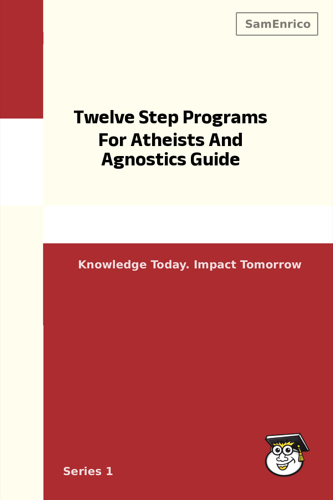
Non-FictionSelf-HelpSecular Recovery
Twelve Step Programs For Atheists And Agnostics Guide eBook
Adapts twelve-step principles for non-believers wi
Adapts twelve-step principles for non-believers without higher power language.
Formats
Free sample
Chapter 1: The Powerless Paradox--–- The first time someone told me I was powerless, I almost walked out of the room. Not because I disagreed, but because I thought they were trying to humiliate me. I had spent fifteen years building a life around controlling everything—my emotions, my image, my intake, my relationships. The word "powerless" sounded like surrender to a weakness I had spent decades denying. So I sat there, arms crossed, jaw tight, waiting for the punchline that never came.
What arrived instead was a paradox that would save my life: the admission of powerlessness, when understood correctly, is the first act of genuine power an addict ever takes.This chapter is called The Powerless Paradox because that is exactly what Step One presents to the atheist or agnostic mind: a contradiction that only makes sense when you stop treating it like a theological confession and start treating it like a neurological fact. The original twelve-step language says, "We admitted we were powerless over alcohol—that our lives had become unmanageable." For the non-believer, this sounds like a religious conversion moment, a groveling before an unseen force. But what if powerlessness has nothing to do with God? What if it is simply a description of how the addicted brain functions, no more spiritual than acknowledging that a broken leg cannot bear weight? This chapter will dismantle the fear, clarify the framework, and give you a secular, science-based understanding of Step One that does not require you to abandon your reason, your dignity, or your atheism.The Central Framework That Will Guide This Entire Book Before we dive into Step One, let me introduce a three-part framework that will resolve the apparent contradiction between powerlessness and personal agency.
This framework appears throughout the book, and understanding it now will prevent the confusion that many non-believers experience when they first encounter twelve-step language.Part One: Powerlessness over the first use. This means that once you take the first drink, inhale the first line, place the first bet, or swallow the first pill, your addicted brain takes over in ways your conscious mind cannot reliably control. The habit loops are faster than your reasoning. The cravings override your intentions. This is not a moral failure.
This is neuroscience. You are powerless to moderate once you start because addiction has rewired your reward system.Part Two: Agency over the decision to start. This means that before the first use, you have a window of choice. It may be a small window. It may be a window that feels impossibly narrow when a craving hits.
But it exists. You can choose to delay. You can choose to call someone. You can choose to remove yourself from the environment where using is possible. This is not willpower in the traditional sense—it is strategic action based on self-knowledge.Part Three: Healthy limitations.
This means you cannot recover alone. Not because you are weak, but because human beings are social mammals whose brains are wired for connection. Isolation fuels addiction; community disrupts it. Acknowledging that you need others is not submission to a higher power. It is an evidence-based recognition of how recovery works.These three parts—powerlessness over the first use, agency over the decision to start, and healthy limitations—work together.
They are not contradictions. They are complementary truths about the same reality. Step One focuses primarily on the first part: powerlessness. But we will keep the other two parts in mind because they prevent the despair that sometimes follows an honest admission of powerlessness. You are powerless once you start, but you have agency before you start, and you are not alone in either condition.What Powerlessness Is Not Let me be extremely clear about what powerlessness does not mean, because traditional twelve-step meetings often blur these lines, and atheists and agnostics have good reason to be suspicious.Powerlessness is not helplessness.
Helplessness is the belief that nothing you do matters, that change is impossible, that you are a victim of forces beyond any influence. Powerlessness, as defined in this book, is much narrower: it is the inability to control your substance use once it has begun. That is all. You can still control many other things. You can control whether you go to a meeting.
You can control whether you pour out the remaining alcohol. You can control whether you pick up the phone. Helplessness says, "Nothing I do will ever make a difference." Powerlessness says, "Once I start drinking, I cannot reliably stop—so I need to focus my energy on not starting."Powerlessness is not a moral confession. Traditional religious frameworks treat powerlessness as an admission of sin, a confession of moral failure that requires divine forgiveness. That is not what we are doing here.
We are making a factual statement about neurobiology. When you say, "I am powerless over alcohol once I start," you are saying something as morally neutral as "I am allergic to peanuts" or "I cannot digest lactose." These are statements about how your body and brain function. They carry no moral weight. They simply describe reality.Powerlessness is not permanent. The brain is plastic.
Neuroplasticity means that over time, with sustained abstinence and new behavioral patterns, the craving circuits weaken and the executive control circuits strengthen. You may always have a vulnerability to addiction—that is a chronic condition, like asthma or diabetes. But the intensity of that vulnerability can change. Powerlessness describes your relationship to the substance in the present moment if you use. It does not describe your potential for change over time.Powerlessness is not the same as giving up.
This is the most common fear. Many atheists and agnostics hear "powerless" and imagine themselves defeated, passive, waiting for rescue that will never come because they do not believe in a rescuer. But that image is exactly backward. Admitting powerlessness is the prerequisite for effective action. You cannot solve a problem you refuse to name.
You cannot fix a mechanism you pretend does not exist. When a pilot admits that the engine has failed, that admission is not giving up—it is the first step toward emergency landing procedures. Powerlessness clears the ground for strategic action.The Neuroscience of Powerlessness: Why Your Brain Betrays You To understand why Step One works for atheists and agnostics, you need to understand what happens inside your brain when you use an addictive substance. This section contains no theology, no metaphysics, no supernatural claims. It contains only what we have learned from decades of neuroscience research.The Habit Loop Every addiction operates through a four-part habit loop: cue, craving, response, reward.
Here is how it works.Cue. Something in your environment or your body triggers the addiction circuit. A cue might be external: walking past a bar, seeing a text from a difficult family member, hearing a song you associate with using. A cue might be internal: feeling anxious, feeling bored, feeling exhausted, feeling celebratory. Cues are everywhere because addiction generalizes.
Your brain learns to associate more and more stimuli with the possibility of using.Craving. The cue activates the dopamine system, specifically the nucleus accumbens and the ventral tegmental area. Dopamine is not the…
This is the end of the free sample. Get the eBook to keep going. Buy now
About this book
Details
- Author
- Broussard Tod
- Publisher
- SamEnrico
- Language
- English
- Genre
- Non-Fiction, Self-Help, Secular Recovery
- Released
- 2026-06-10
- Pages (approx.)
- 141
- Available as
- eBook, Audiobook

Read better in the ZLOADR app
Your eBooks on your phone or tablet. Sign in with your SamEnrico account and start reading.
More by Broussard Tod
 Stress Asthma Breathing GuideBroussard Tod$11.99
 Corporate Risk Management to NonprofitBroussard Tod$11.99
 Goal Setting for HobbiesBroussard Tod$11.99
 Suicide and AnxietyBroussard Tod$11.99
 Sleep and Memory ConsolidationBroussard Tod$11.99
 Online Casino Addiction HelpBroussard Tod$11.99
 Gym Membership NegotiationBroussard Tod$11.99
 The Lost Codex of Hypatia: A Scholar’s Defiance in a Burning WorldBroussard Tod$11.99
 The Quantum Gardeners: Black Pioneers of Life’s CodeBroussard Tod$11.99
 A Collector's Handbook to the Peugeot Cabriolet.Broussard Tod$11.99
 How to Start a Envelope Stuffing Machine Business (Beginners Guide)Broussard Tod$11.99
 Cash Flow for Service BusinessesBroussard Tod$12.99
You may also like
 Hong Kong Handover 1997Dunn Johnnie$11.99
 Zumba For Postnatal Recovery CourseNeal Christian$11.99
 Zumba for BeginnersLadner Nikia$11.99
 YouTube Comment Mining GuideHumes Pandora$12.99
 Worry Box MeditationCarlin Rudy$11.99
 Workplace Stress MeditationNguyen Lynn$11.99
 Workplace Stress and Sleep RepairHawley Ivory$11.99
 Workplace Perfectionism CureDelaney Jeffry$11.99
 Workplace Injustice Anger GuideWallen Isabelle$11.99
 Work Addiction and Burnout LinkGreenwood Ester$11.99
 Women in Yoga and WellnessBeattie Galina$11.99
 Women in Stand Up ComedyChun Evangeline$11.99