
Non-FictionSelf-HelpMindfulness
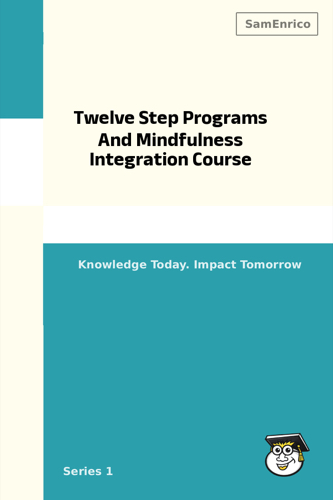
Twelve Step Programs And Mindfulness Integration Course eBook
Combines twelve-step principles with secular mindf
Combines twelve-step principles with secular mindfulness practices.
Formats
Free sample
Chapter 1: The Pause That Saves...--–- The craving arrived like a freight train in a tunnel. One moment I was fine—sitting at my kitchen table, staring at a cold cup of coffee, watching the morning light crawl across the linoleum. The next moment, my heart was hammering, my palms were sweating, and every cell in my body was screaming for the thing I had sworn I would never touch again. I didn't decide to crave. I didn't choose it.
It chose me. It rose up from somewhere beneath my conscious mind, some ancient, wired-in circuit that had been forged over years of repetition. The craving was not a thought. It was a possession.My hand was already reaching for my jacket. My keys were already in my other hand.
My feet were already carrying me toward the door. I had not made a single conscious decision. My body was moving on its own, following a path it had walked a thousand times before. This is what addiction does. It rewires your nervous system so that the behavior runs on autopilot, bypassing your rational mind entirely.
You do not choose to use. You simply find yourself using, wondering how you got there, powerless to stop what has already begun.But something was different about this morning. I had been practicing something new. For the past week, I had been learning a skill that seemed almost laughably simple: the art of pausing. Just pausing.
Before any automatic response, before any conditioned reaction, just stopping for a single breath. It felt ridiculous at first. What could three seconds of doing nothing possibly accomplish against a freight train of craving?As my hand touched the doorknob, I remembered. I paused. I stopped reaching.
I stopped walking. I stood there, hand frozen on the cold brass, and I took a single breath. Then another. Then another. The craving did not disappear.
It roared. It screamed. It told me I was wasting time, that I could pause later, that just this once wouldn't matter. But I had learned something about cravings: they are waves. They rise, they peak, and they fall.
The only way to drown is to fight the wave. The only way to survive is to surf.I surfed. I stood in that doorway for what felt like an eternity but was probably less than two minutes. My heart pounded. My mind raced.
My body trembled. And then, slowly, the wave began to recede. The craving did not vanish. It never vanishes. But it became bearable.
I took my hand off the doorknob. I walked back to the kitchen table. I sat down. And I did not use.That was the moment I realized that "One Day at a Time" was not just a slogan. It was a technology.
And the technology worked one breath at a time.The Slogan You Already Know If you have spent any time in Twelve-Step meetings, you have heard the slogan "One Day at a Time" hundreds of times. It is so familiar that it has become almost invisible, like wallpaper in a room you have lived in for years. You nod when you hear it. You repeat it to newcomers. You might even have it on a keychain or a bumper sticker.
But have you ever stopped to ask what it actually means?"One Day at a Time" is not about denial. It is not about pretending that tomorrow does not exist. It is not about white-knuckling through twenty-four hours until you can collapse into bed. The slogan is actually a mindfulness practice in disguise. It is an instruction to bring your attention back to the present moment, over and over again, because the present moment is the only place where you have any choice at all.Think about it.
You cannot use in the past. The past is gone. You cannot use in the future. The future has not arrived. You can only use in the present moment.
And the present moment is also the only place where you can choose not to use. The slogan "One Day at a Time" is a reminder to return your awareness to the here and now, because the here and now is where your recovery lives.But there is a problem. For most of us, "one day" is too long. A day contains 86,400 seconds. Telling someone in early recovery to stay sober for an entire day can feel like telling someone drowning to hold their breath for an hour.
The slogan is true, but the scale is wrong. What we need is something smaller. Something we can actually do. Something we can practice right now, in this moment, while we are reading these words.That something is the mindful pause. One breath at a time.The Neuroscience of Automatic Pilot To understand why the mindful pause works, you need to understand how your brain betrays you.
I do not say this to scare you. I say it because knowledge is power, and the neuroscience of addiction is one of the most hopeful stories in all of medicine.Your brain is composed of approximately 86 billion neurons, each connected to thousands of others. These neurons communicate through electrical and chemical signals, forming pathways that become stronger with repetition. Every time you engage in a behavior—whether it is drinking, using, gambling, or eating—you are reinforcing a neural pathway. The more you engage in the behavior, the stronger the pathway becomes.
This is called Hebb's Law: neurons that fire together wire together.Addiction hijacks this system. When you use a substance repeatedly, your brain adapts to its presence. It downregulates your natural reward chemicals. It strengthens the pathways that lead to using while weakening the pathways that lead to other activities. Over time, the neural pathway for using becomes a superhighway, while the pathways for everything else become dirt roads.
This is why addicts continue to use even when they desperately want to stop. The brain has been physically rewired. The behavior has moved from conscious choice to automatic pilot.Automatic pilot is the brain's default mode. It is the state you are in when you drive a familiar route and arrive at your destination with no memory of the journey. It is the state you are in when you eat an entire bag of chips while watching television and do not taste a single one.
It is the state you are in when you reach for your phone fifty times a day without deciding to. Automatic pilot is efficient. It conserves energy. It allows you to function without exhausting your conscious mind. But automatic pilot is also the enemy of recovery.Why?
Because addiction lives in automatic pilot. The craving arises. The hand reaches. The substance is consumed. All of this happens below the level of conscious awareness.
By the time you realize what is happening, you are already using. This is the experience I described at the beginning of this chapter: one moment I was fine, the next moment I was at the door. Automatic pilot had taken over. I was not driving the bus. The addiction was.The mindful pause is the emergency brake on automatic pilot.…
This is the end of the free sample. Get the eBook to keep going. Buy now
About this book
Details
- Author
- Mcgill Dorsey
- Publisher
- SamEnrico
- Language
- English
- Genre
- Non-Fiction, Self-Help, Mindfulness
- Released
- 2026-06-08
- Pages (approx.)
- 120
- Available as
- eBook, Audiobook

Read better in the ZLOADR app
Your eBooks on your phone or tablet. Sign in with your SamEnrico account and start reading.
More by Mcgill Dorsey
 Forgiveness After Suicide LossMcgill Dorsey$11.99
 OKR and KPI Integration GuideMcgill Dorsey$11.99
 Self Talk for Gaming AddictionMcgill Dorsey$11.99
 Turmeric for Brain HealthMcgill Dorsey$11.99
 Pet Cancer Death GriefMcgill Dorsey$11.99
 Fiverr Voiceover Gig OptimizerMcgill Dorsey$11.99
 Speaking Anger Without HarmMcgill Dorsey$11.99
 The Round Table’s Legacy: How Medieval Tournaments Shaped the Modern StadiumMcgill Dorsey$11.99
 The Nuns of Tilly: Sisters of Mercy in the Thirty Years' WarMcgill Dorsey$11.99
 How to Start a Piling (building) Business (Beginners Guide)Mcgill Dorsey$11.99
 Growing AphyllanthesMcgill Dorsey$11.99
 A Collector's Handbook to the Plymouth Wimbledon Six)Mcgill Dorsey$11.99
You may also like
 Hong Kong Handover 1997Dunn Johnnie$11.99
 Zumba For Postnatal Recovery CourseNeal Christian$11.99
 Zumba for BeginnersLadner Nikia$11.99
 YouTube Comment Mining GuideHumes Pandora$12.99
 Worry Box MeditationCarlin Rudy$11.99
 Workplace Stress MeditationNguyen Lynn$11.99
 Workplace Stress and Sleep RepairHawley Ivory$11.99
 Workplace Perfectionism CureDelaney Jeffry$11.99
 Workplace Injustice Anger GuideWallen Isabelle$11.99
 Work Addiction and Burnout LinkGreenwood Ester$11.99
 Women in Yoga and WellnessBeattie Galina$11.99
 Women in Stand Up ComedyChun Evangeline$11.99