
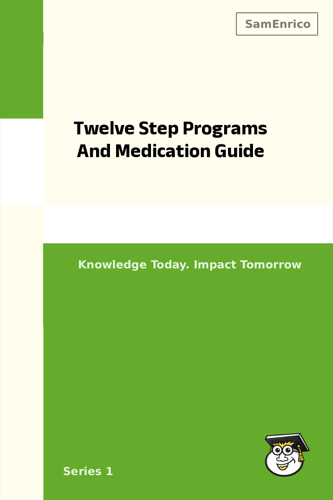
Twelve Step Programs And Medication Guide eBook
Addresses the use of psychiatric medication within
Addresses the use of psychiatric medication within twelve-step philosophy.
Formats
Free sample
Chapter 1: The Voice in the Basement...--The fluorescent lights of the church basement hummed their familiar, indifferent song. Folding chairs formed a lopsided circle. The smell of stale coffee and cigarette smoke—this was still allowed in some rooms back then—clung to the wool coats hanging on a rack by the door. It was a Tuesday night. The "Living Sober" meeting.
I was ninety-three days "clean," a number I clutched like a winning lottery ticket.Maria sat across from me. She was new. Not to suffering, but to the rooms. Her hands trembled around a Styrofoam cup. Her eyes had the hunted look of someone who had recently stared into the abyss and seen it stare back.
She had introduced herself simply: "I'm Maria, and I'm an addict." Heroin. Fentanyl. The usual progression of modern American despair.She had done the right thing. Against the advice of a well-meaning but poorly informed intake counselor at a detox center, she had sought out Medication-Assisted Treatment. She was on Suboxone.
It was keeping the cravings at bay. It was allowing her to sleep. It was, in the clinical sense, saving her life. She was also taking Zoloft for panic attacks that had started when she was twelve years old, long before she ever knew what heroin felt like.After the meeting, during the milling-around-with-cookies phase, a man named Gary cornered her. Gary had twenty-three years sober.
He wore a gold medallion around his neck. In the hierarchy of the fellowship, Gary was royalty. He put a hand on Maria's shoulder—that paternalistic, possessive gesture that older men in recovery often deploy—and said, loud enough for the room to hear, "I heard you share about the Suboxone, sweetheart. You know that's not clean time, right? That's just replacing one drug for another.
If you really want to work the program, you need to flush that stuff and get honest."Maria's face did something I have never forgotten. It didn't crumple. It didn't get angry. It went blank. The blankness of someone who has just been told that the life raft she is clinging to is actually a sin.
She looked at Gary, then at her coffee, then at the floor. She nodded. She said, "Okay. Thank you." She left the meeting early. She did not come back the next week.I found out later, through the small-town gossip mill that is any Twelve-Step fellowship, that Maria had stopped her Suboxone.
Cold turkey. Her sponsor (Gary's wife, as it turned out) told her that withdrawal was "just the pain of recovery" and that she needed to "feel it to heal it." Three weeks later, Maria relapsed on fentanyl. She survived. Many do not.This book exists because of Maria. And because of Gary.
And because of every meeting room where the word "sober" has been weaponized against the very medications that keep people alive.The False Choice If you are reading this book, you have likely been told—or have told yourself—some version of the following: Taking psychiatric medication means you aren't really working a program. Clean time means no mood-altering substances. If you need a pill to function, you haven't surrendered enough.This is a lie.It is not a well-intentioned misunderstanding. It is not a difference of opinion. It is a dangerous, medically illiterate lie that has killed uncounted thousands of people in recovery.
And it spreads through Twelve-Step rooms not because the official literature supports it, but because a specific subculture—born of historical accident, reinforced by anecdote, and weaponized by spiritual pride—has turned "clean time" into a contest of suffering rather than a measure of health.The lie takes many forms:"You're not really sober if you're on methadone.""Antidepressants are just a crutch.""If you need mood stabilizers, you haven't done your Fourth Step inventory.""My sponsor told me that God is the only medication I need."Each of these statements is a version of the same error: confusing the substance with the behavior. A crutch is not a failure of character; it is a tool for walking when your leg is broken. And in recovery, your brain is the broken leg.The central argument of this book is simple, and I will state it here, in Chapter One, so there is no confusion:There is no conflict between taking prescribed psychiatric medication and working a strong Twelve-Step program. The conflict exists only in the minds of people who have confused medical treatment with spiritual failure.To understand how we got here—how a movement founded on medical humility became a breeding ground for anti-medication dogma—we have to go back. Not to the 1930s, when AA was founded, but to the 1970s and 1980s, when something shifted.A Brief and Necessary History: From Medical Humility to Medical Hostility The first thing you need to know is this: the founders of Alcoholics Anonymous were not anti-medicine.
They were, in fact, deeply respectful of physicians.Bill Wilson, AA's co-founder, spent much of his early sobriety under the care of Dr. William Silkworth, a physician who specialized in treating alcoholics at Towns Hospital in New York. Silkworth was the one who told Wilson that alcoholism was not a moral failing but a "physical allergy coupled with a mental obsession." That formulation—the disease model, in embryo—became the medical backbone of the Twelve Steps. The Big Book opens with a chapter titled "Bill's Story," which explicitly credits medical intervention as part of his recovery journey.And then there is Dr. Bob Smith, the other co-founder.
Dr. Bob was a surgeon. He was also, for many years, a desperately sick alcoholic. During his final withdrawal—the one that stuck—he used sedatives. Specifically, he used paraldehyde, a foul-tasting hypnotic drug that was the standard of care for alcohol withdrawal in the 1930s.
He did not consider this a violation of his sobriety. He considered it medicine.The early AA groups did not have a problem with medication. They had a problem with intoxication. The line was drawn not at the pharmacy bottle but at the behavior: if you were taking a drug to get high, to escape, to numb yourself—that was a relapse. If you were taking a drug under a doctor's care to treat a medical condition, that was healthcare.So what changed?Two things.
First, the rise of the "California sober" culture in the 1970s, which blurred the line between medical use and recreational use. Second, and more importantly, the publication of a book called The Addictive Personality (1988) and the subsequent proliferation of treatment centers that taught an absolutist version of "clean time" that included caffeine, nicotine, sugar, and—most destructively—prescribed psychiatric medication.In this new orthodoxy, any substance that altered your mood—even an antidepressant that took six weeks to work, even an antipsychotic that had no recreational value—was a "drug" in the same category as heroin. The distinction between restoring homeostasis and creating intoxication was lost. The result was a fellowship culture that, in some rooms, began to resemble a medical cult: suspicious of doctors, hostile to psychiatry, and deeply, profoundly ashamed of anyone who needed a pill to function.This is the voice in the…
This is the end of the free sample. Get the eBook to keep going. Buy now
About this book
Details
- Author
- Applegate Lenny
- Publisher
- SamEnrico
- Language
- English
- Genre
- Non-Fiction, Self-Help, Medication Ethics
- Released
- 2026-06-12
- Pages (approx.)
- 135
- Available as
- eBook, Audiobook

Read better in the ZLOADR app
Your eBooks on your phone or tablet. Sign in with your SamEnrico account and start reading.
More by Applegate Lenny
 Home Booth Voiceover Setup GuideApplegate Lenny$11.99
 Mild Cognitive Impairment GuideApplegate Lenny$11.99
 Corporate Training to Nonprofit Capacity BuildingApplegate Lenny$11.99
 Suicide Loss and PetsApplegate Lenny$11.99
 Stress Cancer Risk ConnectionApplegate Lenny$11.99
 Budget Authority NegotiationApplegate Lenny$11.99
 Daily Login Reward AddictionApplegate Lenny$11.99
 The Radiant Minds: Black Nobel Laureates Who Lit Up the World of ScienceApplegate Lenny$11.99
 The Battle of Dettingen: Britain’s First Major Land VictoryApplegate Lenny$11.99
 How to Produce a YouviewApplegate Lenny$11.99
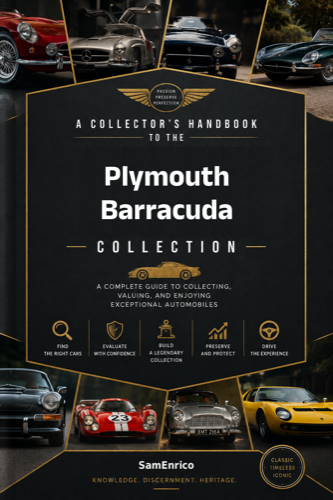 A Collector's Handbook to the Plymouth BarracudaApplegate Lenny$11.99
 Mailchimp Email Preview and TestingApplegate Lenny$12.99