
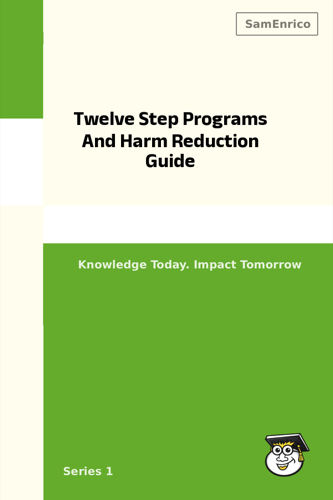
Twelve Step Programs And Harm Reduction Guide eBook
Explores the relationship between twelve-step prog
Explores the relationship between twelve-step programs and harm reduction models.
Formats
Free sample
Chapter 1: The Wreckage Of Certainty–- I spent the first three years of my recovery absolutely certain that I had found the only truth that mattered. I was a twelve-step zealot, the kind who carried a Big Book to coffee shops, who could recite the promises from memory, who believed with every fiber of my being that anyone who disagreed with the program was either in denial or destined for a drink, a jail cell, or a grave. I had been saved from the nightmare of my own drinking, and I owed that salvation to Alcoholics Anonymous. In my mind, AA was not one path among many. It was the path.
The only path. The path that worked if you worked it, and if you were not working it, you were not really trying to get better.I told this to a woman named Grace at a meeting in downtown Portland. Grace was sixty-eight years old, a retired nurse, and she had been coming to that same meeting for twenty-two years. She was also, as she informed me that night, a daily cannabis user for chronic pain from a car accident that had shattered her spine in 1994. She did not share this in the meeting.
She told me afterward, outside by the cigarette smokers, because she had heard me lecturing a newcomer about the dangers of "marijuana maintenance" and wanted to set me straight."You remind me of myself at thirty," she said. "Certain. Righteous. Convinced that my way was the only way."I bristled. I told her she was not really sober.
I told her she was cheating. I told her that the program clearly stated that any mind-altering substance was a relapse.She laughed. Not a mean laugh, but the kind of laugh that comes from having heard it all before. Then she said something I have never forgotten."Honey, I have not had a drink in twenty-two years. I have not wanted a drink in twenty-two years.
I go to four meetings a week. I sponsor six women. I have made my amends, kept my side of the street clean, and helped more alcoholics get sober than you have probably met. If that is not recovery because I smoke a joint before bed so I can sleep through the pain, then I do not want your kind of recovery."I had no answer for her. Every反驳 I could think of sounded hollow in my own head.
She was right about the facts. She was sober from alcohol. She was active in the program. She was helping others. By every measurable standard, Grace was in recovery.
But she did not fit my definition, and that meant, according to the certainty I had wrapped around myself like armor, that she was wrong.It took me another five years to admit that the problem was not Grace. The problem was my certainty.The Dangerous Comfort of Absolute Answers Certainty is seductive. I know this because I have lived inside it. When you are certain, you do not have to question yourself. You do not have to sit in the uncomfortable space of not knowing.
You do not have to look at evidence that contradicts your beliefs and figure out what to do with it. Certainty gives you a story, and the story tells you who is saved and who is lost, who is trying and who is lying, who is in recovery and who is just fooling themselves.The twelve-step program gave me that certainty. It told me that I was powerless over alcohol, that my life had become unmanageable, that only a Higher Power could restore me to sanity. It told me that anyone who was a "real alcoholic" could never drink safely, that moderation was a fantasy, that any plan to cut down was just the addiction talking. It told me that if I worked the steps, went to meetings, and helped others, I would be fine.
And if I was not fine, it was because I was not working the program hard enough.For a while, that certainty worked. It gave me structure when I had none. It gave me hope when I was hopeless. It gave me a community of people who spoke the same language and believed the same things. I am not here to tell you that twelve-step programs are bad.
They saved my life. They have saved millions of lives. The fellowship, the accountability, the spiritual framework, the simple discipline of showing up—these are powerful forces for change.But certainty has a dark side. Certainty is what allowed the men at that meeting to surround the woman with fifteen years of sobriety and tell her she was not really clean because she used medical cannabis. Certainty is what allows sponsors to tell sponsees on Suboxone that they are not "truly abstinent" and should throw away their medication.
Certainty is what kills people.I do not say that lightly. I mean it literally. Certainty kills people.When a person is told that the only acceptable recovery is total abstinence, and that person is not ready or able to achieve total abstinence, what do they do? They hide. They lie.
They avoid treatment entirely. They use alone because they are ashamed to tell anyone they are still using. And then they overdose, and no one is there to save them because they have been taught that asking for harm reduction help is admitting defeat.Certainty also kills people on the other side of the divide. I have watched harm reduction purists insist that abstinence goals are "internalized stigma" and that anyone who wants to quit is just buying into the capitalist, colonialist, prohibitionist narrative. They tell people that moderation is fine, that using is fine, that any goal is valid—and then they watch those same people spiral into addiction without ever challenging them to aim higher.
Certainty is what allows a harm reduction counselor to watch a client lose their job, their housing, and their kids while nodding along about "meeting them where they are."Certainty, in other words, is the enemy of good. Certainty is what happens when we mistake our map for the territory, our story for the truth, our experience for universal law.The Birth of a False Binary The conflict between twelve-step and harm reduction models is not ancient history. It is not a natural division that emerged organically from different philosophies of care. It is a manufactured war, built on misunderstanding, fear, and the human tendency to see the world in terms of us and them.Let me take you back to the 1980s.The AIDS epidemic was ravaging communities of people who injected drugs. In New York City alone, more than half of all injection drug users were HIV-positive by the end of the decade.
The public health system was completely unprepared. Abstinence-based treatment had been the standard for decades, but it was not working fast enough. People were dying while waiting for detox beds. People were dying because they were too afraid to seek help. People were dying because the only message they heard was "stop using," and they could not stop.So activists and public health…
This is the end of the free sample. Get the eBook to keep going. Buy now
About this book
Details
- Author
- Hastings Lacy
- Publisher
- SamEnrico
- Language
- English
- Genre
- Non-Fiction, Self-Help, Harm Reduction
- Released
- 2026-06-09
- Pages (approx.)
- 138
- Available as
- eBook, Audiobook

Read better in the ZLOADR app
Your eBooks on your phone or tablet. Sign in with your SamEnrico account and start reading.
More by Hastings Lacy
 Relationship Maintenance PlanHastings Lacy$11.99
 Stress Immune System RecoveryHastings Lacy$11.99
 Criminal Defense StressHastings Lacy$11.99
 Options Trading AddictionHastings Lacy$11.99
 Recording Embedded CommandsHastings Lacy$11.99
 Pet Keepsake IdeasHastings Lacy$11.99
 Anger After Betrayal HealingHastings Lacy$11.99
 Ymir's Bones: The World Born from a Giant's FallHastings Lacy$11.99
 The Green Pioneers: Black Naturalists Who Charted Africa’s Wild FrontiersHastings Lacy$11.99
 How to Produce Mobile Phone AccessoriesHastings Lacy$11.99
 A Collector's Handbook to the Pontiac Quality SixHastings Lacy$11.99
 US Minimum Wage Update GuideHastings Lacy$12.99
You may also like
 Alcoholism Harm Reduction WorkbookArtist Hilda$11.99
 Opioid Overdose Prevention GuideMcneill Serafina$11.99
 Drug Dependency Harm Reduction GuideRowell Olen$11.99
 Cannabis Moderation in Alcohol RecoveryParson Nieves$11.99
 Alcoholism Harm Reduction GuideSchmidt Yvonne$11.99
 Opioid Withdrawal Compassionate Care PlanHoyle Lilliana$11.99
 Moderation Management for DrinkersEpstein Nana$11.99
 Fentanyl Test Strip UseUpdegraff Kandra$11.99
 Fentanyl Overdose Prevention GuideDunning Junita$11.99
 Fentanyl Crisis Family Rescue GuideLerma Hipolito$11.99
 Alcohol Harm Reduction GuideMartz Maryland$11.99
 Needle Exchange GuideEnos Tess$11.99