
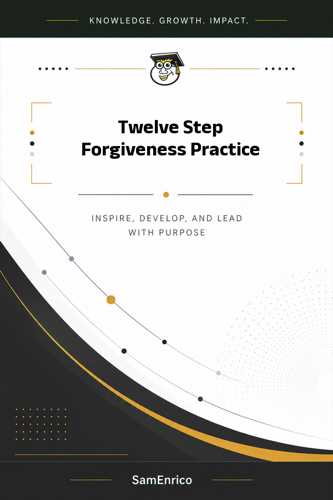
Non-FictionSelf-Help / Forgiveness
Twelve Step Forgiveness Practice eBook
Teaches self-forgiveness and forgiving others as p
by Styles Rob
Teaches self-forgiveness and forgiving others as part of step four, five, and nine work.
Formats
Free sample
Chapter 1: The Forgiveness Trap--–- You have been lied to about forgiveness. Not maliciously, but persistently. The lies came from well-meaning people—parents who told you to “just let it go,” religious leaders who said forgiveness is required for your own soul, self-help books that promised peace if you could only release your resentment. They meant well. But their advice has likely failed you more than once, and that failure is not your fault.
You were given a map to a country that does not exist.The most damaging lie is this: that forgiveness is a feeling. That you should wait until you feel like forgiving, and then somehow, magically, the hurt will dissolve. This lie has left millions of people stuck in a loop of guilt—feeling bad that they cannot feel forgiving, trying harder to feel it, failing again, and concluding that something is wrong with them. Nothing is wrong with you. You were just taught a feeling when you needed a skill.This book is built on a different premise: forgiveness is not a feeling.
It is a decision. And like any decision, it can be practiced, failed at, practiced again, and eventually mastered. The feelings may follow. They may not. But you do not need to wait for them.This chapter introduces the four axioms that will undergird everything else in this book.
Think of axioms as the rules of the road. If you ignore them, you will still move, but you will crash into every intersection. If you learn them, the path—while never easy—becomes coherent.Axiom One: Forgiveness Is a Decision, Not a Feeling Let us be brutal about this. You have never once in your life waited to feel like doing something difficult and then done it. You did not wait to feel like going to work.
You did not wait to feel like exercising. You did not wait to feel like having that hard conversation with your partner. You decided, and then you acted, and then—sometimes, not always—the feeling followed.Forgiveness works the same way. The decision to forgive is a choice you make with your mouth and your mind before your heart catches up. You say, “I am choosing to release this person from the debt I believe they owe me.” You say it even when you do not mean it yet.
You say it as an act of will, not an act of emotion.This is not pretending. This is not toxic positivity. This is the same mechanism by which you have done every hard thing in your adult life: you decide first, and you let the feeling arrive on its own schedule, if it ever does.Here is what you gain by separating decision from feeling: freedom from the tyranny of your emotional state. If forgiveness requires a feeling, you are at the mercy of your nervous system. On a good day, you might feel generous enough to forgive.
On a bad day, you are off the hook—you simply do not feel like it. But if forgiveness is a decision, you can make it in thirty seconds, in any emotional weather, while crying, while angry, while exhausted. The decision does not ask you to feel better. It only asks you to choose.Axiom Two: You Cannot Forgive What You Will Not Name This axiom will appear throughout the book. You cannot forgive what you will not name.
If you keep your resentment vague—"they hurt me," "they were wrong," "they should have known better"—you have nowhere to aim your forgiveness. It is like trying to treat a disease without knowing which organ is infected.Naming is not blaming. Naming is specificity. “On March 12th, 2019, my partner said X, and I felt Y, and the consequence for my life has been Z.” That is naming. Naming requires you to look directly at the harm without flinching.
Most people avoid this because they fear that naming will make the pain worse. The opposite is true. Vague pain haunts you. Specific pain can be addressed.The same applies to harms you have caused. “I was a bad parent” is useless.
“On three specific occasions, I yelled at my child in a way that I knew was shame-based, and here is what I said” is usable. You cannot apologize for what you cannot name. You cannot forgive yourself for what you cannot name. You cannot ask for forgiveness for what you cannot name.This chapter introduces a practice that will recur in various forms: the naming list. Write down a specific harm done to you.
Write down the date, if you remember it. Write down the exact behavior. Write down the consequence. You are not writing a novel; you are writing a diagnosis. The more precise you are, the more possible forgiveness becomes.Axiom Three: Justification and Explanation Are Not the Same This is the most subtle and most violated axiom in all of forgiveness work.
A justification says, “What I did was right.” An explanation says, “Here is why I did what I did, which was wrong.” These sound similar. They are worlds apart.When you justify, you close the door to forgiveness. “I had every right to be angry because they started it.” That is a justification. It may even be true. But justifications keep score.
They establish who was right and who was wrong. Forgiveness does not care who was right. Forgiveness is not a courtroom verdict; it is an amnesty.An explanation opens the door: “I was exhausted, I had not slept in three days, I was triggered by a memory from my childhood, and I lashed out. That does not make it right. It explains how I got there.” Explanations create compassion without excusing the harm.
You can understand why someone hurt you and still hold them accountable. You can understand why you hurt someone and still make amends.The practice for this axiom is simple: take a resentment you hold against someone. Write down a justification for their behavior. Then write down an explanation. Feel the difference in your body.
The justification will make your jaw tight. The explanation will make your shoulders drop slightly. That drop is the beginning of forgiveness.Axiom Four: Forgiveness Is a Shift from Fear to Love Resentment is fear in a costume. Under every grudge, you will find a fear. Fear of being vulnerable again.
Fear of being seen as weak. Fear that if you forgive, you are condoning what happened. Fear that without the resentment, you will have no identity. Fear that you will be hurt again.These fears are real. They are not stupid.
They evolved to protect you. But they are also expensive. The cost of maintaining fear-based protection is that you live in a small, guarded world where love cannot reach you. You cannot be open and protected at the same time. You cannot be intimate and defended at the same time.
You cannot be free and resentful at the same time.Forgiveness is the decision to shift from fear-based perception to love-based perception. Love-based perception does not mean you become a doormat. It does not mean you trust someone who has proven…
This is the end of the free sample. Get the eBook to keep going. Buy now
About this book
Details
- Author
- Styles Rob
- Publisher
- SamEnrico
- Language
- English
- Genre
- Non-Fiction, Self-Help / Forgiveness
- Released
- 2026-06-06
- Pages (approx.)
- 124
- Available as
- eBook, Audiobook

Read better in the ZLOADR app
Your eBooks on your phone or tablet. Sign in with your SamEnrico account and start reading.
More by Styles Rob
 Peyronie Disease and EDStyles Rob$11.99
 The Parent Anger Nutrition GuideStyles Rob$11.99
 Empathy For Identity StrugglesStyles Rob$11.99
 The Jack the Ripper SignatureStyles Rob$11.99
 The Great Balloon Chase: The Untold Story of the First Cross-Atlantic FlightStyles Rob$11.99
 Register .africa Domain GuideStyles Rob$12.99
 PR for Ecommerce StartupsStyles Rob$12.99
 Member Experience AssociateStyles Rob$11.99
 The Breeder's Guide to Newfoundland Pony HorsesStyles Rob$11.99
 How to Become a Log GraderStyles Rob$11.99
You may also like
 Hong Kong Handover 1997Dunn Johnnie$11.99
 Zumba For Postnatal Recovery CourseNeal Christian$11.99
 Zumba for BeginnersLadner Nikia$11.99
 YouTube Comment Mining GuideHumes Pandora$12.99
 Worry Box MeditationCarlin Rudy$11.99
 Workplace Stress MeditationNguyen Lynn$11.99
 Workplace Stress and Sleep RepairHawley Ivory$11.99
 Workplace Perfectionism CureDelaney Jeffry$11.99
 Workplace Injustice Anger GuideWallen Isabelle$11.99
 Work Addiction and Burnout LinkGreenwood Ester$11.99
 Women in Yoga and WellnessBeattie Galina$11.99
 Women in Stand Up ComedyChun Evangeline$11.99