
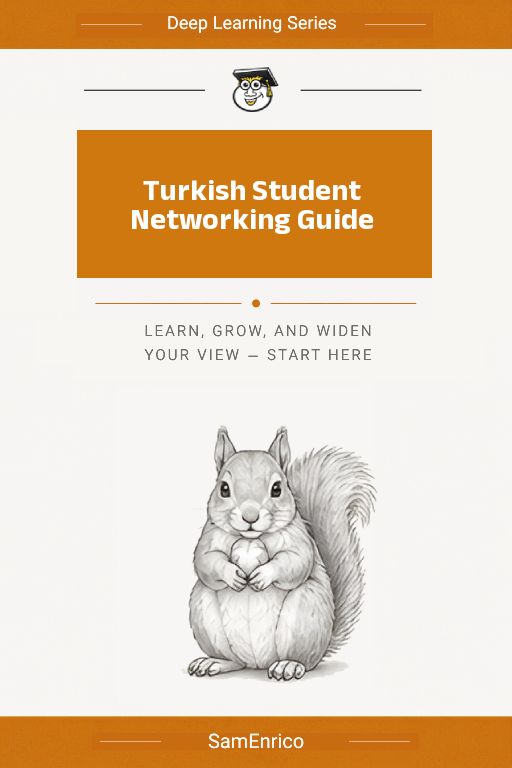
Non-FictionStudent's ShortcutCareer Networking
Turkish Student Networking Guide eBook
Build professional network through LinkedIn, caree
Build professional network through LinkedIn, career fairs, and student associations in Turkey.
Formats
Free sample
Chapter 1: The Gönül Principle--–- The young man had applied to forty-seven jobs. His CV was flawless—top marks at a respectable university, two internships, and a certificate in digital marketing. Forty-seven applications. Zero interviews. He sat across from me in a crowded Istanbul coffee shop, his hands wrapped around a cold glass of çay, and asked the question I hear from Turkish students everywhere: "Hocam, what am I doing wrong?"I asked him one question in return: "How many of those forty-seven people have you met?"He looked confused.
"Met? I applied online. Through the portal. Isn't that how it works?"That moment—that confused, sincere, heartbreaking moment—is why this book exists. This young man had done everything his professors and career center had told him to do.
He had built a strong CV. He had earned good grades. He had followed the application instructions perfectly. And he had failed because he was playing a game whose rules he did not understand.The game of professional advancement in Turkey is not won with PDFs and portal submissions. It is won with gönül—a Turkish word that has no perfect English translation.
It means heart, soul, deep inclination, and voluntary affection all at once. To win in Turkey, you do not send applications. You build gönül connections.This chapter dismantles the most dangerous myth in Turkish student career development: the belief that networking is selfish, transactional, or optional. It introduces the core philosophy that will guide every tactic in this book. And it forces you to confront a hard truth: your CV is not the problem.
Your network is.The Statistic That Should Terrify You Let me give you a number that changes everything. According to multiple studies of the Turkish labor market, including research from Kariyer.net and university career centers, over sixty percent of jobs in Turkey are filled through referans—a trusted reference—not through open applications. For entry-level positions, that number climbs even higher. Some sectors, like finance and defense, approach eighty percent.Read that again. Six out of ten jobs never appear on a public job board.
They are filled before the application period even opens, through conversations, introductions, and relationships that have been cultivated over months or years.This is not corruption. This is not torpil—the ugly Turkish word for unfair nepotism based on family connections or bribes. Those things exist, certainly. But referans is different. A referans is someone who knows your work, your character, and your potential, and who is willing to put their own reputation on the line to recommend you.
It is social proof in its most powerful form.Think of it this way. If you were hiring for a critical role in your family's business, would you rather interview a stranger with a perfect CV or someone recommended by a trusted colleague who says, "I have worked with this person. They show up on time. They finish what they start. They are honest"?
The answer is obvious. And Turkish employers are not irrational for preferring the same.The problem is that most students misunderstand referans. They think it is something you ask for. Something you request at the end of a coffee meeting. Something you collect like a trading card.Wrong.A referans is not something you ask for.
It is something you become worthy of. It is the natural conclusion of a genuine human relationship built on mutual respect, curiosity, and reciprocity. And the foundation of that relationship is gönül.The Western Handshake vs. The Turkish Sohbet To understand gönül, you must first understand what it is not. Most professional networking advice—especially the advice that floods English-language Linked In, You Tube, and business books—comes from a Western cultural framework.
That framework is built on speed, directness, and transaction.Let me illustrate with a table that contrasts two approaches to professional interaction:The Western Handshake Model The Turkish Sohbet Model Direct: "What can you do for me?"Indirect: "How are you? How is your family?"Fast: Get to the point immediately Slow: Build comfort through conversation Goal-oriented: Define the ask within minutes Relationship-first: The ask comes later, if at all Transactional: Exchange value for value Reciprocal: Give without immediate expectation Individualistic: Focus on your own achievements Relational: Focus on shared connections and context Time-bound: Meetings have strict agendas Fluid: Meetings follow natural conversational rhythms Neither model is morally superior. Each developed in response to different historical, social, and economic conditions. But if you use the Western model in a Turkish context, you will be perceived as rude, aggressive, and untrustworthy. You will get nothing.I have watched this happen dozens of times.
A bright, ambitious Turkish student reads an American networking guide. They attend a career fair. They march up to a company representative, extend their hand, and say, "Hello, I am looking for an internship. Here is my CV." The representative smiles politely, takes the CV, and never responds. The student walks away confused.
"But I did exactly what the book said!"The book was wrong. Not about networking—about Turkish networking.The Turkish sohbet model requires patience. It requires genuine curiosity about the other person. It requires asking about their health, their family, their opinions on the weather or the latest news. It requires drinking tea together without rushing.
It requires understanding that in Turkey, the relationship is the transaction.A senior executive at one of Turkey's largest holding companies once explained it to me this way: "If a student approaches me and immediately asks for a job, I hear nothing else. I close down. But if a student approaches me, asks about my weekend, asks about a project I am working on, shows genuine interest in me as a person—then I want to help them. Not because I owe them anything. Because I like them."That is gönül.
It is the voluntary, heartfelt inclination to help someone because you have developed a genuine human connection with them.The Three Pillars of the Turkish Student Network Throughout this book, you will learn specific tactics for three distinct networking channels. I call them the Three Pillars because, like the structural columns of a building, each supports a different load, and you need all three to stand.Pillar One: Linked In (Digital Visibility)Linked In is your professional storefront—your vitrin. It is where recruiters will find you, where you will research the people you want to meet, and where you will maintain your professional identity over time. But Linked In in Turkey is different from Linked In in New York or London. The expectations for photos, headlines, connection requests, and engagement are shaped by Turkish cultural values.
Chapter 2 and Chapter 3 will teach you exactly how to optimize your digital presence for the Turkish market.Pillar Two: Career Fairs (High-Volume Tactical Encounters)Career fairs are loud, chaotic, and exhausting. Most students hate them. But they are also the single most efficient way to meet dozens of company representatives in a single day. The key is preparation. Most students walk into a career fair with a stack of CVs and a prayer.
You will walk in with intelligence: you will know the names and backgrounds of the representatives at each booth, you…
This is the end of the free sample. Get the eBook to keep going. Buy now
About this book
Details
- Author
- Shin Eleonora
- Publisher
- SamEnrico
- Language
- English
- Genre
- Non-Fiction, Student's Shortcut, Career Networking
- Released
- 2026-05-30
- Pages (approx.)
- 148
- Available as
- eBook, Audiobook

Read better in the ZLOADR app
Your eBooks on your phone or tablet. Sign in with your SamEnrico account and start reading.
More by Shin Eleonora
 Anti Inflammatory Diet AgingShin Eleonora$11.99
 Pornography Use Relationship GuideShin Eleonora$11.99
 Farm and Ranch Insurance GuideShin Eleonora$11.99
 Metta for Test Anxiety CourseShin Eleonora$11.99
 Guided Imagery for Migraine ReliefShin Eleonora$11.99
 The Billion-Dollar Heist: How a Small Town Took Down a Wall Street GiantShin Eleonora$11.99
 Echoes of the Cosmos: The Cosmic Detectives of North AmericaShin Eleonora$11.99
 Public Relations ManagerShin Eleonora$11.99
 Understanding Dentatorubral-pallidoluysian AtrophyShin Eleonora$17.99
 Debt Collection RulesShin Eleonora$12.99
 How to Become a Scooping-machine TenderShin Eleonora$11.99
You may also like
 Hong Kong Handover 1997Dunn Johnnie$11.99
 Zumba For Postnatal Recovery CourseNeal Christian$11.99
 Zumba for BeginnersLadner Nikia$11.99
 YouTube Comment Mining GuideHumes Pandora$12.99
 Worry Box MeditationCarlin Rudy$11.99
 Workplace Stress MeditationNguyen Lynn$11.99
 Workplace Stress and Sleep RepairHawley Ivory$11.99
 Workplace Perfectionism CureDelaney Jeffry$11.99
 Workplace Injustice Anger GuideWallen Isabelle$11.99
 Work Addiction and Burnout LinkGreenwood Ester$11.99
 Women in Yoga and WellnessBeattie Galina$11.99
 Women in Stand Up ComedyChun Evangeline$11.99