
Non-FictionStudent's ShortcutStudy Resources
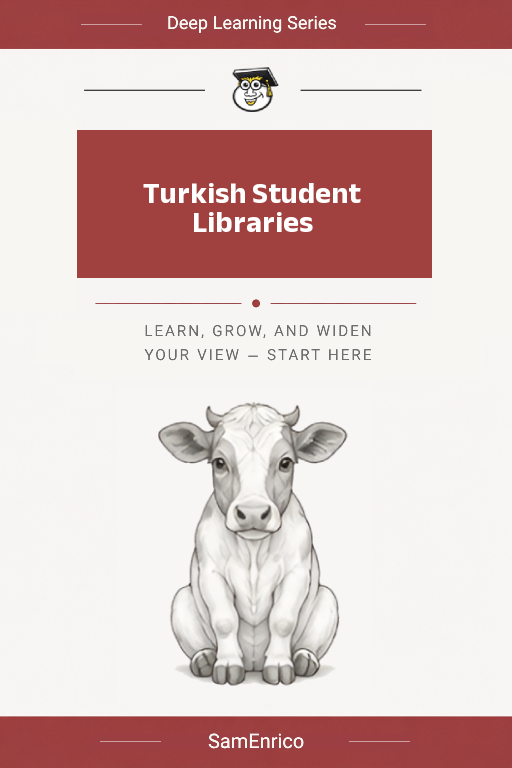
Turkish Student Libraries eBook
Access university libraries, National Library in A
by Rushing Nery
Access university libraries, National Library in Ankara, and online research databases.
Formats
Free sample
Chapter 1: The Kırtasiye Trap...--–- It is 11:47 PM on a Sunday in late December. You are sitting in the third-floor silent reading hall of your university library. The fluorescent lights above you hum a frequency that feels personally designed to induce migraines. Around you, thirty-seven other students stare at laptop screens with the hollow-eyed desperation of people who have been searching for the same three sources for the past four hours. Your coffee cup is empty.
Your phone battery is at 12%. Your literature review is due in eleven days, and you have found exactly two relevant academic sources. One is from 1987. The other is behind a paywall that your university's VPN cannot seem to penetrate.You ask yourself the question that every Turkish university student asks at least once in their academic career: Is research supposed to be this hard?The answer, which no orientation session, no well-meaning advisor, and no library pamphlet has ever told you, is a firm and liberating no.Research is not supposed to be this hard. You are not stupid.
You are not bad at using computers. You are not somehow failing at a task that everyone else seems to find effortless. The problem is not you. The problem is that you have been trapped inside what this chapter calls The Kırtasiye Trap—a fundamental misunderstanding of what libraries are, how they work, and which one you should be using for which task.This chapter will demolish that trap. By the time you finish reading these pages, you will understand something that most Turkish students never learn until their second or third year of graduate school: the difference between a public library, a university library, and the National Library is not just a matter of size or location.
It is a matter of purpose. And once you understand purpose, you stop wasting hours in the wrong building, searching the wrong catalog, asking the wrong questions.Let us begin.The Kırtasiye Illusion The Turkish word kırtasiye translates directly to "stationery store." But for most Turkish students who grew up in the 1990s and 2000s, the word carried a deeper meaning. Your neighborhood kırtasiye was where you bought notebooks before the school year started, where you photocopied handouts, where you sometimes sat at a small desk to study because your home was too loud. The kırtasiye was a hybrid space: part store, part study hall, part social hub.Here is the problem: most Turkish students carry this kırtasiye mental model into university. They assume that a library is simply a larger, quieter kırtasiye with more books.
You walk in. You find a desk. You open your laptop. You search for sources. You leave.This model is catastrophically wrong.A modern research library—whether a university library or the National Library in Ankara—is not a quiet place to sit with your laptop.
It is a research instrument. It is a tool as sophisticated as any microscope in a biology lab or any telescope in an astronomy department. And like any sophisticated tool, it requires training to use effectively.The kırtasiye trap convinces you that all libraries are essentially the same. They are not. Turkey has 1,922 libraries, but they fall into three distinct tiers, each with a different purpose, different collections, and different rules.
Using the wrong tier for your research question is like using a scalpel to chop wood or a hammer to perform surgery. You might eventually get somewhere, but you will waste an enormous amount of time and energy along the way.Tier One: Public District Libraries (Halk Kütüphaneleri)Turkey has 1,295 public district libraries, scattered across 81 provinces. These are the libraries you likely grew up visiting. They are funded by the Ministry of Culture and Tourism, and their primary mission is community access, not advanced research.What public libraries are good for:Silent or semi-silent study space (though noise levels vary dramatically by location)Leisure reading (popular fiction, children's books, magazines, newspapers)Local history collections (newspaper archives, municipal documents, regional publications)Basic computer and internet access for communities with limited connectivity Borrowing popular books (yes, the same bestsellers you see at D&R)What public libraries are NOT good for:Advanced academic research requiring peer-reviewed journals Access to international databases (Web of Science, Scopus, JSTOR)Rare manuscripts or special collections Recent academic monographs from university presses Inter-library loan with university libraries (the public library network has its own ILL system, but it is slow and limited)Here is a hard truth that many students refuse to accept: if you are doing research for a third-year undergraduate paper, a master's thesis, or a doctoral dissertation, the public library is almost certainly the wrong place to be. You are not wrong for going there—it is familiar, it is comfortable, it might be closer to your home than your university library.
But you are wasting time. The public library does not have the sources you need, and no amount of searching will change that.There is one exception, which we will explore in Chapter 7: public libraries can be excellent sources for primary materials in certain kinds of research. If you are writing a history paper about a local event, the public library's newspaper archives might be invaluable. If you are doing sociological research on reading habits, the public library's borrowing records (anonymized, with permission) could provide data. But for standard academic research requiring peer-reviewed sources?
Leave the public library to the novel readers and the high school students.Tier Two: University Libraries (Üniversite Kütüphaneleri)Turkey has 627 university libraries, though the quality varies enormously. A library at a foundation university like Bilkent or Koç, with an annual budget measured in millions of lira, bears almost no resemblance to a library at a small state university with a handful of staff and a collection that has not been updated since 2005.Despite this variation, all university libraries share a common mission: supporting the teaching and research mission of their parent institution. This means that university libraries are the correct first stop for almost all undergraduate and graduate research.What university libraries are good for:Access to course reserves (textbooks and readings assigned by your professors)Peer-reviewed journals (usually through database subscriptions)Inter-library loan (requesting materials from other Turkish universities and the National Library)Subject-specific librarians (librarians who specialize in your discipline)Study spaces designed for different needs (silent, group, graduate-only)Access to the university's thesis collection (though not the full national thesis archive)What university libraries are NOT good for:Materials published before 1950 (most university libraries periodically weed older materials)The complete national thesis archive (only the National Library has everything)Ottoman manuscripts or rare books (only a handful of major universities have these)Legal deposit materials (every book published in Turkey must be sent to the National Library, but not to university libraries)The most common mistake students make with university libraries is assuming that "if it is not in my university's catalog, it does not exist." This is false. Your university library is part of a national network. If your university does not own a book, it can almost certainly borrow it from another university or from the National Library.…
This is the end of the free sample. Get the eBook to keep going. Buy now
About this book
Details
- Author
- Rushing Nery
- Publisher
- SamEnrico
- Language
- English
- Genre
- Non-Fiction, Student's Shortcut, Study Resources
- Released
- 2026-05-30
- Pages (approx.)
- 144
- Available as
- eBook, Audiobook

Read better in the ZLOADR app
Your eBooks on your phone or tablet. Sign in with your SamEnrico account and start reading.
More by Rushing Nery
 Emotional Safety Restoration WorkbookRushing Nery$11.99
 Beginner Fitness Safety GuideRushing Nery$11.99
 Cyber Liability Insurance RegisterRushing Nery$11.99
 Metta for Pet Loss Grief CourseRushing Nery$11.99
 Body Scan Meditation for FibromyalgiaRushing Nery$11.99
 The Quantum Nomads: Ancient Secrets of the SteppeRushing Nery$11.99
 Spice Wars: How a Tiny Indian Restaurant Took on the Fast-Food GiantsRushing Nery$11.99
 How to Become a Treater HelperRushing Nery$11.99
 Principal Machine Learning EngineerRushing Nery$11.99
 Institutional Accreditation RulesRushing Nery$12.99
 Understanding Dental Aberrations Steroid Dehydrogenase DeficienciencyRushing Nery$17.99
You may also like
 Hong Kong Handover 1997Dunn Johnnie$11.99
 Zumba For Postnatal Recovery CourseNeal Christian$11.99
 Zumba for BeginnersLadner Nikia$11.99
 YouTube Comment Mining GuideHumes Pandora$12.99
 Worry Box MeditationCarlin Rudy$11.99
 Workplace Stress MeditationNguyen Lynn$11.99
 Workplace Stress and Sleep RepairHawley Ivory$11.99
 Workplace Perfectionism CureDelaney Jeffry$11.99
 Workplace Injustice Anger GuideWallen Isabelle$11.99
 Work Addiction and Burnout LinkGreenwood Ester$11.99
 Women in Yoga and WellnessBeattie Galina$11.99
 Women in Stand Up ComedyChun Evangeline$11.99