
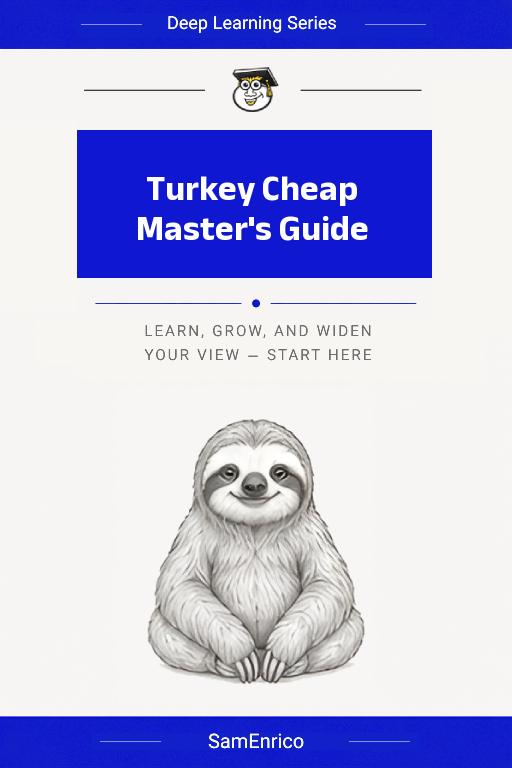
Non-FictionStudent's ShortcutTurkey
Turkey Cheap Master's Guide eBook
Pay €500-2,000 annually for master's degrees at Tu
by Wray Armand
Pay €500-2,000 annually for master's degrees at Turkish public universities for international students.
Formats
Free sample
Chapter 1: The €500 Window--–- Most international students imagine that studying abroad requires life-changing debt. They picture $50,000 annual tuition bills, cramped shared apartments in expensive cities, and years of loan repayments that delay homeownership, marriage, or even starting a family. The study abroad industry has done an exceptional job of marketing this fear. Agents, consultants, and ranking websites all benefit when you believe that quality education must come with a luxury price tag. But what if everything you have been told about the cost of a European master's degree was carefully curated to hide a much cheaper alternative?
What if there existed a country where public universities charged less than a monthly car payment for an entire year of graduate education, where living costs rivaled those of Southeast Asia, and where admission standards were forgiving enough for average students to succeed? That country is Turkey, and the window to exploit this pricing anomaly may not stay open forever.The myth of the "cheap master's" has long been dominated by two European giants. Germany offers tuition-free education at public universities, but the catch is brutal: admission is hyper-competitive, bachelor's degrees must align perfectly, and living costs in cities like Munich or Berlin hover around €1,000–€1,200 per month. Eastern Europe—Poland, Hungary, Czech Republic—offers tuition between €3,000 and €8,000 per year, but many programs require language proficiency tests, complicated visa processes, and the degrees do not always carry the same international recognition as Western European credentials. Turkey's public universities occupy a forgotten middle ground: tuition between €500 and €2,000 per year, living costs as low as €250 per month, and a surprisingly large number of programs taught entirely in English.
This chapter exposes the real fee structures, the currency arbitrage opportunity that can cut your costs in half, and the specific universities where your application will be welcomed rather than rejected.The Real Fee Table: What You Will Actually Pay Let us begin with hard numbers. The following data comes from official 2024–2025 international fee lists published by Ankara University, Istanbul University, Ege University, and Çukurova University. These are not promotional materials from private foundations. These are state-regulated tuition figures that the Turkish Council of Higher Education (YÖK) approves each academic year.For humanities and social science programs—fields such as history, sociology, psychology, literature, philosophy, and political science—annual tuition for international students ranges from €200 to €700. At the lower end of this spectrum, Van Yüzüncü Yıl University charges approximately €220 per year for its master's in Turkish Literature.
At the upper end, Ankara University charges around €650 for its English-medium master's in International Relations. The average across thirty public universities surveyed for this book is €450 per year for humanities programs.For STEM and business programs—engineering, computer science, mathematics, physics, chemistry, business administration, economics, and management—the range climbs to €800–€1,500 per year. Middle East Technical University (METU), one of Turkey's most prestigious public universities, charges approximately €1,200 per year for its English-medium master's in Computer Engineering. Gebze Technical University charges around €900 for its master's in Industrial Engineering. Boğaziçi University, another elite institution, charges roughly €1,400 for its MBA program.
Note that even the most expensive STEM programs at top Turkish public universities remain cheaper than the cheapest master's programs in the United Kingdom, where tuition rarely falls below £10,000 (€11,600) per year.For medicine, dentistry, and pharmacy programs, which are rarely pursued by international master's students due to strict clinical rotation requirements, fees range from €1,500 to €2,000 per year. These programs are included here for completeness, but this book does not recommend them unless you already speak fluent Turkish and have secured a clinical placement in advance.Why the Range Fluctuates: Per-Credit versus Flat Fees Understanding how Turkish universities calculate tuition will save you hundreds of euros. Some institutions charge a flat annual fee regardless of how many credits you take. Others charge per credit, typically €20–€40 per ECTS credit. A standard thesis master's program requires 120 ECTS credits over two years.
At €30 per credit, the total tuition becomes €3,600, which annualizes to €1,800 per year—well within the €500–€2,000 range claimed in this book's subtitle. A non-thesis master's program requires 90 ECTS credits over three semesters. At the same €30 per credit, the total tuition becomes €2,700, which annualizes to approximately €1,800 per year as well, though the program finishes six months earlier.Here is the money-saving insight: per-credit fee structures benefit students who already hold some transferable credits from previous graduate coursework or who plan to take fewer courses per semester while working remotely. Flat annual fees benefit students who want to load up on courses and finish quickly. The chapter teaches you to identify which pricing model each university uses before applying.
This information is almost always buried in the "Tuition and Fees" section of the international applications page, but many students overlook it.Consider two hypothetical students pursuing a master's in Economics. Student A chooses Ankara University, which charges a flat annual fee of €600 regardless of course load. Student B chooses Hacettepe University, which charges €35 per credit for a 120-credit program, totaling €4,200 over two years. Student A saves €3,000 simply by reading the fee structure carefully before applying. This book will show you exactly where to find this information for every major public university.The Lira Arbitrage: How Currency Fluctuation Lowers Your Tuition This section may be the most financially valuable part of the entire chapter.
Turkish universities set their tuition fees in Turkish Lira (TRY) but often advertise them in Euros for international convenience. When the Lira depreciates against the Euro, US dollar, or British pound, your effective tuition cost drops without any action on your part. This is not speculation. This is a mechanical consequence of how currency conversion works for international students.In 2022, the exchange rate was approximately 15 TRY to 1 EUR. A university charging 15,000 TRY in annual tuition cost European students €1,000.
In 2025, the exchange rate has shifted to approximately 33 TRY to 1 EUR. The same 15,000 TRY tuition now costs approximately €450. The university did not lower its fees. The Turkish Lira depreciated, and your Euro became more powerful. Students who pay in dollars or pounds experience similar advantages.This arbitrage opportunity is not guaranteed to continue forever.
Turkish higher education is gradually moving toward Euro-denominated tuition for international students, a trend already visible at more prestigious universities like Boğaziçi and METU. As of 2025, however, the majority of regional public universities still set fees in Lira. The window may close within three to five years. Students who apply now lock in Lira-denominated tuition for the duration of their two-year program, meaning even if the university switches to Euro pricing for new students, existing students continue paying in Lira at the original exchange reference.To exploit this arbitrage, you must pay tuition directly from a foreign currency account or via international wire transfer denominated in Euros, dollars, or pounds. Never allow a Turkish university to convert your payment into Lira at their internal exchange rate, which is almost always worse than the market rate.
Use a service like Wise or Revolut to hold your home currency and convert only at the moment of payment. This strategy alone can save you hundreds of euros per year.Private versus Public: The Warning You Cannot Ignore Turkey has two types of universities: public (state) universities and foundation (private)…
This is the end of the free sample. Get the eBook to keep going. Buy now
About this book
Details
- Author
- Wray Armand
- Publisher
- SamEnrico
- Language
- English
- Genre
- Non-Fiction, Student's Shortcut, Turkey
- Released
- 2026-05-29
- Pages (approx.)
- 150
- Available as
- eBook, Audiobook

Read better in the ZLOADR app
Your eBooks on your phone or tablet. Sign in with your SamEnrico account and start reading.
More by Wray Armand
 Breaking the Illusion of ControlWray Armand$11.99
 Conversation Starters for Blended FamiliesWray Armand$11.99
 End Of Life ConversationsWray Armand$11.99
 Dementia Caregiving JourneyWray Armand$11.99
 Fighting Fair in RelationshipsWray Armand$11.99
 Titanic Artifact Preservation GuideWray Armand$11.99
 Workaholic Relapse PreventionWray Armand$11.99
 SSRI For Social AnxietyWray Armand$11.99
 The Ghost of the Central Bank: South Africa's Boldest Heist Gone WrongWray Armand$11.99
 The Unseen Crown: Michelle Obama’s Global Legacy Beyond the White HouseWray Armand$11.99
 How to Produce Hockey Autographed ParaphernaliaWray Armand$11.99
 A Collector's Handbook to the Ford 3022eWray Armand$11.99
You may also like
 Hong Kong Handover 1997Dunn Johnnie$11.99
 Zumba For Postnatal Recovery CourseNeal Christian$11.99
 Zumba for BeginnersLadner Nikia$11.99
 YouTube Comment Mining GuideHumes Pandora$12.99
 Worry Box MeditationCarlin Rudy$11.99
 Workplace Stress MeditationNguyen Lynn$11.99
 Workplace Stress and Sleep RepairHawley Ivory$11.99
 Workplace Perfectionism CureDelaney Jeffry$11.99
 Workplace Injustice Anger GuideWallen Isabelle$11.99
 Work Addiction and Burnout LinkGreenwood Ester$11.99
 Women in Yoga and WellnessBeattie Galina$11.99
 Women in Stand Up ComedyChun Evangeline$11.99