
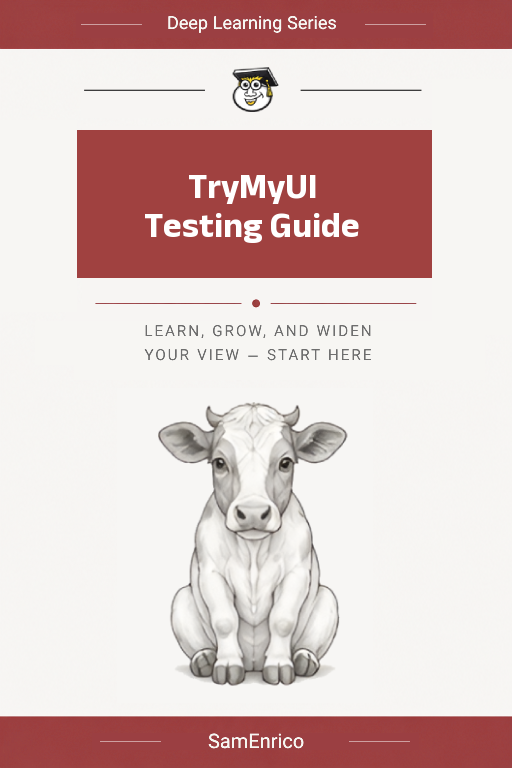
Non-FictionSide Hustle ArchitectUsability
TryMyUI Testing Guide eBook
Makes 60-100 per hour testing websites on TryMyUI,
Makes 60-100 per hour testing websites on TryMyUI, including microphone setup, screen recording, and written feedback delivery.
Formats
Free sample
Chapter 1: The Billion-Dollar Glitch--–- The email arrived at 11:47 PM on a Tuesday. The subject line read: “Your test has been rejected.” No explanation. No human name. Just a red thumbs-down icon and a single sentence: “Audio quality did not meet client standards.”For Sarah, a 34-year-old graphic designer in Ohio, that rejection wasn’t just frustrating—it was bewildering. She had spent eighteen minutes speaking aloud to an empty room, narrating every click, every hesitation, every confused double-take at a checkout button that was the exact same color as the background.
She had used the microphone that came with her $1,200 laptop. She had sat in her well-lit home office. She had done everything the Try My UI (now Trymata) tutorial video had asked. And still, she was rejected.What Sarah didn’t know—and what this chapter will teach you—is that the difference between a rejected tester and a top-earning tester has almost nothing to do with how well you can spot a bug. It has everything to do with how you prepare before you ever click “Accept Test.”This book is called The Try My UI Testing Guide: From First Click to Financial Freedom, and it exists because most people who sign up for usability testing platforms fail within their first five tests.
They are rejected for reasons they never see coming. They earn $0. They quit. And then they tell their friends that user testing is a scam.It is not a scam. But it is also not “easy money.” It is a skill—a teachable, repeatable, profitable skill—and by the end of this chapter, you will understand exactly what separates the 90% who wash out from the 10% who quietly earn 60–60–60–100 per hour testing the websites and apps you use every single day.The Uncomfortable Truth About Usability Testing Let’s start with a number that might surprise you: in 2024, companies spent over $3 billion on usability testing.
That number is projected to double by 2028. Every major e-commerce site, every banking app, every healthcare portal, every airline booking system—they all run tests constantly. And they are desperate for testers.But here is the uncomfortable truth that no Trymata tutorial video will tell you: the platform does not need more testers. It needs better testers.When you sign up for Trymata (formerly Try My UI), you are not joining a community. You are entering a competitive marketplace.
At any given moment, there are thousands of testers refreshing their dashboards, competing for the same 50 slots on a 20-minute test. The platform’s algorithm does not reward effort. It rewards consistency, quality, and a specific kind of communication that most people have never practiced.The core argument of this chapter—and indeed this entire book—is that usability testing is a form of performance psychology more than it is a form of technical debugging. You are not being paid to find bugs. You are being paid to think aloud while being recorded, and to do so in a way that feels authentic, articulate, and useful to a product manager who will watch your recording at 2x speed while eating lunch.That is a very specific skill.
And it is trainable.Why Companies Pay 60–60–60–100 Per Hour for 20 Minutes of Your Time Let’s do the math first, because confusion about pricing is the number one reason testers undervalue themselves or chase the wrong tests.A standard Trymata test pays between 10and10 and 10and40, with most falling in the 15–15–15–25 range for 15–20 minutes of work. That works out to an hourly equivalent of 60–60–60–100. For example:A 20testcompletedin20minutes=20 test completed in 20 minutes = 20testcompletedin20minutes=60 per hour A 25testcompletedin20minutes=25 test completed in 20 minutes = 25testcompletedin20minutes=75 per hour A 33testcompletedin20minutes=33 test completed in 20 minutes = 33testcompletedin20minutes=100 per hour (rare, reserved for top-rated testers)Some testers see 20andthink,“That’snotworthmytime.”Theyaremakingamistake.Thecorrectquestionisnot“Is20 and think, “That’s not worth my time.” They are making a mistake. The correct question is not “Is 20andthink,“That’snotworthmytime.”Theyaremakingamistake.Thecorrectquestionisnot“Is20 a lot of money?” The correct question is: “Can I complete three such tests in an hour and earn 60–60–60–75 consistently?”The answer is yes—but only after you have mastered the workflows taught in this book.Now, why would a company pay that much? The answer lies in opportunity cost.
Imagine an e-commerce website that generates 10millionpermonth.Asingleusabilityflaw—say,acheckoutbuttonthatishardtofindonmobile—couldreduceconversionsbyjust110 million per month. A single usability flaw—say, a checkout button that is hard to find on mobile—could reduce conversions by just 1%. That 1% is 10millionpermonth.Asingleusabilityflaw—say,acheckoutbuttonthatishardtofindonmobile—couldreduceconversionsbyjust1100,000 per month, or $1.2 million per year.Paying twenty testers 20each(20 each (20each(400 total) to identify that flaw before it goes live is not an expense. It is a bargain. In fact, it is one of the highest-ROI activities a product team can undertake.This is why companies are not looking for polite feedback.
They are looking for honest confusion, frustrated clicks, and verbalized hesitation. They want to hear you say, “I expected that blue link to take me to the product page, but it took me to the homepage, and now I’m lost.”That sentence, spoken aloud and recorded, is worth more to a product manager than a thousand automated bug reports.The Try My UI to Trymata Rebrand: What Changed and What Didn’t If you have done any research on usability testing, you have likely encountered the name “Try My UI.” The platform was founded in 2010 and grew to become one of the most respected names in unmoderated usability testing. In 2022, the company rebranded to Trymata.Here is what changed:The name and logo The tester app interface (slightly)Some backend algorithms for test distribution Here is what did NOT change:The core testing process (screen recording + think-aloud + written feedback)The payment structure The quality standards The types of tests available Throughout this book, I will use “Trymata” when referring to the platform as it exists today, and “Try My UI” when referring to historical context or legacy documentation you might encounter. If you see an old help article that still says Try My UI, do not be confused—the instructions still apply, but the dashboard may look different.The single most important thing to know about the rebrand is that the recruiter algorithm—the system that decides which testers see which tests—became more aggressive. In the Try My UI era, a tester with a 4-star rating would still see a steady stream of tests.
In the Trymata era, the algorithm prioritizes testers with 4.5 stars and above, and it deprioritizes anyone with a recent rejection or a low completion rate.This means that your first five tests are critical. A single bad rating in your first week can put you into a “shadow ban” for weeks, where you see almost no tests. Conversely, five good tests in a row can accelerate you into a higher tier where you see premium tests (25–25–25–35 each) before the general population.The Surfer vs. The Professional Evaluator: A Mindset Shift Before we get into hardware, software, or any technical setup, we need to address the single most important variable in your success: your mindset.Most people who sign up for Trymata approach it like a surfer. They…
This is the end of the free sample. Get the eBook to keep going. Buy now
About this book
Details
- Author
- Marvin Winnifred
- Publisher
- SamEnrico
- Language
- English
- Genre
- Non-Fiction, Side Hustle Architect, Usability
- Released
- 2026-05-29
- Pages (approx.)
- 135
- Available as
- eBook, Audiobook

Read better in the ZLOADR app
Your eBooks on your phone or tablet. Sign in with your SamEnrico account and start reading.
More by Marvin Winnifred
 Crucial Conversations WorkbookMarvin Winnifred$11.99
 Worry Time Sleep TechniqueMarvin Winnifred$11.99
 Clean Water Charity Fraud HandbookMarvin Winnifred$11.99
 Burnout Recovery Sleep PlanMarvin Winnifred$11.99
 The High Achiever Breakfast RoutineMarvin Winnifred$11.99
 The Victorian Pen That Shaped Crime: Wilkie Collins and the Birth of Detective FictionMarvin Winnifred$11.99
 How to Start a Barrow Hiring Business (Beginners Guide)Marvin Winnifred$11.99
 Deep Sea Exploration: Ocean MysteriesMarvin Winnifred$11.99
 DTC CAC PlaybookMarvin Winnifred$12.99
 Understanding Wright–dick SyndromeMarvin Winnifred$17.99
You may also like
 Hong Kong Handover 1997Dunn Johnnie$11.99
 Zumba For Postnatal Recovery CourseNeal Christian$11.99
 Zumba for BeginnersLadner Nikia$11.99
 YouTube Comment Mining GuideHumes Pandora$12.99
 Worry Box MeditationCarlin Rudy$11.99
 Workplace Stress MeditationNguyen Lynn$11.99
 Workplace Stress and Sleep RepairHawley Ivory$11.99
 Workplace Perfectionism CureDelaney Jeffry$11.99
 Workplace Injustice Anger GuideWallen Isabelle$11.99
 Work Addiction and Burnout LinkGreenwood Ester$11.99
 Women in Yoga and WellnessBeattie Galina$11.99
 Women in Stand Up ComedyChun Evangeline$11.99