
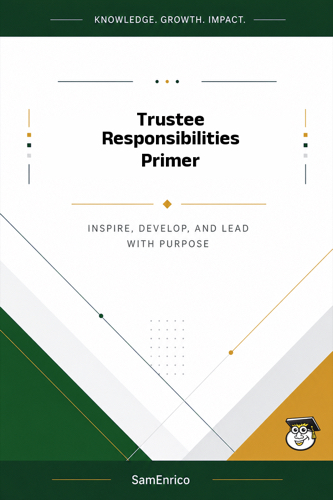
Non-FictionBusiness BriefTrustee Duties
Trustee Responsibilities Primer eBook
Manage trust assets and distributions with confide
Manage trust assets and distributions with confidence using this practical trustee duty manual.
Formats
Free sample
Chapter 1: The Unwanted Inheritance--The envelope arrives on a Tuesday. It is heavy, legal-sized, and sealed with the kind of formality that suggests someone has been waiting for this moment for a long time. Perhaps a lawyer hands it to you across a polished conference table. Perhaps you find it buried in a pile of bills after the funeral, hidden beneath sympathy cards and casserole dishes. Inside, there is a document—the trust—and a single sentence that will rearrange your life: “You have been appointed as trustee.”For most people, this moment arrives without warning, often in the aftermath of loss.
You are grieving. You are exhausted. Your phone will not stop ringing. And now, you are legally responsible for someone else’s financial life. The temptation is to nod, sign the acceptance form, and figure it out later.
That impulse, however understandable, is the first and most dangerous mistake a new trustee can make.Welcome to the first hundred days. This chapter is not a gentle orientation or a philosophical meditation on fiduciary duty. It is an emergency response guide—a practical, step-by-step roadmap designed to take you from panic to competence, from confusion to control. We will move fast. There is no time to waste.
By the time you finish these pages, you will know exactly what to do, what never to do, and where to place your feet first in the treacherous landscape of trust administration.The Weight You Did Not Ask to Carry Before we talk about bank accounts and notification letters, we must acknowledge what you are carrying. Being named a trustee is rarely a random choice. The person who appointed you—the grantor, in legal language—trusted you. Perhaps they trusted your integrity, your financial judgment, or simply your willingness to show up when things got hard. That trust is an honor.
But it is also a legal trapdoor.A trustee occupies a unique and uncomfortable position in American law. You are not the owner of the trust assets. You are not the beneficiary who benefits from them. You are a fiduciary—a person legally required to put the interests of others ahead of your own. This is not a suggestion, a moral aspiration, or a line in a greeting card.
It is a binding legal duty enforced by state statutes, with penalties that include financial surcharges, removal from your position, and, in extreme cases involving fraud or intentional misconduct, criminal prosecution.That sounds frightening. It is meant to. Fear, channeled correctly, becomes precision. The trustee who never forgets the weight of the role is the trustee who never stumbles into the most common traps: commingling money with personal accounts, making hasty distributions to please a demanding beneficiary, or ignoring the paperwork that later becomes their only defense in court. A little fear, properly managed, is not your enemy.
It is your early warning system.Let us also name the emotional reality that no law book will tell you. You did not ask for this. Perhaps you were surprised. Perhaps you were ambushed. Perhaps you said yes out of guilt or duty or the simple inability to say no to a dying person’s request.
Whatever brought you here, you are allowed to feel resentful, overwhelmed, or angry at the grantor for placing this burden on your shoulders. Those feelings are normal. They do not make you a bad person or a bad trustee. They make you human. The key is to acknowledge them without letting them drive your decisions.The First Hundred Days: Why This Window Matters Experienced trust litigators have a saying: “The first hundred days tell you everything you need to know about the trustee.” This is not poetry.
It is pattern recognition, honed over decades of watching fiduciaries succeed or fail. In the early weeks of a trustee’s appointment, beneficiaries are watching. Creditors are circling. Assets are vulnerable. And every decision—including the deliberate decision to do nothing—creates a legal record that will be scrutinized later if things go wrong.The hundred-day window matters for three specific reasons.First, it is the period during which you can still plead reasonable ignorance.
Courts are generally forgiving of a trustee who makes a good-faith error in the first few weeks, provided they correct it promptly and transparently. After a hundred days, that grace period evaporates. What looked like an innocent mistake in week two looks like negligence or worse by month four.Second, it is when assets are most likely to be lost, stolen, or squandered. An untended investment account can bleed value through fees and market movements. An uninsured property can burn down or be vandalized.
A digital wallet without an access key can vanish forever into the cryptographic ether. The trustee who waits to act is the trustee who explains to a judge why fifty thousand dollars disappeared on their watch.Third, it is when beneficiaries form their lasting impression of you. A trustee who communicates clearly, acts deliberately, and demonstrates competence in the first hundred days builds trust that can survive later disappointments. A trustee who hides, delays, or fumbles creates suspicion that no amount of future correctness can fully erase. Once a beneficiary decides you are incompetent or dishonest, every distribution you deny and every fee you take will be viewed through that lens.Your Immediate Priorities: The First Seventy-Two Hours Let us be surgically specific.
You have just learned you are trustee. The envelope is open. The document is in your hands. What do you do in the next seventy-two hours? Not the next month.
Not the next week. The next three days.Priority One: Secure the Original Documents Locate the original trust document. Not a photocopy. Not a scanned PDF. Not a blurry photo on your phone.
The original, signed, and properly notarized or witnessed document. If the grantor is deceased, also locate the original will, even if the trust is the primary estate planning vehicle. Wills often contain important context about the grantor’s intent, including references to assets intended to fund the trust. If the grantor is incapacitated but alive, you will need a written certification of incapacity from one or two physicians (depending on your state’s law) before you have the legal authority to act.Place these documents in a fireproof safe at your home or, preferably, a bank safe deposit box. If you are working with an attorney—and you should be—provide them with certified copies as soon as possible.
Do not carry the originals in your car, your briefcase, or your pocket. Do not leave them on your kitchen counter where a well-meaning relative might “organize” them. Originals are irreplaceable.Priority Two: Do Not Distribute Anything to Anyone Here is the single most violated rule in trust administration, violated again and again by well-intentioned trustees who later find themselves in court: Do not give anyone any money or property during the first seventy-two hours. Not a small gift. Not a token payment.
Not even to the “obviously deserving” beneficiary who is standing in your living room with tears in their eyes. Not even if the grantor promised it on their deathbed.Why? Because until you have read the…
This is the end of the free sample. Get the eBook to keep going. Buy now
About this book
Details
- Author
- Blackmon Carolyne
- Publisher
- SamEnrico
- Language
- English
- Genre
- Non-Fiction, Business Brief, Trustee Duties
- Released
- 2026-06-06
- Pages (approx.)
- 135
- Available as
- eBook, Audiobook

Read better in the ZLOADR app
Your eBooks on your phone or tablet. Sign in with your SamEnrico account and start reading.
More by Blackmon Carolyne
 Bridge Visualization Crossing GuideBlackmon Carolyne$11.99
 Latin America Consumer GuideBlackmon Carolyne$11.99
 Biofeedback For DriversBlackmon Carolyne$11.99
 Commitment and Consistency TacticsBlackmon Carolyne$11.99
 The Lost Voyages of the Punt Expeditions: Africa's Ancient MarinersBlackmon Carolyne$11.99
 Understanding Osteosarcoma Limb Anomalies Erythroid MacrocytosisBlackmon Carolyne$17.99
 Web Application DeveloperBlackmon Carolyne$11.99
 How to Become a Type-rolling-machine OperatorBlackmon Carolyne$11.99
 White Label Terms of Service GuideBlackmon Carolyne$12.99
 Tutoring Chinese University Application EssaysBlackmon Carolyne$12.99
You may also like
 Hong Kong Handover 1997Dunn Johnnie$11.99
 Zumba For Postnatal Recovery CourseNeal Christian$11.99
 Zumba for BeginnersLadner Nikia$11.99
 YouTube Comment Mining GuideHumes Pandora$12.99
 Worry Box MeditationCarlin Rudy$11.99
 Workplace Stress MeditationNguyen Lynn$11.99
 Workplace Stress and Sleep RepairHawley Ivory$11.99
 Workplace Perfectionism CureDelaney Jeffry$11.99
 Workplace Injustice Anger GuideWallen Isabelle$11.99
 Work Addiction and Burnout LinkGreenwood Ester$11.99
 Women in Yoga and WellnessBeattie Galina$11.99
 Women in Stand Up ComedyChun Evangeline$11.99