
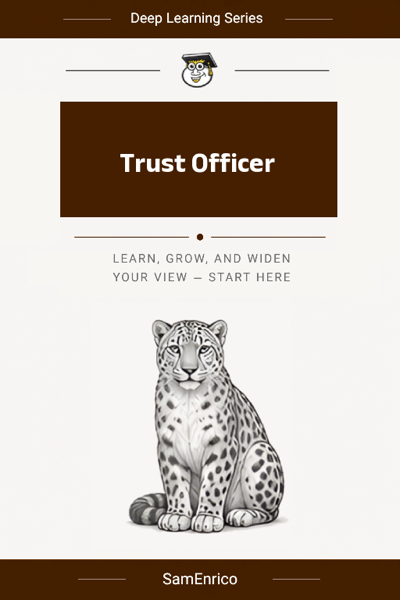
Non-FictionInformativeEducational
Trust Officer eBook
A Coursebook on Trust Officer
A Coursebook on Trust Officer
Formats
Free sample
Chapter 1: The Whitfield Problem--The call came in at 4:47 on a Friday afternoon, which should have been my first warning.I was three weeks into my job as a junior trust officer at a regional bank that shall remain nameless—partly to protect the guilty, mostly because my nondisclosure agreement is ironclad and their legal department has a sense of humor that runs exclusively to cease-and-desist letters. My desk was clean, my inbox was empty, and I was mentally composing my exit strategy for a 5:15 departure that would allow me to beat the worst of the tunnel traffic. Then my phone rang.“Whitfield,” said the voice on the other end. My boss, Margaret. She never used full sentences when she could use single words.
“Conference room. Now.”I should explain what I thought I was signing up for. I had come from a commercial lending background, where the rules were simple: you gave money to people who promised to pay it back, and when they didn’t, you had a frank conversation involving collateral and lawyers. Trust work, I had been told, was different. Trust work was about relationships.
Trust work was about serving as a steward for families across generations. Trust work was about being the calm, steady hand on the tiller of wealthy people’s anxieties.No one told me that trust work was actually about saying no to people who were not accustomed to hearing that word.The conference room held three people: Margaret, whose resting expression suggested she was perpetually calculating your replacement’s start date; a gray-haired man in a suit that cost more than my car; and a younger woman with the kind of polished stillness that comes from decades of etiquette lessons or possibly witness protection. The man’s eyes were red-rimmed. The woman’s hands were folded on the table like she was posing for a portrait called Patience in the Face of Incompetence.“This is Harold Whitfield,” Margaret said, gesturing to the man. “And his daughter, Eleanor.
Harold’s mother—Eleanor’s grandmother—passed away last week. Mrs. Whitfield the elder left a trust. A substantial one. And Harold has just discovered that he is not the trustee.”Harold made a sound like a deflating balloon.
“She named the bank,” he said. “My own mother named the bank. I’ve handled her affairs for thirty years. I paid her bills. I managed her investments.
I visited her every Sunday. And she named the bank.”Eleanor spoke for the first time. Her voice was soft but precise, like a scalpel wrapped in velvet. “Grandmother had her reasons, Dad. You know she didn’t like conflict.”“Conflict,” Harold repeated.
“Conflict. I’m not conflict. I’m her son.”I looked at Margaret. She looked at me. That was when I understood that I was about to become the person in the room that everyone hated.The Anatomy of a Fiduciary Let me tell you what I learned in the three years that followed that Friday afternoon meeting.
It took me that long to fully understand it, and I’m still not sure I’ve grasped all the implications. But here is the truth that every trust officer learns eventually, usually the hard way: You are not the good guy.In commercial banking, you are at worst a neutral party. You lend money; they repay it; everyone goes home satisfied. If they don’t repay it, you take their collateral, and while they may not throw you a parade, at least they understand the rules of the game. In trust work, there is no neutral ground.
You are the person standing between a family and what they believe is rightfully theirs. You are the wall they did not ask for, built by a dead person whose intentions they may not share.The word “fiduciary” comes from the Latin fiducia, meaning trust. But in practice, it means something closer to: You are legally and ethically obligated to act in someone else’s best interest, even when that someone else hates you for it, even when that best interest is unclear, even when every instinct tells you to just give them what they want so they will stop calling your direct line at 7:30 AM on a Saturday.The law recognizes three core duties that define the fiduciary relationship. I memorized them for my certification exam, but I didn’t really understand them until the Whitfield file was spread across my desk like a crime scene.Duty of Loyalty. This means you must put the beneficiary’s interest above your own, above the bank’s, above anyone else’s.
If there is a conflict—and there will always be conflicts—you must resolve it in favor of the trust. This sounds noble until you realize it means you cannot invest in the bank’s proprietary mutual fund if a cheaper, better alternative exists. It means you cannot accept a referral fee from an insurance agent. It means that when a beneficiary offers you a very nice bottle of wine at the holiday party, you smile and decline and feel like a sociopath.Duty of Care. This means you must act with the skill and prudence of a professional.
Not a genius—just a competent, careful professional. You must diversify investments unless the trust instrument says otherwise. You must monitor the portfolio. You must seek expert advice when you are outside your depth. And you must document everything, because if you cannot prove you acted with care, the law presumes you did not.Duty of Impartiality.
This is the one that gets you. This means you must balance the interests of all beneficiaries—the current income beneficiary who wants high cash flow today, and the remainder beneficiaries who want growth for tomorrow. The income beneficiary thinks you are stingy. The remainder beneficiaries think you are reckless. Everyone is equally unhappy, which means you have done your job perfectly and will still be sued.The Whitfield trust was a textbook case of all three duties colliding at once.
Harold, the son, was the current income beneficiary. He was sixty-two, recently retired, and accustomed to a lifestyle that required roughly $400,000 per year in distributions. Eleanor, the granddaughter, was a remainder beneficiary. She was thirty-four, a pediatrician with no interest in her grandmother’s money, and she planned to donate her eventual inheritance to a children’s hospital. The trust instrument—drafted in 1995 by a lawyer who had since died, possibly from boredom—was ambiguous about nearly everything.
It instructed the trustee to provide for Harold’s “health, education, maintenance, and support” in “reasonable comfort.” It said nothing about how to balance Harold’s current needs against Eleanor’s future interests. It used the word “reasonable” eleven times without defining it once.Welcome to trust work.The Trust Instrument as Sacred Text If you want to understand why trust officers develop a reputation for being rigid, rule-bound, and emotionally unavailable, you have to understand the document that governs our lives. Every trust is controlled by its governing instrument—the trust agreement, declaration of trust, or will that created it. That document is not a suggestion. It is not a set of guidelines.
It is the law of this particular universe, and we are its priests, bound to interpret it faithfully even when…
This is the end of the free sample. Get the eBook to keep going. Buy now
About this book
Details
- Author
- Spruill Daine
- Publisher
- SamEnrico
- Language
- English
- Genre
- Non-Fiction, Informative, Educational
- Released
- 2026-05-18
- Pages (approx.)
- 151
- Available as
- eBook, Audiobook

Read better in the ZLOADR app
Your eBooks on your phone or tablet. Sign in with your SamEnrico account and start reading.
More by Spruill Daine
 GAD Perfectionism Anxiety GuideSpruill Daine$11.99
 Self Hypnosis For Fertility SupportSpruill Daine$11.99
 Jimmy Carter Iran PolicySpruill Daine$11.99
 Voice Of Customer MapSpruill Daine$11.99
 Eisenhower for Real Estate AgentsSpruill Daine$11.99
 The Castaway of the Red Sea: The Extraordinary Survival of Hasan al-WazirSpruill Daine$11.99
 The Jade Emperor's Celestial TrialSpruill Daine$11.99
 Understanding Hagemoser–Weinstein–bresnick SyndromeSpruill Daine$17.99
 Artificial Intelligence Retail OutlookSpruill Daine$12.99
 Twenty Minutes to Citation MasterySpruill Daine$12.99
 How to Start a Buckets Made of Steel Business (Beginners Guide)Spruill Daine$11.99
You may also like
 Hong Kong Handover 1997Dunn Johnnie$11.99
 Zumba For Postnatal Recovery CourseNeal Christian$11.99
 Zumba for BeginnersLadner Nikia$11.99
 YouTube Comment Mining GuideHumes Pandora$12.99
 Worry Box MeditationCarlin Rudy$11.99
 Workplace Stress MeditationNguyen Lynn$11.99
 Workplace Stress and Sleep RepairHawley Ivory$11.99
 Workplace Perfectionism CureDelaney Jeffry$11.99
 Workplace Injustice Anger GuideWallen Isabelle$11.99
 Work Addiction and Burnout LinkGreenwood Ester$11.99
 Women in Yoga and WellnessBeattie Galina$11.99
 Women in Stand Up ComedyChun Evangeline$11.99