
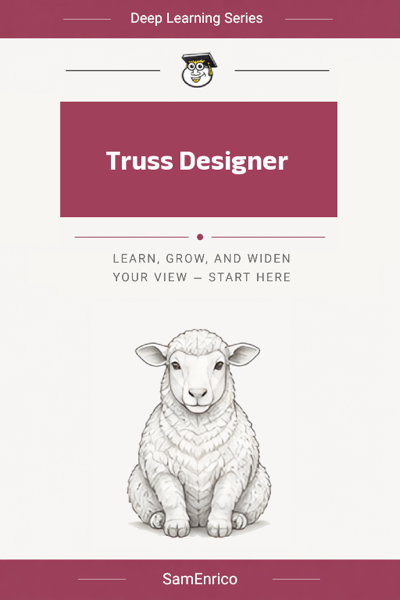
Non-FictionInformativeEducational
Truss Designer Audiobook
A Coursebook on Truss Designer
by Yost Carlota
A Coursebook on Truss Designer
Formats
Free sample
Chapter 1: The Triangle’s Secret...--–- In the winter of 1876, a railroad bridge across the Ashtabula River in Ohio carried a Lake Shore and Michigan Southern train carrying 159 passengers. The bridge was a Howe truss—a lattice of cast and wrought iron members arranged in a pattern of repeating triangles. It had been inspected just days earlier and declared sound. As the train reached mid-span, the bridge collapsed without warning, dropping locomotives and cars 70 feet into the frozen river. The subsequent investigation revealed that a single cast-iron tension member, poorly detailed at its connection, had snapped.
That one failure unzipped the entire structure because the triangles—so carefully designed—lost their geometry. The official report concluded: “The bridge was a study in the consequences of misunderstanding how forces move through triangulated forms.”This chapter establishes why the triangle is the structural engineer’s most sacred shape and how it transforms the problem of spanning space. While a solid beam resists loads through internal bending moments—tension on one side, compression on the other, with shear stresses distributed throughout—a truss resolves all forces into axial tension or compression along individual members. That distinction is not academic. It is the difference between a structure that fights gravity by bending and a structure that fights gravity by channeling forces along discrete, predictable paths.
The triangle does not deform under load because its shape is inherently stable. A rectangle, by contrast, collapses into a parallelogram when pushed. Add a diagonal to that rectangle, creating two triangles, and the shape becomes rigid. That simple observation—geometry as structural logic—underpins every bridge, roof, crane boom, transmission tower, and space frame ever built.The chapter opens with the collapse at Ashtabula not as a morbid curiosity but as a warning. The engineers of 1876 understood triangulation.
They knew that a truss worked by converting bending into axial forces. What they underestimated was the critical importance of connections, the real-world behavior of pinned joints, and the consequences of load paths that deviate from geometric ideals. More than a century later, the same mistakes appear in forensic reports. The goal of this chapter is to give you a visceral understanding of why triangulation works, what assumptions you are allowed to make, and which assumptions will betray you if you apply them carelessly.The Fundamental Difference: Beams Versus Trusses A solid beam, whether made of steel, wood, or reinforced…
This is the end of the free sample. Get the Audiobook to keep going. Buy now
About this book
Details
- Author
- Yost Carlota
- Publisher
- SamEnrico
- Language
- English
- Genre
- Non-Fiction, Informative, Educational
- Released
- 2026-05-11
- Pages (approx.)
- 144
- Available as
- eBook, Audiobook

Listen in the VoxFlicks app
Audiobooks and audio dramas wherever you go. Sign in with your SamEnrico account and press play.
More by Yost Carlota
 Delegation for Event PlannersYost Carlota$11.99
 TM and Other MeditationsYost Carlota$11.99
 Home Preparation for Sale WorkbookYost Carlota$11.99
 Men's Leg Swelling Heart FailureYost Carlota$11.99
 Managing Workload Stress EffectivelyYost Carlota$11.99
 The CRISPR Code: How a Nobel-Winning Discovery Could Rewrite HumanityYost Carlota$11.99
 The Code Breaker: Alan Turing’s Secret War Against the EnigmaYost Carlota$11.99
 How to Become a Cake-press-operator HelperYost Carlota$11.99
 Vendor Audit Checklist PackYost Carlota$12.99
 Astrology App RetentionYost Carlota$12.99
 Understanding Chromosome 14q, Terminal DeletionYost Carlota$17.99
You may also like
 Hong Kong Handover 1997Dunn Johnnie$11.99
 Zumba For Postnatal Recovery CourseNeal Christian$11.99
 Zumba for BeginnersLadner Nikia$11.99
 YouTube Comment Mining GuideHumes Pandora$12.99
 Worry Box MeditationCarlin Rudy$11.99
 Workplace Stress MeditationNguyen Lynn$11.99
 Workplace Stress and Sleep RepairHawley Ivory$11.99
 Workplace Perfectionism CureDelaney Jeffry$11.99
 Workplace Injustice Anger GuideWallen Isabelle$11.99
 Work Addiction and Burnout LinkGreenwood Ester$11.99
 Women in Yoga and WellnessBeattie Galina$11.99
 Women in Stand Up ComedyChun Evangeline$11.99