
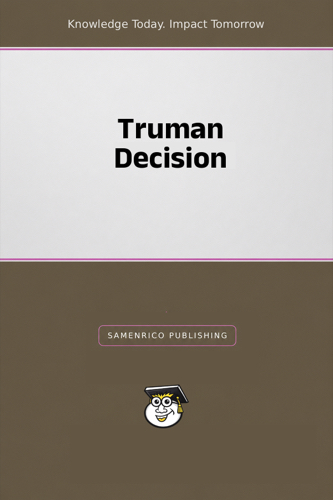
Non-FictionBiographyPresidential
Truman Decision eBook
Reveals the atomic bomb decision and whistle stop
by Getz Cordie
Reveals the atomic bomb decision and whistle stop campaign.
Formats
Free sample
Chapter 1: The Weight of Silence...--April 12, 1945, began like any other Thursday for Harry S. Truman. He had been Vice President of the United States for eighty-two days, a period so devoid of meaningful responsibility that he later joked his primary duty was to preside over the Senate and "listen to a lot of windy oratory." At 5:00 PM, he accepted an invitation from Speaker of the House Sam Rayburn for a bourbon and water at Rayburn's hideaway office, a cramped room known as the "Board of Education" where powerful men gathered to drink and gossip. Truman arrived at 6:15 PM, loosened his tie, and settled into a worn leather chair. Someone mentioned that President Franklin Delano Roosevelt had gone to Warm Springs, Georgia, for rest.
Truman nodded. He had spoken to FDR exactly twice since becoming Vice President, and neither conversation had lasted more than fifteen minutes. He was not expecting a phone call.At 7:25 PM, a White House operator reached him. "The President is dead," she said. Truman thought she meant FDR's assistant, Edwin "Pa" Watson, who had recently suffered a stroke.
"No," the operator insisted. "The President. The President of the United States." Truman sat in stunned silence. Rayburn later recalled that Truman's face went gray, then white, then gray again. He stood up, reached for his hat, and said, "The President is dead.
I have to go to the White House."The drive across Washington was surreal. Truman did not know that Eleanor Roosevelt had already sent a telegram to her children, or that the wires were buzzing with rumors of an assassination, or that millions of Americans would learn of FDR's death from a commercial break on the radio. He knew only that he was about to become the thirty-third President of the United States, and he was utterly unprepared.The Transfer of Power At 7:45 PM, Truman arrived at the White House. Eleanor Roosevelt met him in the main hallway. She looked smaller than he remembered, her famous composure held together by a thread.
"Harry," she said, placing a hand on his arm, "the President is dead. He died this afternoon of a cerebral hemorrhage." Truman asked if there was anything he could do for her. Eleanor famously replied, "Is there anything we can do for you? For you are the one in trouble now."The words landed like a physical blow. Truman later wrote that he felt "like the moon, the stars, and all the planets had fallen on me." At 8:00 PM, Chief Justice Harlan F.
Stone arrived to administer the oath of office. The ceremony took just two minutes. Truman stood with his hand on a Bible opened to the Sermon on the Mount, repeated the words, and became President. No cameras captured the moment. No crowd cheered.
A handful of staffers watched in silence.At 8:15 PM, Truman called his mother in Grandview, Missouri. "The President is dead," he said. His mother, a sharp-tongued ninety-two-year-old who had never much liked FDR, replied, "I'm sorry, Harry. I'm sorry for the country." Truman did not sleep that night. He sat in his new office, now empty of FDR's memorabilia but still thick with the scent of the dead man's cigarette smoke, and tried to understand what he had inherited.He did not know about the atomic bomb.
He did not know that American forces were planning an invasion of Japan that would cost an estimated one million lives. He did not know that the Soviet Union was already positioning itself for postwar dominance. He knew only that he was a former haberdasher from Missouri, a failed businessman who had clawed his way through the corrupt Pendergast machine to the Senate, and a Vice President who had been deliberately excluded from nearly every major decision of the war.The Missouri Farm Boy To understand why Truman was so unprepared, one must first understand how unlikely his presidency truly was. Harry S. Truman was born on May 8, 1884, in Lamar, Missouri, a town so small that the census recorded 850 residents.
His parents, John and Martha Truman, were farmers who moved the family repeatedly in search of better land. The young Harry wore thick glasses after a childhood bout of diphtheria left him with severely impaired vision—glasses so thick that he could not participate in sports, so thick that other children called him "Four Eyes," so thick that he spent his childhood reading rather than playing.He graduated from high school in 1901, but his family lacked the money for college. Instead, he worked a series of clerical jobs in Kansas City, then returned to the family farm for a decade. At thirty, he married Bess Wallace, the daughter of a prominent Independence family, and opened a haberdashery in Kansas City with a friend named Eddie Jacobson. The store did well for two years, then collapsed in the postwar recession of 1921-1922.
Truman was forty years old, deeply in debt, and without a profession. He had failed at business. He had failed at farming. He had no law degree, no military academy pedigree, no family fortune. He had only the connections he had made in the local Democratic Party—connections that led him to a man named Tom Pendergast.Pendergast was the boss of Kansas City's Democratic machine, a political operator who controlled votes through patronage, gambling, and, some said, violence.
In 1922, Pendergast needed a candidate for a minor county judgeship. He chose Truman because he was honest enough to win votes but pliable enough to take orders. Truman won. He spent the next decade as a Pendergast judge, learning the machinery of local government, before winning a Senate seat in 1934 with the machine's backing.The Senate was a shock. Truman arrived as "the Senator from Pendergast," a political hack whose only qualification was loyalty.
The eastern establishment dismissed him. Journalists mocked his bow ties and his habit of rising at 5:00 AM to walk three miles before breakfast. But Truman worked. He served on the Interstate Commerce Committee, investigating railroad monopolies. He became known for his meticulous preparation, his photographic memory for facts, and his refusal to take campaign contributions from lobbyists.
By 1940, when Pendergast went to prison for tax evasion, Truman had already built his own reputation. He won reelection without the machine's help.The Vice Presidency That Wasn't In 1944, Franklin Roosevelt needed a new Vice President. His previous vice president, Henry Wallace, was considered too liberal by party leaders. Roosevelt, already showing signs of the heart disease that would kill him, chose Truman as a compromise—someone who would not alienate the conservative wing of the party, someone who would do no harm. Truman was not the first choice, nor the second, nor the third.
He was the acceptable fallback.The campaign was a blur. Truman delivered 214 speeches across thirty-four states, rarely mentioning his own views because he had not been consulted on any major policy. When reporters asked about the war, he repeated what he had been told: things were going well, the enemy was weakening, the Allies would prevail. He did not know about the Manhattan Project. He did not know that American scientists were racing to build a bomb that would change the nature of warfare forever.
He did not know because no one had told him.The inauguration took place on January 20, 1945. Truman took the…
This is the end of the free sample. Get the eBook to keep going. Buy now
About this book
Details
- Author
- Getz Cordie
- Publisher
- SamEnrico
- Language
- English
- Genre
- Non-Fiction, Biography, Presidential
- Released
- 2026-06-06
- Pages (approx.)
- 126
- Available as
- eBook, Audiobook

Read better in the ZLOADR app
Your eBooks on your phone or tablet. Sign in with your SamEnrico account and start reading.
More by Getz Cordie
 Relationship Building for EngineersGetz Cordie$11.99
 Social Skills EQ DevelopmentGetz Cordie$11.99
 Loneliness Astronomy Club GuideGetz Cordie$11.99
 Addressing Poor PerformanceGetz Cordie$11.99
 Real Estate Capital DeploymentGetz Cordie$11.99
 Preventing Architectural BurnoutGetz Cordie$11.99
 Hypnosis Research GuideGetz Cordie$11.99
 Hypnotic Visualization TrainingGetz Cordie$11.99
 When the Sky Split: The Maori Birth of Te Ao MāramaGetz Cordie$11.99
 The Banquet of the Medici: Feasting with Florence's Renaissance TitansGetz Cordie$11.99
 The Ghost of the Kremlin: How a Double Agent Outplayed the Cold WarGetz Cordie$11.99
 Prompting for System Architecture DesignGetz Cordie$11.99
You may also like
 Hong Kong Handover 1997Dunn Johnnie$11.99
 Zumba For Postnatal Recovery CourseNeal Christian$11.99
 Zumba for BeginnersLadner Nikia$11.99
 YouTube Comment Mining GuideHumes Pandora$12.99
 Worry Box MeditationCarlin Rudy$11.99
 Workplace Stress MeditationNguyen Lynn$11.99
 Workplace Stress and Sleep RepairHawley Ivory$11.99
 Workplace Perfectionism CureDelaney Jeffry$11.99
 Workplace Injustice Anger GuideWallen Isabelle$11.99
 Work Addiction and Burnout LinkGreenwood Ester$11.99
 Women in Yoga and WellnessBeattie Galina$11.99
 Women in Stand Up ComedyChun Evangeline$11.99