
Non-FictionHealth & WellnessHormone Therapy
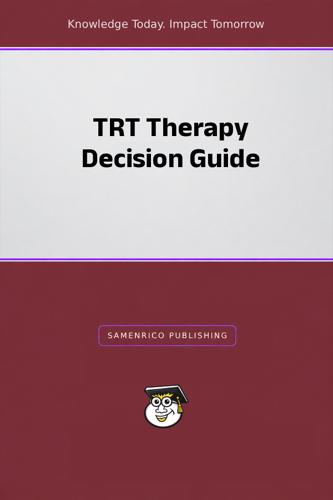
TRT Therapy Decision Guide eBook
Evaluate the pros and cons of testosterone replace
Evaluate the pros and cons of testosterone replacement therapy for symptomatic deficiency.
Formats
Free sample
Chapter 1: Beyond the Number--The first thing you need to unlearn is that testosterone replacement therapy is about a number on a lab report.Walk into any men's health forum, social media group, or anti-aging clinic waiting room, and you will hear the same question repeated like a mantra: "What's your total testosterone?" Men compare their levels the way teenagers compare video game scores. Four hundred nanograms per deciliter is dismissed as "low-normal." Six hundred is respectable. Eight hundred or above is the holy grail. And anyone below three hundred is immediately told to find a doctor who will prescribe injections by the end of the week.This obsession with a single number has caused more harm than good. It has led healthy men with perfectly adequate testosterone levels to believe they are deficient.
It has led symptomatic men with numbers in the "normal" range to be denied treatment that could transform their lives. And it has created a generation of patients who can recite their total testosterone from memory but cannot name a single symptom of hypogonadism beyond "low T."This chapter will dismantle that framework.You will learn what hypogonadism actually means, how to distinguish primary from secondary causes, and why two men with identical testosterone levels can have completely different experiences of the condition. You will learn to recognize the specific symptoms that matter—not vague "low energy" but measurable, observable changes in libido, mood, cognition, and physical function. You will understand the placebo effect and why it complicates every conversation about testosterone. And you will meet two forty-five-year-old men with the exact same total testosterone of 320 nanograms per deciliter—one who thrives on TRT and one who feels nothing at all.By the end of this chapter, you will never ask "What's your number?" again.
You will ask the only question that matters: "What are your symptoms, and how are they affecting your life?"What Hypogonadism Actually Means The word hypogonadism sounds clinical and intimidating, but its meaning is straightforward. Hypo means low or deficient. Gonadism refers to the gonads—the testicles in men, the ovaries in women. Hypogonadism, then, is a condition in which the gonads produce insufficient amounts of sex hormones: testosterone in men, estrogen in women.But this simple definition conceals a crucial distinction. There are two types of hypogonadism, and they are treated very differently.Primary hypogonadism means the testicles themselves are the problem.
They have been damaged, underdeveloped, or have failed for reasons that may be genetic, traumatic, infectious, or idiopathic (meaning no identifiable cause). In primary hypogonadism, the brain—specifically the hypothalamus and pituitary gland—is doing its job correctly. It sends luteinizing hormone (LH) and follicle-stimulating hormone (FSH) to the testicles, signaling them to produce testosterone and sperm. But the testicles cannot respond adequately. As a result, LH and FSH levels are high or high-normal, while testosterone remains low.
This is sometimes called hypergonadotropic hypogonadism because the gonadotropins (LH and FSH) are elevated.Common causes of primary hypogonadism include Klinefelter syndrome (an extra X chromosome), mumps orchitis (viral infection of the testicles), testicular trauma or torsion, chemotherapy or radiation exposure, and undescended testicles that were not corrected in childhood. In many cases, no cause is ever found.Secondary hypogonadism means the problem lies in the brain. The hypothalamus or pituitary gland fails to produce or release the hormones that stimulate the testicles. Gn RH (gonadotropin-releasing hormone) from the hypothalamus, or LH and FSH from the pituitary, are low or inappropriately normal despite low testosterone. This is sometimes called hypogonadotropic hypogonadism because the gonadotropins are low.Secondary hypogonadism is far more common than primary hypogonadism, especially in men over thirty.
Its causes include obesity, type 2 diabetes, chronic stress, sleep deprivation, opioid use, high-dose corticosteroid use, prolactin-secreting pituitary tumors (prolactinomas), and genetic conditions like Kallmann syndrome (which also involves an absent sense of smell). In many cases, the cause is simply aging combined with lifestyle factors—a phenomenon sometimes called late-onset hypogonadism.Why does this distinction matter? Because treatment differs. Primary hypogonadism almost always requires testosterone replacement therapy, since the testicles cannot be "awakened" by other means. Secondary hypogonadism can sometimes be reversed by addressing the underlying cause—weight loss, stress reduction, discontinuing opioids—or treated with medications like clomiphene or enclomiphene that stimulate the brain to produce more LH and FSH, which then stimulate the testicles.
Jumping straight to testosterone injections without determining the type of hypogonadism is like replacing an engine without checking whether the fuel line is disconnected.The Symptom List That Actually Matters Testosterone influences dozens of physiological processes, but when men become deficient, a specific cluster of symptoms emerges. These are not vague or subjective complaints. They are measurable, observable, and deeply disruptive to quality of life.Low libido is the most well-known symptom, but it is also the most misunderstood. Low libido does not mean occasionally not feeling in the mood. It means a persistent, weeks-to-months-long absence of spontaneous sexual thoughts, fantasies, and desires.
The man who still wants sex when his partner initiates but never thinks about it on his own may have low libido. The man who still masturbates regularly but feels less intense pleasure may have low libido. A classic sign is the disappearance of morning erections—nocturnal penile tumescence, which occurs during REM sleep, is largely driven by testosterone. Zero morning erections over several weeks is a red flag.Unexplained fatigue is another cardinal symptom, but it is often dismissed as "just getting older" or "being busy." Testosterone deficiency causes a specific kind of fatigue: the kind that does not improve with sleep. A man with low T can sleep nine hours, wake up, and feel like he never went to bed.
Afternoon crashes are severe. Exercise that used to feel invigorating now feels exhausting. This is not ordinary tiredness. It is a bone-deep, unshakable weariness that coffee and naps cannot fix.Brain fog is the cognitive manifestation of low testosterone. Men describe it as a slowing of thought, difficulty finding words, losing the thread of conversation, and an inability to focus on complex tasks.
Reading a book becomes difficult. Following a movie plot becomes a chore. Work that once required sharp analysis now feels like wading through mud. This symptom is particularly distressing because men often fear they are developing early dementia or experiencing premature cognitive decline. In many cases, testosterone replacement reverses the fog within weeks.Mood instability in hypogonadal men often presents as irritability rather than depression.
The classic description is "everything gets on my nerves." Small annoyances—a slow driver, a noisy neighbor, a partner asking a simple question—trigger disproportionate anger or frustration. Some men experience true depression: anhedonia (inability to feel pleasure), social withdrawal, and passive suicidal ideation. Others experience anxiety, particularly social anxiety or a sense of impending doom without a clear trigger. The relationship between testosterone and mood is bidirectional: low testosterone causes mood symptoms, and chronic stress (which raises cortisol) suppresses testosterone.Reduced muscle mass and strength is the symptom most closely tied to testosterone's anabolic effects. Men with low T lose muscle despite continued exercise.
Their bench press stalls or declines. Their arms and shoulders look smaller. They feel "soft" even when they are not…
This is the end of the free sample. Get the eBook to keep going. Buy now
About this book
Details
- Author
- Rosado Ashely
- Publisher
- SamEnrico
- Language
- English
- Genre
- Non-Fiction, Health & Wellness, Hormone Therapy
- Released
- 2026-06-08
- Pages (approx.)
- 148
- Available as
- eBook, Audiobook

Read better in the ZLOADR app
Your eBooks on your phone or tablet. Sign in with your SamEnrico account and start reading.
More by Rosado Ashely
 Order Solar Telescope Death Transit Ritual CourseRosado Ashely$11.99
 Bedtime Loneliness GuideRosado Ashely$11.99
 Emotional Regulation LifespanRosado Ashely$11.99
 Mindfulness for Empath BurnoutRosado Ashely$11.99
 The Ballot That Broke the Internet: The 2000 Florida Recount & the Birth of Digital MisinformationRosado Ashely$11.99
 The Rendlesham Radio Silence: When the U.S. Military Encountered the UnknownRosado Ashely$11.99
 How to Start a Portable Wooden Buildings Business (Beginners Guide)Rosado Ashely$11.99
 Dubai Student Emergency ContactsRosado Ashely$12.99
 NSF Graduate Fellowship ProposalRosado Ashely$12.99
 Content Production PipelinesRosado Ashely$11.99
 Understanding Ceroid Lipofuscinois, Neuronal 3, JuvenileRosado Ashely$17.99
You may also like
 Hong Kong Handover 1997Dunn Johnnie$11.99
 Zumba For Postnatal Recovery CourseNeal Christian$11.99
 Zumba for BeginnersLadner Nikia$11.99
 YouTube Comment Mining GuideHumes Pandora$12.99
 Worry Box MeditationCarlin Rudy$11.99
 Workplace Stress MeditationNguyen Lynn$11.99
 Workplace Stress and Sleep RepairHawley Ivory$11.99
 Workplace Perfectionism CureDelaney Jeffry$11.99
 Workplace Injustice Anger GuideWallen Isabelle$11.99
 Work Addiction and Burnout LinkGreenwood Ester$11.99
 Women in Yoga and WellnessBeattie Galina$11.99
 Women in Stand Up ComedyChun Evangeline$11.99