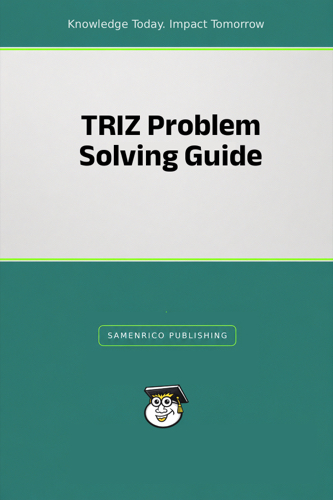
TRIZ Problem Solving Guide eBook
Apply engineering contradiction matrix to any fiel
by Caswell Mica
Apply engineering contradiction matrix to any field.
Formats
Free sample
Chapter 1: The Welder’s Secret--–- In 1946, a 20-year-old patent examiner named Genrich Altshuller sat in a cramped office in Baku, Azerbaijan, surrounded by stacks of Soviet patent applications. His job was to classify inventions—to decide which ideas were genuinely new and which were merely variations of existing patents. Most examiners saw this as bureaucratic tedium. Altshuller saw something else. As he read through thousands of applications, a pattern emerged that would challenge one of the most cherished beliefs of human civilization: the belief that creativity is a mysterious gift granted to a lucky few.The pattern was simple and devastating.
Altshuller noticed that the vast majority of patents—over 80 percent—were not breakthroughs at all. They were systematic, predictable, and repeatable solutions to the same basic types of problems. The inventors weren't geniuses. They were people who had learned, often unconsciously, to do one thing: eliminate contradictions. When Altshuller dug deeper, he found that the remaining 20 percent of patents—the genuine breakthroughs—also followed patterns.
There was no magic. There was only logic applied to conflict.This discovery was dangerous. In Stalin’s Soviet Union, the official ideology held that creativity was a product of the proletarian spirit, not a teachable skill. Altshuller wrote a letter to Stalin explaining his findings and suggesting that the USSR should teach inventive thinking systematically. The response was swift.
In 1950, Altshuller was arrested, accused of "inventing a machine for creating ideas"—a crime in a system that thrived on chaos and control. He was sentenced to 25 years in the Gulag.But even in the camps, Altshuller kept working. He interviewed fellow prisoners—engineers, physicists, and soldiers—collecting their inventive principles like seeds for a future garden. After his release in 1954, he spent the next three decades codifying what he had learned into a systematic methodology. He called it TRIZ—a Russian acronym for the Theory of Inventive Problem Solving.
At its heart was a simple but radical idea: every problem is a contradiction, and every contradiction has been solved before.Here is the secret that Altshuller discovered, the secret that this entire book is built upon: There is no such thing as a trade-off. There are only contradictions waiting to be eliminated.Everything you believe about "you can't have it all" is wrong.The Lie of "You Can’t Have It All"Close your eyes for a moment and think about the last time you accepted a trade-off. Perhaps you were a manager who chose speed over quality because the deadline was impossible. Perhaps you were a parent who chose safety over freedom because the world felt dangerous. Perhaps you were an entrepreneur who chose low cost over high features because your budget was tight.In every case, someone—maybe your boss, maybe your industry, maybe your own tired brain—told you that trade-offs are inevitable.
"You can't have fast and good." "You can't have cheap and reliable." "You can't have secure and easy to use." These phrases are so common that we have stopped questioning them. They have become the furniture of our thinking, the background noise of decision-making.But here is the truth that Altshuller’s 200,000 patents reveal: trade-offs are not laws of physics. They are failures of imagination.A trade-off is what you accept when you stop looking for a better answer. A contradiction is what you solve when you refuse to accept the trade-off. The difference between the two is not in the problem—it is in the person looking at the problem.Consider this: For centuries, sailors faced an impossible trade-off.
They needed ships that were strong enough to survive storms but light enough to move quickly. Every shipbuilder believed that you had to choose—heavy and safe, or light and fast. Then someone asked a different question: "What if the ship changed its properties depending on the conditions?" The result was the sliding keel, the centerboard, and eventually the modern sailboat—a vessel that is simultaneously heavy (when it needs stability) and light (when it needs speed) because it changes its configuration in real time. The trade-off was never real. It was a limitation of thinking, not a limitation of physics.This book is about learning to see the invisible third option in every conflict.What This Chapter Will Teach You By the end of this chapter, you will understand:Why most problems remain unsolved not because they are hard, but because we name them incorrectly The difference between a complaint, a problem, and a contradiction—and why only one of them can be solved The three-step translation method that converts any frustration into a solvable contradiction Why the same 40 principles appear in everything from jet engines to jury deliberations How a patent examiner from Baku became the most important thinker you have never heard of But more importantly, by the end of this chapter, you will have solved a problem that you have been carrying for months or years.
Not because I am brilliant, but because you will stop looking for a trade-off and start looking for the contradiction.Let us begin.The First Mistake: Naming the Wrong Thing There is a scene in the movie Apollo 13 that captures the essence of TRIZ better than any textbook. The astronauts are losing oxygen. The carbon dioxide filters are failing. The engineers at Mission Control have a box of random spacecraft parts—hoses, duct tape, plastic bags, and filters that don't fit the system. The problem seems impossible.
They need to connect a square filter to a round hole, but they have no adapters.Then an engineer says something remarkable. He does not say, "We need a better filter." He does not say, "We need to redesign the system." Instead, he says, "We need to fit this square filter into this round hole using only the parts we have." He has just done the first and most important step of TRIZ: he has named the contradiction precisely.A complaint sounds like this: "This is impossible." A problem sounds like this: "The filters don't match." A contradiction sounds like this: "We need to connect a square component to a round component without any adapters, using only existing parts."Do you see the difference? The complaint stops thinking. The problem invites thinking but lacks direction. The contradiction gives you a precise target.
You cannot solve a complaint. You can barely solve a problem. But a contradiction? A contradiction is a puzzle, and puzzles have solutions.Most of us spend our lives at the level of complaints and problems. We say, "This project is a mess," or "My team is under-resourced," or "There aren't enough hours in the day." These statements feel true, but they are useless.
They describe a condition, not a conflict. They are weather reports, not engineering challenges.The TRIZ method demands that you translate every complaint into a contradiction. This is not a semantic trick. It is a cognitive shift. When you name a contradiction, you are forced to identify the two things that are actually in conflict.
And once you name those two things, you have a fighting chance of finding a solution that gives you both.The Three Layers of Naming In my work with…
This is the end of the free sample. Get the eBook to keep going. Buy now
About this book
Details
- Author
- Caswell Mica
- Publisher
- SamEnrico
- Language
- English
- Genre
- Non-Fiction, Self-Help, TRIZ
- Released
- 2026-06-09
- Pages (approx.)
- 146
- Available as
- eBook, Audiobook

Read better in the ZLOADR app
Your eBooks on your phone or tablet. Sign in with your SamEnrico account and start reading.
More by Caswell Mica
 Nose Touching DeceptionCaswell Mica$11.99
 Self Hypnosis for Tension HeadachesCaswell Mica$11.99
 Remote Work Tax GuideCaswell Mica$11.99
 Self Esteem for MinoritiesCaswell Mica$11.99
 Conversation Starters for ConcertsCaswell Mica$11.99
 Parental Anger After AdoptionCaswell Mica$11.99
 The Sultan's Stolen Steeds: The Crime That Sparked Ottoman ReformCaswell Mica$11.99
 Prototyping for StartupsCaswell Mica$11.99
 The Unseen Playbook: How Bill Belichick’s Obsession with Film Changed Football ForeverCaswell Mica$11.99
 WindsurfingCaswell Mica$11.99
 Launching A Youtube Channel For Your Brand FoundationsCaswell Mica$12.99
 Belgian ARES Scholarships GuideCaswell Mica$12.99