
Non-FictionHealth & WellnessPolyphasic Sleep
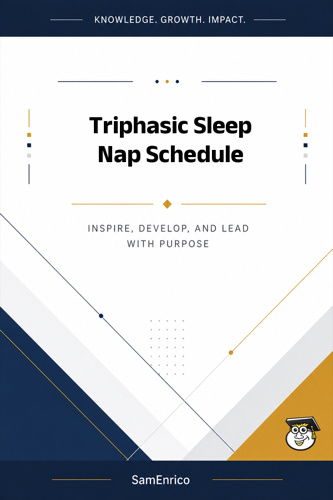
Triphasic Sleep Nap Schedule eBook
Distribute sleep across three daily naps for maxim
by Combs Wen
Distribute sleep across three daily naps for maximum waking hours.
Formats
Free sample
Chapter 1: The Segmented Inheritance--–- On a cold December night in 1992, sleep researcher Dr. Thomas Wehr did something that would upend a century of medical dogma. He locked six healthy male volunteers in a laboratory where darkness fell for fourteen hours each day. No electric lights. No screens.
No reading lamps. For twenty-eight days, the subjects experienced only natural light during the day and absolute darkness from dusk until dawn. What happened next was not supposed to be possible. Within two weeks, every single subject had spontaneously abandoned the monolithic eight-hour sleep block that modern medicine had declared biologically mandatory. Instead, they settled into a rhythm that looked nothing like what your doctor would recognize as normal sleep.Each night, these men slept in two distinct phases.
First sleep began approximately two hours after darkness fell and lasted roughly three to four hours. Then they woke – not groggy, not disoriented, but alert and calm – for a quiet waking period of one to three hours. During this interval, they lay in bed reading, talking softly, or simply reflecting. Then second sleep arrived, another three to four hour block, lasting until dawn. Not one subject returned to the consolidated eight-hour pattern.
Not one preferred it. When the experiment ended and electric lights were restored, the men reported feeling that segmented sleep was more natural, more restorative, and more satisfying than the compressed schedule modern life had forced upon them.Wehr's experiment rediscovered what your great-great-grandparents knew, what every pre-industrial culture practiced, and what your biology still remembers: human sleep is not, and was never meant to be, a single unbroken block of unconsciousness from midnight to dawn. The eight-hour monolith is a recent invention, a byproduct of factory whistles and electric light bulbs, not a biological mandate written into your DNA.This chapter dismantles the assumption that has governed your sleep choices since childhood. It traces how segmented sleep – the natural pattern of two or three distinct rest periods per day – was systematically erased from collective memory, replaced by a schedule optimized for industrial production rather than human biology. You will learn why the "eight hours straight" rule is younger than Coca-Cola, why your afternoon slump is not a failure of willpower but a vestigial echo of biphasic heritage, and how the triphasic schedule you are about to undertake is not a radical departure from nature but a return to it.
The cult of the monolith has held you captive for too long. It is time to understand why.The Invention of the Eight-Hour Block Before the Industrial Revolution, no culture on Earth treated consolidated nocturnal sleep as the only legitimate pattern. The historical record is unambiguous. In pre-industrial Europe, as documented by historian Roger Ekirch in his landmark work At Day's Close, the standard pattern was "first sleep" and "second sleep." Legal depositions, court records, and personal diaries from the Middle Ages through the eighteenth century routinely reference "first sleep" as a temporal landmark. People scheduled activities around it.
They described crimes occurring during "first sleep" or waking from "first sleep" to discover a fire, a birth, or an intruder. The phrase "first sleep" appears so frequently in medieval literature that its absence in modern vocabulary is evidence of a profound cultural amnesia.Consider the evidence. In Geoffrey Chaucer's The Canterbury Tales (circa 1380), one character describes lying in bed after "first sleep" contemplating a dream. In the medieval French romance Roman de la Rose, the narrator distinguishes between dreaming during "first sleep" and dreams that come after. Medical texts from the period, including those from the influential Salerno medical school, advised patients to rise after first sleep for prayer, digestion, or even sexual intercourse, which was believed to be most beneficial when undertaken during the waking interval between sleep segments.This pattern was not a quirk of European peasantry.
Anthropologist Carol Worthman documented identical segmented sleep patterns among the Ewe people of Togo and the !Kung San of the Kalahari. The Tiv people of Nigeria naturally divide their rest into afternoon naps (midday rest), evening sleep (dusk to midnight), and a dawn sleep segment (pre-dawn to sunrise). In all cases, total sleep time remains stable at seven to nine hours per day, but the distribution follows local environmental conditions – heat, predation risk, social obligations – rather than a rigid clock.The rupture came with light. Artificial illumination, first from gas lamps and then from Edison's incandescent bulb, did more than extend the working day. It fundamentally rewired the relationship between darkness and rest.
Before electric light, the average person slept approximately nine hours per night, distributed across two or three segments. By 1920, after just four decades of electric light, average sleep duration had dropped to seven and a half hours, compressed into a single block. The waking interval between first and second sleep – that quiet, reflective hour that Wehr's subjects reported as deeply satisfying – disappeared entirely, erased by the ability to illuminate the night and continue working, reading, or socializing.The Industrial Revolution accelerated this compression. Factory owners needed workers awake and alert for twelve to fourteen consecutive hours. A sleep schedule that included a midnight waking interval was inefficient.
A worker who naturally woke for an hour at 1 AM could not be trusted to return to sleep reliably, and that hour of wakefulness represented lost productivity. The solution was to pathologize segmented sleep. Medical manuals from the late nineteenth century began describing "broken sleep" as a disorder, a sign of nervous weakness or moral failing. By the 1920s, the consolidated eight-hour block had become not just the norm but the ideal – a mark of civilization's triumph over primitive, fragmented biology.The Consolidated Sleep Myth The eight-hour block rests on three foundational assumptions, none of which survive scrutiny. The first assumption is that consolidated sleep is evolutionarily ancient.
It is not. The evidence for segmented sleep stretches back through recorded history and into prehistory. Archaeological studies of ancient sleeping arrangements – the size and layout of sleeping platforms, the positioning of hearths, the presence of barriers between sleeping areas – suggest that early humans slept in short bursts timed to environmental threats rather than one long block. The consolidated block is a modern artifact, not a biological inheritance.The second assumption is that waking during the night is a sign of sleep pathology. This assumption has caused immense harm.
Millions of people who naturally wake for thirty to sixty minutes in the middle of the night have been diagnosed with "sleep maintenance insomnia" and prescribed sedatives, cognitive behavioral therapy, and anxiety medications. Yet Wehr's subjects, when returned to a natural light-dark cycle, all exhibited this exact waking pattern – and none experienced it as distressing. They described the waking interval as peaceful, productive, and restorative. The problem is not waking. The problem is believing that waking is a problem.The third assumption is that sleep quality is measured by continuity.
Sleep medicine has historically treated sleep fragmentation as inherently pathological, but this confuses cause and effect. Chronic fragmentation caused by sleep apnea, restless leg syndrome, or pain is indeed harmful. But the intentional, predictable segmentation that characterized pre-industrial sleep produces no such harm. In Wehr's experiment, subjects showed no elevation in cortisol, no impairment in…
This is the end of the free sample. Get the eBook to keep going. Buy now
About this book
Details
- Author
- Combs Wen
- Publisher
- SamEnrico
- Language
- English
- Genre
- Non-Fiction, Health & Wellness, Polyphasic Sleep
- Released
- 2026-06-05
- Pages (approx.)
- 152
- Available as
- eBook, Audiobook

Read better in the ZLOADR app
Your eBooks on your phone or tablet. Sign in with your SamEnrico account and start reading.
More by Combs Wen
 Psychological Safety Creativity GuideCombs Wen$11.99
 Nonviolent Communication WorkbookCombs Wen$11.99
 Migraine Rescue Medications GuideCombs Wen$11.99
 Buy Me a Coffee StoryCombs Wen$11.99
 The Gift of TimeCombs Wen$11.99
 The Skin Stress Reaction HandbookCombs Wen$11.99
 Blue Zone Olive OilCombs Wen$11.99
 The Wellness Retreat PrisonCombs Wen$11.99
 The Radiocarbon Revolution: Unlocking the Secrets of the Pacific's Lost CivilizationsCombs Wen$11.99
 The Golden Age of Athens: Socrates, Plato, and the Birth of Western ThoughtCombs Wen$11.99
 Operation Midnight Sun: The Secret Cyberwar That Almost Changed a U.S. ElectionCombs Wen$11.99
 Career Development and Employability SkillsCombs Wen$11.99
You may also like
 Hong Kong Handover 1997Dunn Johnnie$11.99
 Zumba For Postnatal Recovery CourseNeal Christian$11.99
 Zumba for BeginnersLadner Nikia$11.99
 YouTube Comment Mining GuideHumes Pandora$12.99
 Worry Box MeditationCarlin Rudy$11.99
 Workplace Stress MeditationNguyen Lynn$11.99
 Workplace Stress and Sleep RepairHawley Ivory$11.99
 Workplace Perfectionism CureDelaney Jeffry$11.99
 Workplace Injustice Anger GuideWallen Isabelle$11.99
 Work Addiction and Burnout LinkGreenwood Ester$11.99
 Women in Yoga and WellnessBeattie Galina$11.99
 Women in Stand Up ComedyChun Evangeline$11.99