
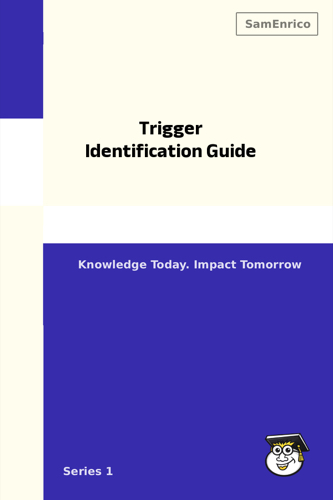
Trigger Identification Guide eBook
undefined
by Reno Lupita
undefined
Formats
Free sample
Chapter 1: The Triggered Lie--You have used the word “triggered” to describe a rude email, a slow internet connection, a political opinion you disagreed with, or a friend who forgot to text you back. That is like using the word “earthquake” to describe a spilled drink. The word has not just been overused—it has been hollowed out, gutted of its clinical meaning, and turned into a punchline. And that casual misuse has caused real harm, not just to the word itself but to the people who genuinely experience neurobiological triggers as part of their daily survival.This chapter exists to take the word back.If you are reading this book, you have likely experienced moments when your reaction did not fit the room. Someone said something small—a tone of voice, a sideways glance, a single word—and suddenly you were not yourself anymore.
Your heart pounded. Your vision narrowed. Your mouth moved before your brain could catch up. Hours later, lying in bed, you replayed the scene and asked yourself the question that haunts every triggered person: Why did I do that? That wasn’t me.Here is the answer that no one has given you: it was you, but it was not your present you.
It was a version of you that was activated by a sensory cue that bypassed your rational brain and connected directly to a much older, much more survival-oriented part of your nervous system. That is a trigger. Not an annoyance. Not an offense. Not a disagreement.
A true trigger is a neurobiological event—a sensory cue that activates the brain’s threat detection system so quickly and so completely that rational thought does not have time to intervene.This chapter dismantles the pop-culture misuse of the word “trigger” and restores its clinical and practical meaning. You will learn the critical difference between internal and external triggers, the concept of emotional time travel, and the liberating truth that being triggered is not a character flaw but a survival mechanism gone overboard. By the end of this chapter, you will never use the word “triggered” casually again—and more importantly, you will stop blaming yourself for reactions that were never entirely within your control.The Casualty of Casual Language Let us begin with a story about a woman named Maya. Maya is a thirty-four-year-old elementary school teacher. She loves her job.
She loves her students. She loves her principal, a kind and patient woman named Dr. Harris who has never raised her voice in Maya’s presence. But there is a problem. Every time Dr.
Harris says the phrase “we need to talk,” Maya bursts into tears. Not just watery eyes—full, heaving sobs that make her colleagues uncomfortable and leave her humiliated in the bathroom for twenty minutes afterward.Maya knows Dr. Harris is not a threat. She knows the conversation that follows “we need to talk” is almost always positive: a compliment, a new opportunity, a routine check-in. Maya has tried everything to stop the tears.
She has taken deep breaths. She has repeated mantras. She has clenched her fists until her nails left crescent moons in her palms. Nothing works. The tears come anyway, as predictable as sunrise.Here is what Maya did not know until she started the work you are about to do: her ex-husband, a man who caused her years of emotional pain, used the exact same phrase—“we need to talk”—before every difficult conversation in their marriage.
Before the affair was revealed. Before he asked for a separation. Before he told her he was moving out. Maya’s brain had encoded that phrase as a danger signal, and now, years later and miles away, her body did not know the difference between Dr. Harris and her ex-husband.Maya is not weak.
Maya is not broken. Maya is not “too sensitive.” Maya is having a neurobiological response to a sensory cue that her brain has classified as a threat. That is a trigger.Now consider how pop culture would describe Maya’s experience. A social media post might say she was “triggered by her boss.” A coworker might roll their eyes and mutter that Maya “needs to get over it.” A comment section might mock her for being “so easily triggered.” All of these responses miss the point entirely because they treat “triggered” as a synonym for “annoyed” or “offended” or “oversensitive.” But Maya is not annoyed. She is not offended.
She is having a physiological response that she cannot control through willpower alone.The casual misuse of the word “trigger” has done three specific kinds of damage. First, it has made it harder for people with genuine triggers to be taken seriously. When someone says “I was triggered” and means “I was mildly irritated,” they are crying wolf—and when the wolf actually arrives, no one listens. Second, it has led people like Maya to believe that their reactions are character flaws rather than biological events. If everyone else can hear “we need to talk” without crying, Maya concludes that something must be wrong with her.
Third, it has obscured the actual mechanism of triggers, leaving people without the vocabulary they need to understand and change their own responses.This chapter is the antidote to that damage. By the time you finish reading, you will have a precise, clinically accurate understanding of what a trigger actually is—and more importantly, what it is not.The Match and the Gasoline To understand triggers, you must first understand the critical distinction between external triggers and internal triggers. Most people focus exclusively on external triggers, and that is why most people fail to change their triggered responses.External triggers are the sensory cues that come from outside your body. They include:Specific sounds: a door slamming, a particular song, a tone of voice, a baby crying Specific sights: a certain color car, a familiar face, a type of clothing, a photograph Specific smells: cologne, perfume, cigarette smoke, a particular food cooking, the scent of rain on concrete Specific places: a street you used to live on, a doctor’s office, a restaurant, a family member’s house Specific people: their presence, their voice, even their name mentioned in conversation Specific dates: anniversaries, birthdays, holidays, the anniversary of a traumatic event External triggers are the match. They are visible, identifiable, and often predictable.
But a match alone cannot start a fire unless there is something flammable nearby.Internal triggers are the gasoline. They come from inside your body and include:Physical sensations: a racing heart, shallow breathing, a clenched jaw, a hollow stomach, a burning face, numb extremities Emotions: sudden fear, a wave of sadness, inexplicable anger, a rush of shame Thoughts: automatic negative thoughts, intrusive images, worst-case scenario predictions, memories that seem to come from nowhere Bodily states: hunger, exhaustion, hormonal fluctuations, illness, pain Here is the truth that most trigger literature avoids: external triggers are often beyond your control. You cannot prevent your boss from saying “we need to talk.” You cannot ensure that you never smell a certain cologne again. You cannot erase certain dates from the calendar. But internal triggers are different.
While you cannot eliminate them entirely, you can learn to recognize them early, and early recognition is the difference between…
This is the end of the free sample. Get the eBook to keep going. Buy now
About this book
Details
- Author
- Reno Lupita
- Publisher
- SamEnrico
- Language
- English
- Genre
- Non-Fiction, Self-Help / Triggers
- Released
- 2026-06-06
- Pages (approx.)
- 149
- Available as
- eBook, Audiobook

Read better in the ZLOADR app
Your eBooks on your phone or tablet. Sign in with your SamEnrico account and start reading.
More by Reno Lupita
 Partner Mirror Effect GuideReno Lupita$11.99
 Dark Therapy for RhythmReno Lupita$11.99
 Trauma Response Patterns HandbookReno Lupita$11.99
 DT Prevention Medical GuideReno Lupita$11.99
 Personal Brand ROI GuideReno Lupita$11.99
 Crime Insurance CoverageReno Lupita$11.99
 Cognitive Load ManagementReno Lupita$11.99
 The Court of Mozart: Music as RoyaltyReno Lupita$11.99
 The Forger’s Gamble: How a Japanese Master Tricked the Art World (1980s-1990s)Reno Lupita$11.99
 How to Become a Hat MakerReno Lupita$11.99
 How to Trade RiceReno Lupita$11.99
 A Collector's Handbook to the Aston Martin Db5Reno Lupita$11.99