
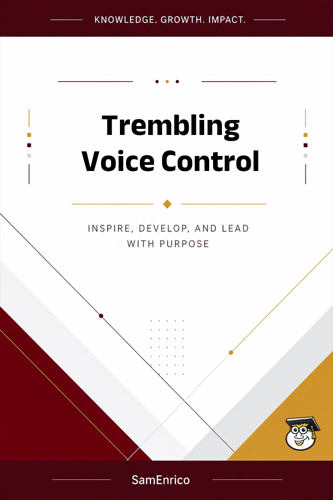
Non-FictionHealth & WellnessVoice
Trembling Voice Control eBook
Techniques to steady shaky voice during speaking.
Techniques to steady shaky voice during speaking.
Formats
Free sample
Chapter 1: The 200-Millisecond Betrayal...--–- You are standing at the front of a conference room. Forty-seven faces look up at you. The CEO is in the second row, arms crossed. You open your mouth to say your first word—your own name, the simplest sound in your vocabulary—and something goes wrong. Your voice does not emerge as a clean, steady tone.
It wavers. It trembles. It cracks on the vowel. You hear it happen in real time, that microsecond of vocal instability, and suddenly the forty-seven faces blur into a single judgmental mass. Your face flushes.
Your palms dampen. Your next word comes out even shakier than the first. By the third sentence, you are no longer present in the room; you are watching yourself fail from somewhere outside your body, and a voice in your head is already writing the ending: Everyone noticed. I sound weak. I should never speak in public again.If this scenario feels familiar, you are not weak.
You are not broken. You are not "just nervous." You are experiencing one of the most fundamental design flaws in the human nervous system: the 200-millisecond betrayal. That is how fast your amygdala—the brain's threat-detection center—can hijack your voice before your conscious mind even knows what is happening. Two-tenths of a second. Less time than it takes to blink.
In that window, your body decides that a room full of people is a survival threat equivalent to a predator, and it prepares you accordingly. Your heart rate spikes. Your breathing becomes shallow. And your vocal folds—those two small bands of muscle and tissue that must oscillate hundreds of times per second to produce speech—begin to spasm at an irregular, rapid frequency. That is the sound of a trembling voice.This book is not about "calming down." It is not about "thinking positive thoughts." It is not about the tired advice to imagine your audience in their underwear.
This book is about understanding why your voice trembles at the precise moment you need it to be steady, and then retraining the reflex that causes it. By the time you finish this chapter, you will understand the anatomy of a quiver, the difference between performance anxiety and stage fright, and why willpower will never stop a tremor—but retraining your nervous system absolutely can.The Anatomy of a Quiver: What Is Actually Happening in Your Throat Let us begin with the machinery of your voice. Your larynx, commonly called the voice box, sits at the top of your trachea, just behind your Adam's apple. Inside the larynx are two bands of tissue called the vocal folds (often mistakenly called vocal cords—they are not cords, they are layered structures of muscle, ligament, and mucosa). When you speak, air from your lungs travels upward, passes between these folds, and causes them to vibrate.
That vibration produces sound waves, which your tongue, lips, and palate then shape into consonants and vowels.For your voice to sound steady, your vocal folds need to vibrate at a consistent frequency—say, 120 times per second for an average male speaking voice, or 200 times per second for an average female voice. That is remarkably fast. A tremor occurs when those vibrations become irregular: the folds might vibrate at 120 Hz for a few cycles, then slow to 110 Hz, then speed up to 130 Hz, all within a single syllable. This rapid, involuntary fluctuation is what the human ear perceives as a shake, wobble, or quiver.Now, what causes these micro-spasms? The answer lies in the autonomic nervous system, specifically its sympathetic branch—the "fight-or-flight" response.
When your amygdala detects a threat, it sends an emergency signal to your hypothalamus, which activates your adrenal glands. Within seconds, epinephrine (adrenaline) floods your bloodstream. Adrenaline has many effects: it increases heart rate, dilates pupils, shunts blood toward large muscle groups, and—critically for our purposes—it causes small, involuntary muscle contractions throughout the body. Including the tiny intrinsic muscles inside your larynx.There are two sets of laryngeal muscles you need to know. The thyroarytenoid muscles run parallel to the vocal folds and shorten them, lowering pitch.
The cricothyroid muscles stretch the vocal folds, raising pitch. Under normal conditions, these muscles work in perfect coordination. Under an adrenaline surge, they begin to contract and release erratically, at a frequency of approximately 4 to 7 cycles per second. That is the neural signature of a vocal tremor. Your voice shakes because the muscles controlling it are receiving chaotic signals from a nervous system that believes you are in danger.Here is what most people get wrong about this process.
They assume that because the tremor feels psychological—because it only happens when they are nervous, because it disappears when they are alone—it must be something they can "think" their way out of. This assumption is false. The amygdala processes threats and initiates physical responses approximately 200 milliseconds faster than the prefrontal cortex—the conscious, reasoning part of your brain—can even register that a threat exists. By the time you think "I need to calm down," your vocal folds have already begun to tremor. Willpower arrives too late.
It is like trying to stop a sneeze after you have already inhaled. The reflex is already in motion.Performance Anxiety versus Stage Fright: Two Different Beasts One of the most important distinctions this book makes—a distinction that most public speaking guides blur or ignore entirely—is between performance anxiety and stage fright. These are not the same thing, and confusing them leads to ineffective solutions.Performance anxiety is the nervousness that builds in the minutes, hours, or even days before a speaking event. It is the butterflies in your stomach, the racing heart, the dry mouth, the repetitive loop of worst-case scenarios playing in your head. Performance anxiety is anticipatory.
It exists in the future: What if my voice cracks? What if I forget my words? What if they can tell I'm terrified? Performance anxiety can be managed with preparation techniques, breathing exercises, and cognitive reframing—all of which we will cover in later chapters.Stage fright, by contrast, is the acute freeze response that occurs during the act of speaking itself. It is not anticipatory; it is immediate.
Stage fright is your nervous system interpreting the present moment—the faces, the silence, the attention—as an active threat. Stage fright bypasses your conscious mind entirely. It is why otherwise confident people can rehearse a presentation perfectly in their hotel room at 7:00 AM and then, at 9:00 AM in the conference room, open their mouths to find that their voice has abandoned them.Here is the crucial insight: You can have performance anxiety without stage fright, and you can have stage fright without performance anxiety. Some speakers feel perfectly calm before they begin—no butterflies, no racing heart—and then, the moment they are on stage, their voice trembles uncontrollably. Others feel terrible for days in advance, but once they start speaking, the tremor vanishes.
Most people fall somewhere in between. The techniques in this book are designed to address both conditions, but the first step is knowing which one you are dealing with.Take a moment to assess your…
This is the end of the free sample. Get the eBook to keep going. Buy now
About this book
Details
- Author
- Westmoreland Twila
- Publisher
- SamEnrico
- Language
- English
- Genre
- Non-Fiction, Health & Wellness, Voice
- Released
- 2026-06-09
- Pages (approx.)
- 135
- Available as
- eBook, Audiobook

Read better in the ZLOADR app
Your eBooks on your phone or tablet. Sign in with your SamEnrico account and start reading.
More by Westmoreland Twila
 Fishing Boat Crew GapWestmoreland Twila$11.99
 Resentment After No ApologyWestmoreland Twila$11.99
 The Holy Order of MANSWestmoreland Twila$11.99
 The Workaholism and Depression GuideWestmoreland Twila$11.99
 Bloodline of the Sun: The Nepotism That Built an EmpireWestmoreland Twila$11.99
 How to Start a Cesspools Emptying and Cleaning Business (Beginners Guide)Westmoreland Twila$11.99
 Blockchain Freight DocumentationWestmoreland Twila$12.99
 Zero Audience Kindle Launch GuideWestmoreland Twila$12.99
 Understanding Leber's DiseaseWestmoreland Twila$17.99
 Claims ProcessingWestmoreland Twila$11.99
You may also like
 Hong Kong Handover 1997Dunn Johnnie$11.99
 Zumba For Postnatal Recovery CourseNeal Christian$11.99
 Zumba for BeginnersLadner Nikia$11.99
 YouTube Comment Mining GuideHumes Pandora$12.99
 Worry Box MeditationCarlin Rudy$11.99
 Workplace Stress MeditationNguyen Lynn$11.99
 Workplace Stress and Sleep RepairHawley Ivory$11.99
 Workplace Perfectionism CureDelaney Jeffry$11.99
 Workplace Injustice Anger GuideWallen Isabelle$11.99
 Work Addiction and Burnout LinkGreenwood Ester$11.99
 Women in Yoga and WellnessBeattie Galina$11.99
 Women in Stand Up ComedyChun Evangeline$11.99