
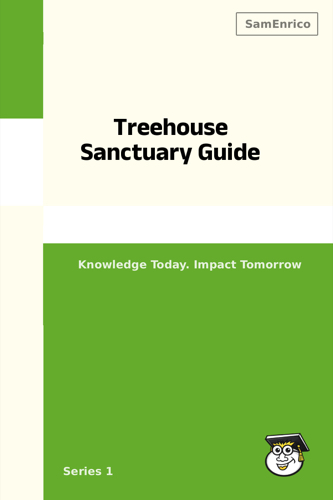
Treehouse Sanctuary Guide eBook
Climb into a cozy treehouse above the forest floor
Climb into a cozy treehouse above the forest floor, hidden and safe.
Formats
Free sample
Chapter 1: The Anxiety Escape--–- The first time I climbed into a treehouse as an adult, I wasn't looking for nostalgia. I was looking for a place where my phone couldn't find me, where my to-do list couldn't follow, and where the low-grade hum of anxiety that had become my baseline might finally quiet. I found a rotted 4x4 platform in a friend's backyard oak, held together by rusted nails and hope. I sat there for forty-five minutes, feet dangling, saying nothing. When I climbed down, my shoulders had dropped two inches.
That was the moment I stopped believing treehouses were for children.The question this book answers is simple: Why does being ten feet off the ground change how you feel? And the follow-up question, the one that turns curiosity into action: How do you build one for yourself, hidden and safe, without being a master carpenter or winning the lottery?The Call of the Canopy is not a metaphor. It is a physiological fact. When you leave the ground floor—the domain of bills, email, laundry, and the endless performance of adult competence—your nervous system begins to downshift. The sympathetic branch (fight or flight) hands the wheel to the parasympathetic branch (rest and digest).
Your breathing deepens because you are no longer bracing against the weight of the ceiling above you. Your peripheral vision expands because you are now an observer rather than a participant. You are, for the first time in maybe years, simply there.This book is not a standard DIY manual. It will not teach you how to build a luxury treehouse with plumbing, electricity, and a wet bar. Those books already exist, and they are written for people who own construction companies or have recently sold a startup.
This book is for the rest of us. It is for the burned-out nurse, the remote worker whose home office has become a prison cell, the parent who needs twenty minutes of silence to remember who they are, and the person who has simply looked at a tree and thought: I want to be up there, and I want no one to know.We will call this kind of place a sanctuary. Not a playhouse, not an office, not a guest room in the air. A sanctuary is quiet, protective, intentional, and adult. It does not need Wi Fi.
It does not need a mini-fridge. It does not need to impress anyone. It needs to hold you, and only you, and ask nothing in return.Let me tell you who this book is for. It is for Sarah, a hospice nurse in Ohio who built a 4x4 platform in a red oak behind her garage after a patient told her, "You give everyone else peace. Who gives it to you?" It is for Marcus, a video game designer in Oregon who realized he had not looked at a horizon line in three years.
It is for Priya, a single mother of twins who built a six-foot-square pod just tall enough to stand in, because it was the only place in her life where no one needed anything from her. These are real people. Their treehouses are not magazine spreads. They are crooked, salvaged, beautiful, and exactly enough.By the end of this chapter, you will write a one-sentence sanctuary statement that names exactly how you want to feel when you climb up. That sentence will be the spine of everything that follows.
It will determine how big you build, where you hide, what you put inside, and how fiercely you protect the place from the demands of the world.Let us begin.The Psychology of Height: Why Your Brain Changes in the Air We do not normally think of elevation as a psychiatric intervention. But the research is clear and compelling. Studies on forest bathing (shinrin-yoku) in Japan have demonstrated that time spent beneath a canopy of trees reduces cortisol levels by an average of 12 to 16 percent. Blood pressure drops. Heart rate variability—a key marker of nervous system resilience—improves.
But those studies were conducted on the ground. What happens when you add another ten to fifteen feet of vertical separation?The answer comes from an unexpected field: evolutionary biology. Human beings are descended from arboreal primates who spent millions of years sleeping, eating, and躲避 predators in trees. Your brain is still wired to interpret height as safety. A raised platform offers a 360-degree view of approaching threats.
It removes you from the path of ground-based dangers—flood, large animals, unwelcome visitors. It creates a single point of access that can be controlled (a ladder, a rope, a trap door). In short, your body remembers something your conscious mind has forgotten: up is safe.But the psychological benefits go beyond ancient wiring. Height creates passive surveillance without responsibility. On the ground, you are a participant in your environment.
You dodge, negotiate, respond, react. At height, you become an observer. The world continues below you—cars pass, children play, wind moves through lower branches—but you are not required to engage with any of it. This is the opposite of the hypervigilance that characterizes modern anxiety. Hypervigilance says everything is a potential threat.
The canopy says nothing up here requires your reaction.I have sat in dozens of treehouses with first-time builders, and I have watched the same transformation happen every time. For the first five minutes, they check their phones. Then they put the phones down because there is no signal or because the screen looks ridiculous against the bark. Then they look at the horizon. Then they exhale.
Then they say something like, "Oh. That's what quiet sounds like."This is not escapism. Escapism runs from something. The treehouse sanctuary runs toward something: a version of yourself that is not defined by productivity, obligation, or performance. It is a retreat in the most literal sense—a place to pull back the arrow of your attention and let it rest.Sanctuary vs.
Playhouse: The Crucial Distinction Before we talk about trees and bolts and roofs, we must talk about intention. A surprising number of treehouse books collapse under the weight of a single unexamined assumption: that a treehouse is inherently a place of joy. Joy is fine. Joy is wonderful. But joy is not sanctuary.
Joy is loud, energetic, social, and temporary. Sanctuary is quiet, solitary, stable, and enduring.I want you to imagine two structures. Both are ten feet off the ground. Both are built in healthy oaks. Both have ladders and railings.
But they are not the same thing.The playhouse has a rope swing, a slide, a flag, and enough room for four children to bounce around. It is painted primary colors. It has a bucket for toys and a sign that says "No Grownups Allowed." It is wonderful for birthday parties and summer afternoons. It is also abandoned by October, vandalized by teenagers by March, and dismantled by the following summer when the family moves or the children discover video games.The sanctuary has a single chair, a small shelf for a book, and a window cut to frame exactly one view—maybe a creek, maybe a distant ridge, maybe just the way…
This is the end of the free sample. Get the eBook to keep going. Buy now
About this book
Details
- Author
- Corrigan Taneka
- Publisher
- SamEnrico
- Language
- English
- Genre
- Non-Fiction, Self-Help, Childhood
- Released
- 2026-06-08
- Pages (approx.)
- 134
- Available as
- eBook, Audiobook

Read better in the ZLOADR app
Your eBooks on your phone or tablet. Sign in with your SamEnrico account and start reading.
More by Corrigan Taneka
 Distraction Proofing Your BrainCorrigan Taneka$11.99
 1031 Exchange Improvement ExchangesCorrigan Taneka$11.99
 Ex Spouse Death Complicated GriefCorrigan Taneka$11.99
 Memory for NursingCorrigan Taneka$11.99
 Navy Corpsman Iwo JimaCorrigan Taneka$11.99
 Morning Routine For CreativesCorrigan Taneka$11.99
 Industrial Warehouse Investment StrategyCorrigan Taneka$11.99
 Job Search Time BlocksCorrigan Taneka$11.99
 Night Wolves: The Soviet Saboteurs of Operation GreifCorrigan Taneka$11.99
 The Troll King's Last Stand: A Forgotten Saga of CamelotCorrigan Taneka$11.99
 The Ghost of Station X: The Secret Codebreakers of Bletchley ParkCorrigan Taneka$11.99
 The Complete Guide to Half Assed Weight LossCorrigan Taneka$11.99
You may also like
 Hong Kong Handover 1997Dunn Johnnie$11.99
 Zumba For Postnatal Recovery CourseNeal Christian$11.99
 Zumba for BeginnersLadner Nikia$11.99
 YouTube Comment Mining GuideHumes Pandora$12.99
 Worry Box MeditationCarlin Rudy$11.99
 Workplace Stress MeditationNguyen Lynn$11.99
 Workplace Stress and Sleep RepairHawley Ivory$11.99
 Workplace Perfectionism CureDelaney Jeffry$11.99
 Workplace Injustice Anger GuideWallen Isabelle$11.99
 Work Addiction and Burnout LinkGreenwood Ester$11.99
 Women in Yoga and WellnessBeattie Galina$11.99
 Women in Stand Up ComedyChun Evangeline$11.99