
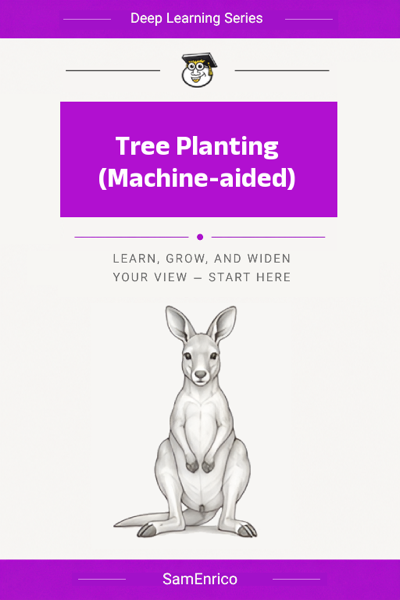
Non-FictionInformativeEducational
Tree Planting (Machine-aided) eBook
A Coursebook on Tree Planting (Machine-aided)
A Coursebook on Tree Planting (Machine-aided)
Formats
Free sample
Chapter 1: The Reforestation Math...--–- The numbers don’t lie, but they do hide. Beneath the glossy headlines about billion-tree campaigns and corporate carbon offsets lies a brutal arithmetic that few people understand and even fewer are willing to face. Here it is: the world loses approximately ten million hectares of forest every year. That is an area roughly the size of Iceland. Every twelve months.
And what does the world plant? According to the Food and Agriculture Organization, official reforestation efforts across all nations, NGOs, and private companies total roughly two million hectares annually. That leaves a net loss of eight million hectares. Every year. The gap is not a small funding shortfall or a logistical hiccup.
It is a chasm. And it is growing.To close that gap using traditional manual planting methods—men and women walking across clear-cut land or burned slopes with dibble bars and bags of seedlings—the industry would need to recruit, train, and deploy approximately six million additional full-time planters. Six million people. Each expected to plant one thousand trees per day. Every day.
For an entire planting season. This is not a labor shortage. It is a fantasy.The problem is not that people do not care. The problem is not that money is unavailable. The problem is that the manual-only model of reforestation has reached its absolute physical and economic limit.
And that limit arrived decades ago. The forestry industry has been quietly aware of this ceiling for at least thirty years. But admitting the limit would mean admitting that the feel-good narrative of hand-planting our way out of climate change is just that—a narrative. The uncomfortable truth is that manual planting, for all its romantic appeal and its genuine importance in certain contexts, cannot scale to meet planetary demand. It never could.This is where the machines enter.
Not as a replacement for human care or ecological wisdom. Not as a silver bullet that erases the complexities of forest restoration. But as a mathematical necessity. When a single worker equipped with a motorized tree planter can place two thousand seedlings in the ground in an hour—a task that would take a manual planter an entire day—the arithmetic shifts. When a drone swarm can broadcast five thousand seed pods per minute across terrain too steep or too remote for any person to safely walk, the impossible becomes merely difficult.
When an autonomous ground robot can plant, mulch, water, and log GPS coordinates for every single tree without ever getting tired, hungry, or sick, the economic equation inverts.But here is the warning that must come before any celebration. Machine-aided tree planting is not simply manual planting with faster tools. It is a fundamentally different discipline that requires a fundamentally different kind of practitioner. The machine-aided forester does not replace the traditional forester any more than a cardiac surgeon replaces a general physician. The skills overlap but diverge sharply where precision, calibration, data integration, and systems thinking become paramount.
This book is for that new professional.Before we design the solution, we must understand the full scope of the problem. And before we understand the problem, we must understand how we arrived here. The history of tree planting is, in many ways, the history of human ambition colliding with ecological reality.The Ancient Roots of Forced Reforestation Tree planting as a deliberate human activity is not new. The first recorded reforestation efforts date back to the Roman Empire, where legislators in the fourth century BC mandated the planting of trees along public roads and aqueducts, not for timber but for shade and soil stabilization. The Roman agricultural writer Columella, in his first-century work De Re Rustica, described techniques for transplanting wild olive and cypress saplings that would be recognizable to any modern planter.
His advice on root pruning and soil preparation remains sound two thousand years later.But for most of human history, reforestation was incidental—a consequence of abandoning marginal farmland that then reverted to forest naturally, or a luxury of wealthy estates that could afford to plant ornamental groves. The idea that humans might need to actively replant forests on a massive scale to replace what they had cut was slow to emerge. Even as Europe deforested itself to build ships, smelt iron, and heat homes, the prevailing assumption was that forests were inexhaustible. They were not.The first true industrial reforestation efforts began in Germany in the late eighteenth century, driven by the realization that timber shortages threatened entire economies. German foresters developed the concept of Nachhaltigkeit—sustainability—which meant harvesting no more wood than could be regrown.
They established the first tree nurseries and developed systematic planting methods using bare-root seedlings. By 1850, Prussia alone was planting over ten million trees annually. These were not ecological restoration projects. They were timber farms.This German model spread across Europe and then to North America, where the catastrophic deforestation of the nineteenth century finally provoked a response. The United States Timber Culture Act of 1873 gave settlers 160 acres of land if they planted forty acres of trees.
It was a well-intentioned disaster. Settlers planted whatever seeds they could get cheaply—often non-native species like Russian olive and tamarisk—in straight lines across the prairie, with no understanding of soil conditions, moisture availability, or long-term maintenance. Most of these plantations failed within a decade. The survivors became ecological nightmares, invasive monocultures that choked out native vegetation.The lesson, learned slowly and painfully, was that planting trees is not the same as creating forests. A forest is a complex, self-sustaining ecosystem with multiple layers of vegetation, diverse species, fungal networks, and animal populations.
A planted tree farm is a crop. The two are not interchangeable. This distinction—between reforestation as ecological restoration and reforestation as timber production—runs through every chapter of this book. The machines discussed here can serve either purpose, but the machine operator must know which purpose they are serving.The Manual Planting Ceiling Every manual tree planter eventually develops an intuition for what their body can sustain. For a fit, experienced worker on flat, clear land with good soil, the maximum sustainable rate is roughly one thousand to fifteen hundred seedlings per ten-hour day.
That number drops steeply with slope, rocks, brush, rain, heat, and fatigue. The world record for manual tree planting in a single day is somewhere around seven thousand seedlings, set by a Canadian planter in perfect conditions, with a support crew handing her seedlings and a videographer following behind. That is not a production rate. It is an athletic stunt.The global tree planting workforce is estimated at roughly five hundred thousand people, most of them seasonal workers earning piece rates. In a good year, with no fires, no pandemics, no supply chain disruptions, and no extreme weather events, this workforce can plant perhaps three billion trees.
That sounds impressive until you run the math. Three billion trees, at a typical spacing of two meters by three meters (about sixteen hundred trees per hectare), covers roughly 1.9 million hectares. That is the high end of the FAO’s two-million-hectare annual reforestation estimate. It is also only twenty percent of what is needed to…
This is the end of the free sample. Get the eBook to keep going. Buy now
About this book
Details
- Author
- Crider Weldon
- Publisher
- SamEnrico
- Language
- English
- Genre
- Non-Fiction, Informative, Educational
- Released
- 2026-05-07
- Pages (approx.)
- 157
- Available as
- eBook, Audiobook

Read better in the ZLOADR app
Your eBooks on your phone or tablet. Sign in with your SamEnrico account and start reading.
More by Crider Weldon
 Navigating Pregnancy Loss DiscussionsCrider Weldon$11.99
 MBSR for Athletes CourseCrider Weldon$11.99
 The Loving Kindness MBSR IntegrationCrider Weldon$11.99
 Teen Self Esteem and ExerciseCrider Weldon$11.99
 Ayurvedic Meditation GuideCrider Weldon$11.99
 The Bard and the King: Taliesin and the Birth of Welsh MythCrider Weldon$11.99
 Quality Control Automation GuideCrider Weldon$12.99
 Ghana Dropshipping Legal RequirementsCrider Weldon$12.99
 How to Start a Central Greasing Systems Business (Beginners Guide)Crider Weldon$11.99
 Understanding Methylcobalamin Deficiency Cbl G TypeCrider Weldon$17.99
You may also like
 Hong Kong Handover 1997Dunn Johnnie$11.99
 Zumba For Postnatal Recovery CourseNeal Christian$11.99
 Zumba for BeginnersLadner Nikia$11.99
 YouTube Comment Mining GuideHumes Pandora$12.99
 Worry Box MeditationCarlin Rudy$11.99
 Workplace Stress MeditationNguyen Lynn$11.99
 Workplace Stress and Sleep RepairHawley Ivory$11.99
 Workplace Perfectionism CureDelaney Jeffry$11.99
 Workplace Injustice Anger GuideWallen Isabelle$11.99
 Work Addiction and Burnout LinkGreenwood Ester$11.99
 Women in Yoga and WellnessBeattie Galina$11.99
 Women in Stand Up ComedyChun Evangeline$11.99