
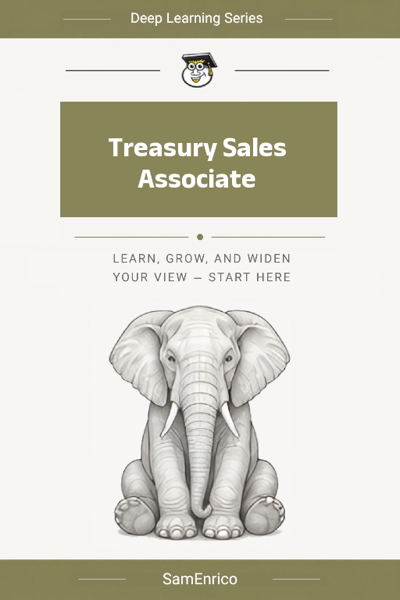
Non-FictionInformativeEducational
Treasury Sales Associate eBook
A Coursebook on Treasury Sales Associate
by Neel Kam
A Coursebook on Treasury Sales Associate
Formats
Free sample
Chapter 1: The Frozen Moment--–- The conference room smelled of stale coffee and expensive cologne. I was twenty-three years old, three weeks into my first Treasury Sales Associate rotation, and I had just been asked a question I could not answer.The client was the CFO of a $400 million manufacturing company. He had gray hair, reading glasses hanging from a cord around his neck, and the weary patience of someone who had been through twenty-seven bank presentations before mine. My Relationship Manager, a silver-haired veteran named Diane who had been covering this client for eleven years, had introduced me as "the treasury expert joining our team."The client looked at me and said: "What's your sweep rate compared to Morgan Stanley?"I opened my mouth. Nothing came out.
Then I said something so embarrassing that I have replayed it in my nightmares for the last decade: "I'll have to get back to you on that."The CFO smiled the smile of a man who had just confirmed everything he suspected about junior bankers. Diane jumped in and saved the call. But I learned something in that frozen moment that no training manual had ever taught me: you cannot sell what you do not understand.This book is the manual I wish I had been given on my first day.Why This Chapter Matters to Your Career If you are reading this book, you have likely accepted a role as a Treasury Sales Associate (TSA) at a commercial bank, or you are aspiring to one. You may have been told that the TSA role is a "stepping stone" to Relationship Manager, or that it is "technical sales support," or that it is "the junior person on the client call."All of these descriptions are wrong. And they are dangerous because they set you up to freeze, as I did, when a client asks a real question.The TSA role is not about selling products.
It is not about filling out compliance forms. It is not about being the junior person who takes notes while the RM talks.The TSA is the liquidity architect. You are the person who designs how cash moves into, through, and out of a client's business. You are the person who finds the $47,000 in idle cash earning nothing and puts it to work. You are the person who spots the fraud risk that the client has overlooked for five years.
You are the person who translates the bank's technical product stack into plain English that a CFO can take to their board.But you cannot do any of that until you understand the world your client lives in. That is what this chapter builds: the foundation of corporate treasury.The Three Pillars of the CFO's Office Every CFO manages three competing priorities. These are not academic categories—they are the actual pressures that keep your clients awake at night. If you understand these three pillars, you understand the battlefield where you will fight and win deals.Pillar One: Working Capital Working capital is the cash a company needs to run its day-to-day operations. It is the difference between current assets (cash, accounts receivable, inventory) and current liabilities (accounts payable, short-term debt).
A simple way to think about it: working capital is the fuel in the tank.When a CFO worries about working capital, they are asking three questions:Do we have enough cash to pay our suppliers on time?Do we have enough cash to make payroll next week?Are we leaving cash trapped in inventory or unpaid invoices?A company with too little working capital cannot pay its bills. A company with too much working capital is inefficient—that cash could be invested, used to pay down debt, or returned to shareholders. The CFO's job is to find the Goldilocks zone: enough cash to operate safely, not so much that capital is idle.What this means for you as a TSA: Every product you sell either improves working capital efficiency or reduces working capital risk. A Zero Balance Account (ZBA) consolidates idle cash so it can be invested. A Line of Credit provides a safety valve when working capital dips.
Positive Pay prevents fraudulent disbursements that would drain working capital overnight. When you understand working capital, you stop selling features and start solving the CFO's actual problem.Pillar Two: Capital Structure Capital structure is how a company finances its operations—the mix of debt (loans, bonds, lines of credit) and equity (stock, retained earnings). A CFO managing capital structure is asking:What is the cheapest way to raise money for our next project?How much debt can we safely carry without risking default?Should we use cash on hand, borrow from a bank, or issue new shares?Debt is cheaper than equity (interest is tax-deductible) but riskier (you have to pay it back). Equity is expensive (shareholders expect returns) but safer (no required payments). The CFO's job is to balance cost and risk.What this means for you as a TSA: When you sell credit products—Lines of Credit, ACH Credit Limits, Intra-day Overdrafts—you are selling capital structure flexibility.
You are not selling debt; you are selling the ability to access cheap capital exactly when it is needed. The CFO who never uses their Line of Credit still values it because it changes their capital structure conversation with their board.Pillar Three: Risk Management Risk management is the CFO's insurance policy against things going wrong. The three biggest risks are:Foreign Exchange (FX) Risk: If you buy goods from a supplier in Europe and the euro strengthens against the dollar before you pay, your costs increase overnight.Interest Rate Risk: If you have variable-rate debt and interest rates rise, your interest expense spikes.Commodity Risk: If you are an airline and jet fuel prices spike, your margins collapse.The CFO cannot eliminate these risks, but they can hedge against them—lock in prices, use derivatives, or structure contracts to transfer risk.What this means for you as a TSA: You may not sell complex FX derivatives in your first year. But you must understand that your client is always managing these risks. When you recommend holding more cash in a domestic account versus moving it overseas for a higher yield, you are making a risk-reward trade-off.
The CFO will notice if you do not understand that trade-off.The TSA as Translator Here is the dirty secret of commercial banking: the bank is organized into product silos that rarely talk to each other.There is a Cash Management team that sells ZBAs and sweeps. There is a Trade Finance team that sells letters of credit. There is a Corporate Lending team that sells Lines of Credit. There is a Foreign Exchange team that sells hedges. These teams have their own sales goals, their own incentive structures, and their own internal politics.The client does not care about any of this.
The client has one treasury department that needs all of these products to work together seamlessly. The client does not want to talk to four different bankers about four different problems. The client wants one person who can see the whole picture.That person is you.The TSA…
This is the end of the free sample. Get the eBook to keep going. Buy now
About this book
Details
- Author
- Neel Kam
- Publisher
- SamEnrico
- Language
- English
- Genre
- Non-Fiction, Informative, Educational
- Released
- 2026-06-02
- Pages (approx.)
- 135
- Available as
- eBook, Audiobook

Read better in the ZLOADR app
Your eBooks on your phone or tablet. Sign in with your SamEnrico account and start reading.
More by Neel Kam
 The Senior Self Acceptance GuideNeel Kam$11.99
 The Poker Addiction GuideNeel Kam$11.99
 Loving Kindness For AutismNeel Kam$11.99
 The Metastatic Breast GuideNeel Kam$11.99
 The Poisoned Chalice: A Victorian Doctor's Deadly DilemmaNeel Kam$11.99
 Understanding Spastic Paraplegia Nephritis DeafnessNeel Kam$17.99
 Price Elasticity MeasurementNeel Kam$12.99
 HARO Press Mention PortfolioNeel Kam$12.99
 How to Start a City Mission Business (Beginners Guide)Neel Kam$11.99
You may also like
 Hong Kong Handover 1997Dunn Johnnie$11.99
 Zumba For Postnatal Recovery CourseNeal Christian$11.99
 Zumba for BeginnersLadner Nikia$11.99
 YouTube Comment Mining GuideHumes Pandora$12.99
 Worry Box MeditationCarlin Rudy$11.99
 Workplace Stress MeditationNguyen Lynn$11.99
 Workplace Stress and Sleep RepairHawley Ivory$11.99
 Workplace Perfectionism CureDelaney Jeffry$11.99
 Workplace Injustice Anger GuideWallen Isabelle$11.99
 Work Addiction and Burnout LinkGreenwood Ester$11.99
 Women in Yoga and WellnessBeattie Galina$11.99
 Women in Stand Up ComedyChun Evangeline$11.99