
Non-FictionSelf-HelpTrauma-Informed
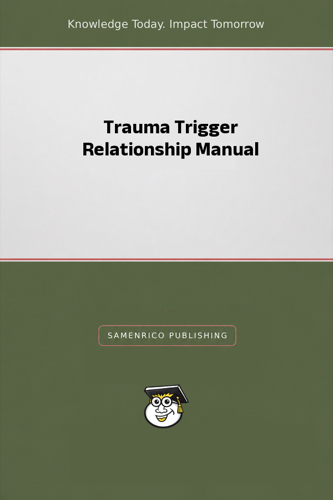
Trauma Trigger Relationship Manual eBook
Explain past trauma triggers to your partner, crea
by Vernon Meg
Explain past trauma triggers to your partner, create safe-word signals, and manage flashbacks without blaming each other.
Formats
Free sample
Chapter 1: When Love Becomes The Trigger--The first time Elena threw a glass against the kitchen wall, she was not angry about the dishes. She was not angry about the money, or the messy closet, or the fact that her partner Marcus had forgotten to call. She was, in that moment, seven years old again, watching her father’s face turn red, feeling the familiar dread of a house about to explode. Marcus had simply said, “Can you please just tell me what’s wrong?” and Elena’s body had answered before her mind could catch up. The glass shattered.
Marcus flinched. And Elena collapsed onto the floor, sobbing, not because she was frightened of Marcus—he had never raised a hand to her—but because she had just seen her own face in the reflection of a man who had.This is the central mystery of trauma in intimate relationships: the person you love most becomes, in certain moments, indistinguishable from the people who hurt you before. Not because your partner has done anything wrong. Not because you are weak or broken or incapable of love. But because your nervous system does not know the difference between then and now.
It only knows threat. And when threat speaks, it speaks louder than logic, louder than love, louder than any promise you have ever made to yourself or to each other.If you are reading this book, you already know this feeling. You know what it is like to be held hostage by a reaction you did not choose. You know what it is like to watch your partner’s face shift from confusion to hurt to exhaustion, all because your body sounded an alarm over something that, in retrospect, seems absurdly small. You know the shame that comes after the explosion, the quiet dread of wondering how many more times your partner will forgive you, the secret fear that you are simply too damaged to be loved.And if you are the partner of a trauma survivor, you know a different but equally painful version of this story.
You know what it is like to walk on eggshells, never sure which innocent comment will detonate an hours-long spiral. You know the frustration of being treated like a villain when you have done nothing wrong. You know the loneliness of loving someone who sometimes looks at you as if you are a stranger, or worse, an enemy. You have wondered, late at night, whether the relationship can survive. You have wondered whether you can survive.Let me tell you something that neither of you has heard enough.
Neither of you is the problem. The problem is the ghost that moved into your relationship long before you met. The problem is a nervous system that learned to fear intimacy because intimacy, in the past, was followed by harm. The problem is a pattern of reaction that was once a brilliant survival strategy but has now become a prison. The problem is not your love.
The problem is what happened to your love before it even had a chance to grow.The Paradox That Breaks Couples Apart Let us name this paradox clearly so that you can stop feeling crazy every time it happens. Romantic relationships activate the same attachment circuitry that was originally wired in infancy and childhood. Your brain, for better or worse, treats your partner as a survival figure—someone on whom your emotional and physical safety depends. This is why a rude comment from a stranger rolls off your back, but a distracted glance from your partner can send you into a spiral of self-doubt. Your attachment system is designed to monitor closeness, danger, and abandonment with exquisite sensitivity, because for most of human history, being rejected by your tribe literally meant death.Now, add trauma to that system.
Trauma is not just a memory. It is a reorganization of the entire nervous system. If you grew up in an environment where closeness was followed by harm—where a parent’s affection turned into criticism, where a caregiver’s presence was unpredictable, where someone who claimed to love you violated your body or your trust—your attachment circuitry becomes corrupted. Not broken, but corrupted. It learns a terrible lesson: closeness is dangerous.
The very intimacy that should feel like home instead feels like the edge of a cliff.This is why your partner can say something as neutral as “We need to talk about our budget” and you suddenly feel trapped, enraged, or numb. This is why a simple request for physical affection can trigger a flashback you cannot explain. This is why you fight about the dishes but actually you are fighting about being ignored at age seven, or about the uncle who touched you, or about the ex who screamed until you disappeared inside yourself. The dishes are never the problem. The dishes are the stage.
The real play is happening in a theater much older than your relationship.I have worked with hundreds of couples trapped in this paradox. One couple fought for three years about a jar of peanut butter left on the counter. Every morning, she would find the jar, feel a wave of rage, and accuse him of disrespecting her home. He would apologize, change his behavior for a week, then forget again. The cycle repeated until they were both convinced the other was a monster.
What they did not know was that her father had left empty food containers around the house as a passive-aggressive way of telling her mother she was a bad housekeeper. The peanut butter jar was not a jar. It was a ghost. And until they saw the ghost, no amount of cleaning would save them.Trauma Echoes: When The Past Wears Your Partner’s Face The concept of trauma echoes is the single most important idea in this book, and I want you to write it down somewhere you will see it every day. A trauma echo occurs when a current situation—usually a moment of conflict or vulnerability—triggers an unconscious replay of a past dynamic.
The survivor reacts to their partner as if the partner were a previous abuser, neglectful parent, or unsafe person. The partner, confused and hurt, reacts to the survivor’s disproportionate response, which further confirms the survivor’s belief that they are not safe. The echo amplifies until both people are fighting a ghost that neither can see, and the original issue—the peanut butter, the tone of voice, the forgotten phone call—has become entirely irrelevant.Here is how you know you are in a trauma echo, not a genuine conflict about the present. Ask yourself these three questions. Be honest.
The answer may sting, but the sting is the beginning of freedom.First, is my emotional reaction wildly out of proportion to what just happened? A spilled glass of water should not produce a full-body collapse. A partner forgetting to take out the trash should not feel like abandonment. A request for alone time should not feel like the end of the world. If your response is a nine or ten on the intensity scale and the trigger is a…
This is the end of the free sample. Get the eBook to keep going. Buy now
About this book
Details
- Author
- Vernon Meg
- Publisher
- SamEnrico
- Language
- English
- Genre
- Non-Fiction, Self-Help, Trauma-Informed
- Released
- 2026-06-07
- Pages (approx.)
- 139
- Available as
- eBook, Audiobook

Read better in the ZLOADR app
Your eBooks on your phone or tablet. Sign in with your SamEnrico account and start reading.
More by Vernon Meg
 Evening Priority ReviewVernon Meg$11.99
 Parental Anger And Adoption DynamicsVernon Meg$11.99
 Strength Training After SixtyVernon Meg$11.99
 Mindfulness for Perfectionist BeginnersVernon Meg$11.99
 The Silent Bridge: How a Forgotten Diplomat Averted World War IIIVernon Meg$11.99
 Iron Will: The Untold Story of the Tuskegee Airmen’s Forgotten AceVernon Meg$11.99
 Landscape Lead HandVernon Meg$11.99
 Nonprofit Form W9 GuideVernon Meg$12.99
 Community Referral ContestVernon Meg$12.99Community Referral ContestVernon Meg$12.99Community Referral ContestVernon Meg$12.99
 Understanding Defect In Synthesis of AdenosylcobalaminVernon Meg$17.99
You may also like
 Hong Kong Handover 1997Dunn Johnnie$11.99
 Zumba For Postnatal Recovery CourseNeal Christian$11.99
 Zumba for BeginnersLadner Nikia$11.99
 YouTube Comment Mining GuideHumes Pandora$12.99
 Worry Box MeditationCarlin Rudy$11.99
 Workplace Stress MeditationNguyen Lynn$11.99
 Workplace Stress and Sleep RepairHawley Ivory$11.99
 Workplace Perfectionism CureDelaney Jeffry$11.99
 Workplace Injustice Anger GuideWallen Isabelle$11.99
 Work Addiction and Burnout LinkGreenwood Ester$11.99
 Women in Yoga and WellnessBeattie Galina$11.99
 Women in Stand Up ComedyChun Evangeline$11.99