
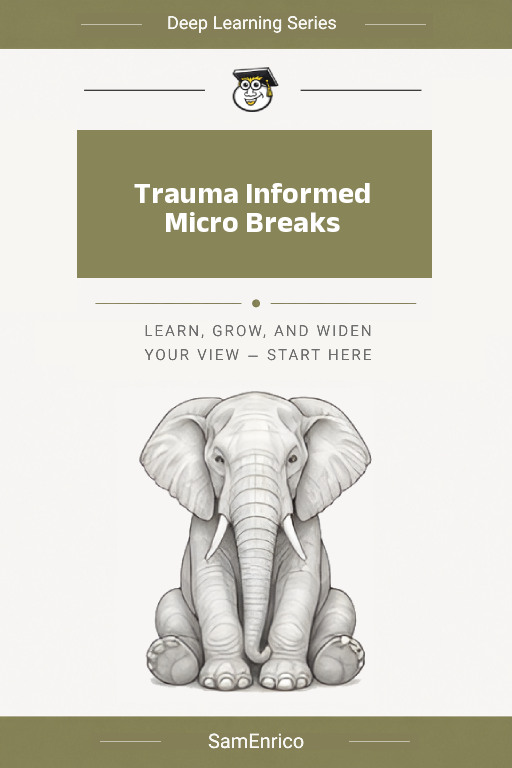
Non-FictionMental WealthTrauma Informed
Trauma Informed Micro Breaks eBook
Uses micro-break techniques that are trauma-inform
by Serna Lera
Uses micro-break techniques that are trauma-informed, avoiding trigger-inducing practices while gently regulating the nervous system.
Formats
Free sample
Chapter 1: The Thermostat Lie–- You believe you are broken. Not in the abstract, poetic way that people use to describe a bad day or a difficult season. You believe there is something fundamentally wrong with you because you cannot seem to handle what everyone else appears to handle with ease. A fifteen-minute phone call with a family member leaves you exhausted for hours. A mildly critical email sends your heart racing for the rest of the afternoon.
A deadline that is still two weeks away sits in your chest like a physical weight, and no amount of logic or self-talk removes it. You have tried everything. You have tried napping, but you wake up groggy and unchanged. You have tried weekends off, but Sunday night still brings the same dread. You have tried meditating, journaling, exercising, eating better, going to bed earlier, and drinking less caffeine.
Some of these things help at the margins. None of them fix the core problem. And so you have arrived at the only conclusion that seems to make sense: you are lazy, or weak, or fundamentally flawed in a way that cannot be repaired. You are a good person who tries very hard, but somewhere beneath the effort, you suspect that others have a resilience you lack, a capacity you were not given, a toughness you cannot manufacture.This chapter exists to tell you that this conclusion is wrong. Not partially wrong, not situationally wrong, but categorically and scientifically wrong.
The problem is not your character, your willpower, or your effort. The problem is your thermostat.The Thermostat You Did Not Choose Imagine for a moment that your nervous system is a thermostat. A good thermostat does one job: it detects the temperature of the room and adjusts the heating or cooling to bring that temperature to a set point. If the room is too cold, the thermostat turns on the heat. If the room is too hot, it turns on the air conditioning.
When the temperature reaches the desired setting, the system goes quiet. The thermostat does not judge the temperature. It does not shame the room for being too cold. It simply responds.Your nervous system works the same way. It has a set point—a default temperature at which it feels safe, regulated, and capable.
When your environment (internal or external) pushes you away from that set point, your nervous system activates survival responses to bring you back. Those responses are not character flaws. They are not signs of weakness. They are your thermostat doing its job.The problem is that for many people, especially those with trauma histories, the thermostat was calibrated in a dangerous environment. If you grew up in a home where yelling was constant, your thermostat learned that yelling is normal.
It set its "safe" temperature to high alert. If you grew up in a home where you were ignored or abandoned, your thermostat learned that silence means danger. It set its "safe" temperature to hyper-vigilance. If you experienced situations where you could not fight and could not flee, your thermostat learned that shutdown is the only option. It set its "safe" temperature to numbness.
Your thermostat is not broken. It is perfectly calibrated to the environment it was trained in. The problem is that you are no longer in that environment, but your thermostat does not know that. It is still running the old program, trying to protect you from threats that no longer exist, cranking the heat or the air conditioning in response to stimuli that others barely notice.This is the Thermostat Lie: the belief that your outsized reactions to small stressors mean you are weak. The truth is that your reactions are perfectly proportional—to a past that no longer exists.
Your nervous system is not overreacting. It is accurately reacting to the wrong map.Why "Just Relax" Makes Everything Worse You have almost certainly been told to relax. By friends, by partners, by therapists, by wellness apps, by well-meaning articles that assume your nervous system works like theirs. "Just take a deep breath." "Just close your eyes and meditate." "Just let it go." These instructions feel insulting not because you are stubborn but because they are impossible. You cannot "just relax" a nervous system that believes it is under threat, any more than you can "just unburn" your hand after touching a hot stove.
The relaxation response is not a choice. It is a physiological state that becomes available only when the nervous system detects safety. Telling someone in hyper-arousal to relax is like telling someone drowning to just breathe. It is not helpful. It is cruel.This chapter draws on two foundational texts in the trauma literature: Bessel van der Kolk's The Body Keeps the Score and Gabor Maté's When the Body Says No.
Van der Kolk spent decades documenting what trauma survivors already knew: the body remembers what the mind tries to forget. Traumatic experiences are not stored as narratives or memories in the way we usually understand those terms. They are stored as physiological responses—racing hearts, clenched jaws, shallow breathing, numb limbs, digestive distress, chronic pain. The body keeps the score, and it plays that score every time something in the present vaguely resembles something in the past. Maté extends this insight by showing how suppressed stress—the constant effort to push through, to be fine, to not burden others—does not disappear.
It goes into the body, where it contributes to autoimmune disease, cancer, chronic fatigue, and a host of other physical illnesses. When your body says no, Maté argues, you would do well to listen. But most of us have been trained to ignore the no, to push through, to override the body's signals with willpower and shame.This book is the opposite of that. This book is an instruction manual for listening to the no before it becomes a crash.The Two Faces of Dysregulation: Hyper and Hypo Your nervous system has two primary ways of responding to perceived threat, and understanding the difference between them is the single most important skill you will learn in this book. The first is hyper-arousal.
This is the fight-or-flight response. In hyper-arousal, your sympathetic nervous system takes over. Your heart rate increases. Your breathing becomes shallow and rapid. Your pupils dilate, creating tunnel vision.
Your muscles tense, preparing for action. Blood moves away from your digestive system and toward your large muscle groups. You may feel anxious, irritable, rageful, panicked, or simply "wired but tired." You cannot sit still. Your mind races. Small sounds make you jump.
You snap at people and then feel guilty. You feel like a live wire, vibrating with energy that has nowhere to go. Hyper-arousal is exhausting, but it is also familiar. Many people live in low-grade hyper-arousal for years without recognizing it. They think they are just "type A" or "high-strung" or "passionate." They are not.
They are stuck in fight-or-flight.The second response is hypo-arousal. This is the freeze or shutdown response. When the nervous system decides that fight or flight is impossible—that no amount of struggling will change the outcome—it defaults to the dorsal vagal branch of the parasympathetic…
This is the end of the free sample. Get the eBook to keep going. Buy now
About this book
Details
- Author
- Serna Lera
- Publisher
- SamEnrico
- Language
- English
- Genre
- Non-Fiction, Mental Wealth, Trauma Informed
- Released
- 2026-06-01
- Pages (approx.)
- 144
- Available as
- eBook, Audiobook

Read better in the ZLOADR app
Your eBooks on your phone or tablet. Sign in with your SamEnrico account and start reading.
More by Serna Lera
 Workaholism in MilitarySerna Lera$11.99
 Submarine War Diving TourismSerna Lera$11.99
 Anger for MusiciansSerna Lera$11.99
 FODMAP Stacking GuideSerna Lera$11.99
 The Identity Based Habits GuideSerna Lera$11.99
 The Swiss Pikes of Marignano: The Last Stand of the Mercenary KingsSerna Lera$11.99
 How to Become a Lead-burner SupervisorSerna Lera$11.99
 Cooperative Success StoriesSerna Lera$12.99Cooperative Success StoriesSerna Lera$12.99
 Auto RacingSerna Lera$11.99
 Understanding Spontaneous Periodic HypothermiaSerna Lera$17.99
You may also like
 Hong Kong Handover 1997Dunn Johnnie$11.99
 Zumba For Postnatal Recovery CourseNeal Christian$11.99
 Zumba for BeginnersLadner Nikia$11.99
 YouTube Comment Mining GuideHumes Pandora$12.99
 Worry Box MeditationCarlin Rudy$11.99
 Workplace Stress MeditationNguyen Lynn$11.99
 Workplace Stress and Sleep RepairHawley Ivory$11.99
 Workplace Perfectionism CureDelaney Jeffry$11.99
 Workplace Injustice Anger GuideWallen Isabelle$11.99
 Work Addiction and Burnout LinkGreenwood Ester$11.99
 Women in Yoga and WellnessBeattie Galina$11.99
 Women in Stand Up ComedyChun Evangeline$11.99