
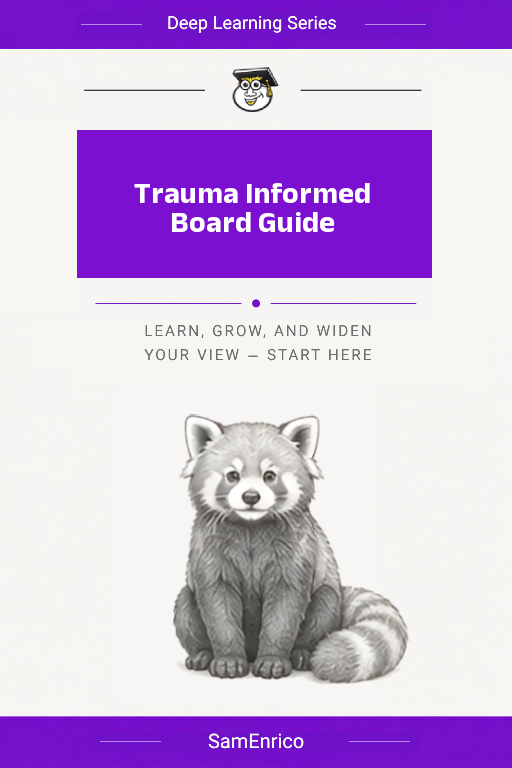
Trauma Informed Board Guide eBook
Train all non-clinical advisors on trauma basics,
Train all non-clinical advisors on trauma basics, avoiding triggers and understanding dissociation, flashbacks, and hypervigilance.
Formats
Free sample
Chapter 1: The Brainstem Betrayal--–- Imagine you are in a boardroom. It is 2:47 PM on a Tuesday. You have been reviewing financial statements for forty minutes. The coffee is cold. The CEO is presenting quarterly results, and then—without warning—a board member cuts them off.
"That's not what we asked for last quarter," they say, voice sharp. "Did you even read the strategic plan?"The CEO stops speaking. Their face goes blank. Their hands, which were gesturing confidently, drop to their sides. They begin to answer, but the words come out slow, fractured.
"I... we... let me find that section..." Another board member jumps in: "This is exactly what I was worried about. We're moving too fast. No one is paying attention to the details." Voices rise.
Papers shuffle. Someone sighs loudly.Twenty minutes later, the board votes to delay a major initiative. The CEO leaves the meeting early, citing a headache. Two board members exchange text messages under the table: "What just happened?" "I don't know. She seemed off today."What just happened was not a failure of strategy.
It was not a lack of preparation. It was not incompetence, laziness, or disrespect.What just happened was a brainstem hijacking.And it happens in boardrooms every single day, wearing the mask of "robust debate," "healthy tension," or "holding leadership accountable."This book exists because most board members—even the most well-intentioned, highly educated, mission-driven leaders—do not understand the basic biology of trauma. They do not know that the traditional boardroom, with its rigid hierarchies, sudden criticism, time pressure, and power imbalances, is physiologically unsafe for trauma-affected brains. They do not know that the very structures they believe create rigor and accountability are, for a significant portion of the people in the room, indistinguishable from environments where they were once harmed.This is the Brainstem Betrayal: the boardroom, designed to govern wisely, instead triggers survival responses that make wise governance impossible.And until you understand why this happens, you will continue to make bad decisions—not because you are a bad person, not because you lack intelligence or dedication, but because your nervous system and the nervous systems of everyone around you are running a different operating system than the one you think you are using.The Three Brains Sitting at Your Table To understand why boardrooms trigger trauma, you must first understand a simple but powerful framework: the triune brain model. Developed by neuroscientist Paul Mac Lean and popularized in trauma literature by Bessel van der Kolk (author of the seminal The Body Keeps the Score), this model divides the human brain into three layers that evolved at different times and serve different functions.The Brainstem (Sometimes called the reptilian brain).
This is the oldest part, responsible for survival. It detects threats, regulates heart rate and breathing, and controls fight, flight, freeze, or fawn (appease) responses. The brainstem does not speak English. It does not understand strategic plans, mission statements, or five-year forecasts. It understands only one question: Am I safe?The Limbic System (The emotional brain).
This includes the amygdala (fear and threat detection), hippocampus (memory), and hypothalamus (stress response). The limbic system attaches emotional significance to events. It is where trauma lives. It remembers not just what happened, but how it felt. And it generalizes: if a person with a high-pitched voice hurt you once, the limbic system will treat all high-pitched voices as potential threats.The Prefrontal Cortex (The executive brain).
This is the newest evolution, responsible for logic, planning, impulse control, empathy, and decision-making. This is the part of the brain you believe you are using during board meetings. This is the part that reads spreadsheets, evaluates trade-offs, and votes yes or no.Here is the problem that changes everything: when the brainstem detects a threat, it shuts down the prefrontal cortex.Not slows it down. Not distracts it. Shuts it down.Blood flow redirects from the executive centers to the survival centers.
The logic centers go offline. You cannot reason your way through a brainstem hijacking because the part of your brain that does reasoning is no longer fully online. This is not a metaphor. This is measurable physiology.Now consider your boardroom. The raised voice.
The sudden criticism. The unexpected question. The time pressure. The power differential. The person who interrupts.
The person who sighs loudly. The agenda item added at the last minute.To the prefrontal cortex, these are social dynamics.To the brainstem, they are survival threats.And the brainstem always wins.The Window That Explains Everything Before we go deeper into the boardroom, we need one more piece of biology: the Window of Tolerance, developed by psychiatrist Dan Siegel. This is not abstract theory. It is the single most useful governance tool you have never heard of.Every person has an optimal zone of arousal—a window—within which they can think, listen, learn, decide, and relate to others. Inside this window, the prefrontal cortex is online.
You can handle complexity. You can hold two opposing ideas at once. You can receive feedback without collapsing. You can disagree without destroying relationships.When you are inside your window, you are governable.Outside the window, two things happen, and neither is compatible with good governance.Hyperarousal (Fight or Flight). The nervous system speeds up.
Heart rate increases. Breathing becomes shallow. Muscles tense. In a boardroom, hyperarousal looks like interrupting, shouting, blame, rapid speech, personal attacks, rigid positions, and an inability to hear nuance. Decisions made in hyperarousal are punitive, simplistic, and almost always regretted.
You are not governing in hyperarousal. You are surviving.Hypoarousal (Freeze or Fawn). The nervous system slows down or shuts down. Heart rate drops. Energy collapses.
Dissociation begins. In a boardroom, hypoarousal looks like going silent, staring at a fixed point, agreeing to anything just to end the meeting, answering questions with "I don't know" or "whatever the group thinks," and leaving with no memory of what was decided. Decisions made in hypoarousal are not commitments; they are abandonments. The person will not implement what they agreed to because they were not actually present when they agreed.Here is what every board member must memorize: Silence is not consent. Agreement is not commitment.
And a vote taken while anyone is outside their window of tolerance is not a valid governance decision. It is a trauma reaction wearing a business suit.Now let us return to the opening story. The CEO who went blank? That was hypoarousal. The board members who raised their voices and demanded answers?
Hyperarousal. Neither group was governing. Both groups were surviving. And the mission lost.Why Traditional Professionalism Is a Trauma Trigger Most boards have a written or unwritten code of professionalism. It usually includes: be prepared, be on time, be respectful, challenge ideas not people, hold leadership accountable, ask hard questions, don't take things personally.On paper, these sound reasonable.In practice, they are a minefield for trauma-affected nervous systems.Consider "ask hard questions." To a non-traumatized brain, a hard question is an intellectual exercise.
To a traumatized brain that learned that questions were precursors to punishment, a hard question is an attack. The body does not distinguish between "we are…
This is the end of the free sample. Get the eBook to keep going. Buy now
About this book
Details
- Author
- Buffington Yuette
- Publisher
- SamEnrico
- Language
- English
- Genre
- Non-Fiction, Mental Wealth
- Released
- 2026-06-01
- Pages (approx.)
- 159
- Available as
- eBook, Audiobook

Read better in the ZLOADR app
Your eBooks on your phone or tablet. Sign in with your SamEnrico account and start reading.
More by Buffington Yuette
 Inner Critic Taming GuideBuffington Yuette$11.99
 Saying No To Extra WorkBuffington Yuette$11.99
 The Anger and Contempt FixBuffington Yuette$11.99
 RMS Titanic 3D PhotogrammetryBuffington Yuette$11.99
 Mindful Eating for Emotional HungerBuffington Yuette$11.99
 Small Talk for Trade ShowsBuffington Yuette$11.99
 Video Feedback TherapyBuffington Yuette$11.99
 Workaholic Part Time GuideBuffington Yuette$11.99
 The Harmonic Pioneers: Black Naturalists Who Composed the Symphony of LifeBuffington Yuette$11.99
 Rising from the Ashes: The Miracle of the 2018 Thai Cave RescueBuffington Yuette$11.99
 How to Produce Hockey HelmetsBuffington Yuette$11.99
 A Collector's Handbook to the Ford Anglia 105eBuffington Yuette$11.99
You may also like
 Hong Kong Handover 1997Dunn Johnnie$11.99
 Zumba For Postnatal Recovery CourseNeal Christian$11.99
 Zumba for BeginnersLadner Nikia$11.99
 YouTube Comment Mining GuideHumes Pandora$12.99
 Worry Box MeditationCarlin Rudy$11.99
 Workplace Stress MeditationNguyen Lynn$11.99
 Workplace Stress and Sleep RepairHawley Ivory$11.99
 Workplace Perfectionism CureDelaney Jeffry$11.99
 Workplace Injustice Anger GuideWallen Isabelle$11.99
 Work Addiction and Burnout LinkGreenwood Ester$11.99
 Women in Yoga and WellnessBeattie Galina$11.99
 Women in Stand Up ComedyChun Evangeline$11.99