
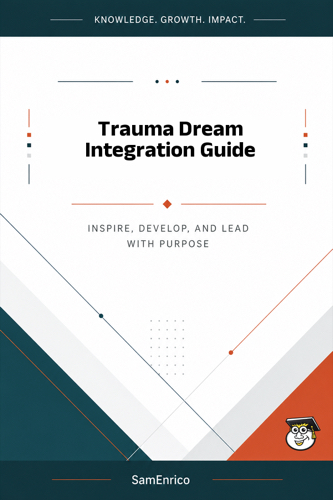
Non-FictionSelf-HelpTrauma Therapy
Trauma Dream Integration Guide eBook
Incorporate nightmare content into trauma processi
Incorporate nightmare content into trauma processing therapy.
Formats
Free sample
Chapter 1: The Failed Mastery...--–- You wake up at 3:17 AM for the four hundredth night. Your heart is a fist pounding against your ribs. The sheets are soaked through, cold against your skin. You cannot move for a long moment, trapped somewhere between the dream and the ceiling fan spinning lazily above you. The image is already fading—the monster's face dissolving like ink in water—but the feeling remains.
Terror. Helplessness. A bone-deep certainty that something is very wrong with you.Here is the truth that no one has told you: there is nothing wrong with you. Your brain is not broken. You are not secretly weak, nor are you being punished by your unconscious mind.
What you experienced tonight was not a random malfunction or a sign of impending madness. It was, in fact, a failed attempt at healing.This is the most important sentence you will read in this entire book: The nightmare is not the enemy. It is a failed attempt at mastery.For decades, the psychological establishment treated nightmares as symptoms to be suppressed—noise to be canceled, fires to be extinguished. Sleep studies prescribed medication to flatten REM sleep. Trauma protocols taught clients to "rehearse" new endings, to imagine the monster turning into a bunny, to pretend the attacker became a friend.
And when these techniques failed—as they so often did for survivors of profound trauma—the patient was left with an additional layer of shame. I couldn't even change my own dream. I must be beyond help.You are not beyond help. You have simply been given the wrong map.This chapter will reorient your entire understanding of trauma nightmares. You will learn why the brain repeats the same terrifying imagery night after night.
You will discover the neurological mechanism behind the "Failed Mastery" principle. And you will begin to see your nightmare not as an enemy to be destroyed, but as a messenger to be understood. By the end of this chapter, you will never fear the 3:17 AM wake-up in quite the same way again.The Misunderstood Nightmare: A Cultural and Clinical History Before we dive into the neuroscience, we must first clear away the debris of bad ideas that have accumulated around nightmares like barnacles on a ship. For most of human history, nightmares were understood as visitations—demons pressing on the sleeper's chest (the origin of the word "nightmare" comes from the Old English mare, a female demon or goblin), divine punishments, or prophetic warnings. The medieval church called them incubus attacks.
Indigenous traditions recognized them as spiritual intrusions requiring ritual cleansing. In each case, the nightmare was understood as something external attacking the dreamer.Modern psychology, for all its advances, made a different but equally problematic error. Freud viewed nightmares as failed wish-fulfillments—the return of repressed desires too threatening even for the dream censor. Later researchers, reacting against Freud's sexual theories, swung hard in the opposite direction: nightmares were simply random neural firing, the brain's housekeeping mechanism gone awry. Neither model helped the person waking up in a cold sweat.The breakthrough came in the 1980s and 1990s, when researchers like Deirdre Barrett and Ross Levin began studying the specific phenomenology of trauma nightmares—distinct from the occasional bad dreams experienced by the general population.
What they discovered upended decades of assumptions.Unlike ordinary bad dreams (which typically involve being chased, falling, or showing up unprepared for an exam), trauma nightmares are characterized by several unique features. First, they are often exact replays or close symbolic approximations of the original traumatic event. Second, they tend to occur earlier in the sleep cycle, during lighter stages of non-REM sleep as well as REM. Third, they do not decrease in intensity over time without intervention; they remain as vivid and terrifying on the hundredth replay as they were on the first.Most critically, trauma nightmares are accompanied by a specific physiological signature that distinguishes them from ordinary dreams. Heart rate remains elevated rather than dropping during REM.
The body's stress response system remains activated. The sleeper wakes in a state of full fight-or-flight, not the groggy confusion of a normal awakening.This is not random noise. This is a system stuck in a loop.The Neurology of Terror: What Happens Inside Your Sleeping Brain To understand why your nightmare repeats, you must first understand how a healthy brain processes memory during sleep. Let us take a brief journey inside the sleeping skull.During a normal night of sleep, your brain cycles through four stages: N1 (light sleep), N2 (deeper sleep), N3 (slow-wave or deep sleep), and REM (rapid eye movement). It is during REM sleep that most ordinary dreaming occurs.
The brain is highly active during REM—almost as active as when you are awake—but several key differences exist. The prefrontal cortex (your brain's executive, the part responsible for logic, planning, and self-awareness) is downregulated. Meanwhile, the amygdala (the fear center) and the visual cortex are highly active. This is why dreams feel emotionally intense but often lack logical coherence.Crucially, during healthy REM sleep, the brain also performs a critical function: memory consolidation. Throughout the day, your brain has been collecting experiences, emotions, and sensory data.
During REM, it sorts through this material, filing some memories into long-term storage, discarding others, and—most importantly for our purposes—integrating emotional experiences into your existing narrative of self. A stressful conversation with your boss gets processed. A near-miss on the highway gets filed as "danger avoided." The emotion is detached from the event, and the memory becomes a story about the past rather than a present threat.This is why you often wake up feeling clearer about a problem after a good night's sleep. Your brain has been working on it while you dreamed.Trauma breaks this system.When you experience a traumatic event—defined psychologically as an experience that overwhelms your capacity to cope—your brain's normal memory consolidation process goes offline. The amygdala, the brain's smoke detector, goes into overdrive.
It flags the event not as "something that happened" but as "something that is still happening." The hippocampus, which normally helps contextualize memories in time and place ("this happened yesterday, in that specific location"), becomes impaired by the flood of stress hormones. It cannot stamp the memory with a "past" label.The result is a memory that exists outside of time. It is not a story about the past. It is a live wire, carrying the same voltage as the original event.Here is where the nightmare comes in.The Failed Mastery Principle: Why Your Brain Keeps Trying and Failing Every night, as you enter REM sleep, your brain attempts to do its job. It tries to process the day's events, to file memories, to integrate emotions.
And it encounters the traumatic memory—that unlabeled, uncontextualized file burning in the corner of the mind. The brain does what it has always done: it attempts to master the experience. It replays the memory, trying to find a resolution, trying to file it as "past," trying to extract the lesson without the terror.But because the trauma is not a normal memory, the replay does not work. The brain cannot…
This is the end of the free sample. Get the eBook to keep going. Buy now
About this book
Details
- Author
- Cottrell Allie
- Publisher
- SamEnrico
- Language
- English
- Genre
- Non-Fiction, Self-Help, Trauma Therapy
- Released
- 2026-06-08
- Pages (approx.)
- 146
- Available as
- eBook, Audiobook

Read better in the ZLOADR app
Your eBooks on your phone or tablet. Sign in with your SamEnrico account and start reading.
More by Cottrell Allie
 Quit Smoking After Relapse GuideCottrell Allie$11.99
 Smell Peg System CourseCottrell Allie$11.99
 Hearing Loss Memory ConnectionCottrell Allie$11.99
 Acadia National Park VanishedCottrell Allie$11.99
 Charitable Remainder Trust GuideCottrell Allie$12.99
 Paleo Slow Cooker CompendiumCottrell Allie$11.99
 Stress Accuracy RelationshipCottrell Allie$11.99
 Metformin PCOSCottrell Allie$11.99
 The Storming of Diu: Portugal's Clash of EmpiresCottrell Allie$11.99
 Blood, Sweat, and the Great Wall: The Untold Marathon of the First EmpressCottrell Allie$11.99
 A Collector's Handbook to the Daihatsu CompagnoCottrell Allie$11.99
 How to Start a Metal Rolling Mills and Rolls for Such Mills Business (Beginners Guide)Cottrell Allie$11.99
You may also like
 Hong Kong Handover 1997Dunn Johnnie$11.99
 Zumba For Postnatal Recovery CourseNeal Christian$11.99
 Zumba for BeginnersLadner Nikia$11.99
 YouTube Comment Mining GuideHumes Pandora$12.99
 Worry Box MeditationCarlin Rudy$11.99
 Workplace Stress MeditationNguyen Lynn$11.99
 Workplace Stress and Sleep RepairHawley Ivory$11.99
 Workplace Perfectionism CureDelaney Jeffry$11.99
 Workplace Injustice Anger GuideWallen Isabelle$11.99
 Work Addiction and Burnout LinkGreenwood Ester$11.99
 Women in Yoga and WellnessBeattie Galina$11.99
 Women in Stand Up ComedyChun Evangeline$11.99