
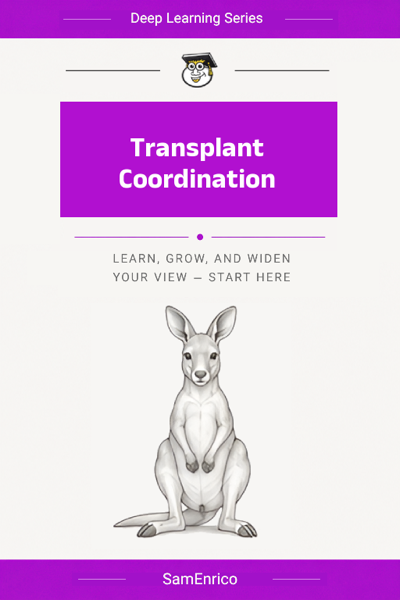
Non-FictionInformativeEducational
Transplant Coordination eBook
A Coursebook on Transplant Coordination
A Coursebook on Transplant Coordination
Formats
Free sample
Chapter 1: The Midnight Phone...--The ringtone was always the same—a generic digital trill that Jenna had grown to hate over seven years as a transplant coordinator. It was 2:47 AM on a Tuesday when her work phone screamed from the nightstand. She was awake before the third ring, a reflex honed by hundreds of previous calls. Her husband, Michael, didn't stir anymore. In the early years, he used to sit up with her, asking if everything was okay.
Now he simply rolled over, a silent acknowledgment that this was her war, fought in hospital corridors and ICUs while the rest of the world slept."Jenna, it's Paul from the OPO," said the voice on the other end. Paul was the overnight referral coordinator at the Organ Procurement Organization, a man she had never met in person but whose voice she recognized immediately—gravelly, efficient, and slightly weary. "I've got a potential donor for you. Twenty-three-year-old male, traumatic brain injury from a motorcycle accident. No helmet.
He's at St. Mary's in the ICU. Neurology just declared brain death twenty minutes ago."Jenna swung her legs over the side of the bed, her feet finding her slippers in the dark. She had a pen in her hand before she consciously reached for it—another reflex. "Tell me about the family.""That's the complicated part," Paul said.
"His mother is in the waiting room. She's alone. The father is flying in from out of state, won't arrive until tomorrow morning. The attending physician has already explained brain death twice. She's not...
she's not understanding. Or maybe she doesn't want to."Jenna closed her eyes. This was the part that no textbook could teach, no simulation could replicate. A mother, alone, in a hospital waiting room at three in the morning, being told that her twenty-three-year-old son was legally dead even though his chest was still rising and falling with the help of a machine. And somewhere in this same city, five floors up in another hospital, a forty-seven-year-old father of two was being told that his kidneys were failing and that without a transplant, he had maybe six months to live."I'll be there in forty-five minutes," Jenna said.This is the world of transplant coordination—a world that exists in the small hours, in the spaces between life and death, in the conversations that most people cannot imagine having.
It is a world where a single phone call can mean the difference between a funeral and a birthday, between a widow and a second chance. And it is a world that, until now, has remained almost entirely invisible.The Call That Changes Everything What Jenna experienced that night—the 2:47 AM phone call, the hurried drive to an unfamiliar hospital, the walk through empty corridors to a waiting room where grief hung in the air like fog—is the defining moment of a transplant coordinator's career. Not the surgery. Not the organ recovery. The call.
Because the call represents possibility, and possibility, in transplantation, is a fragile and fleeting thing.Every transplant coordinator remembers their first solo call. For Jenna, it had been six years earlier—a fifty-six-year-old stroke victim at a small community hospital fifty miles from the city. She had been so nervous that she forgot her badge and had to talk her way past security. The family had said yes within ten minutes, and she had cried in her car afterward, not from sadness but from the overwhelming weight of what had just happened: a stranger had agreed to give their loved one's organs to people they would never meet.But she also remembered her first refusal. That had been three months into the job.
A nineteen-year-old who had drowned in a swimming accident. The family—religious, devout, and certain that their son needed his body intact for the afterlife—had looked at her with an expression she would never forget. It wasn't anger. It was bewilderment. How could you ask us this?
How could you come here, in our worst moment, and ask us to cut up our son?She had no answer then. She had no answer now, except this: because somewhere, someone is dying who doesn't have to.The Birth of a Lifeline: A History of Impossible Firsts To understand the transplant coordinator, you must first understand the audacity of transplantation itself. The idea that a human organ could be removed from one body and placed into another, where it would resume function and extend a life, was the stuff of science fiction for most of human history. The ancient Egyptians and Greeks wrote about transplanting limbs and organs in their myths, but no one seriously believed it was possible. The barriers seemed insurmountable: how do you connect blood vessels?
How do you keep an organ alive outside the body? And most daunting of all—how do you convince the body not to destroy this foreign invader?The first successful human organ transplant occurred on December 23, 1954, at Peter Bent Brigham Hospital in Boston. The surgeon was Dr. Joseph Murray, a quiet, determined man who would later win the Nobel Prize for his work. The patient was Richard Herrick, a twenty-three-year-old man dying of chronic kidney disease.
The donor was Richard's identical twin brother, Ronald. Because the twins shared the same genetic makeup, the problem of rejection—the immune system's natural response to foreign tissue—was temporarily bypassed. The transplanted kidney functioned immediately. Richard lived for eight more years, long enough to marry the nurse who had cared for him during his recovery.The 1954 transplant was a miracle, but it was also a dead end. Most patients in need of an organ did not have an identical twin.
For transplantation to become a viable treatment for thousands of patients, surgeons needed a way to prevent rejection even when donor and recipient were not genetically identical. The answer came in the form of drugs that suppressed the immune system.The first immunosuppressive agents were crude and dangerous. Azathioprine, introduced in the 1960s, worked by inhibiting the production of new immune cells, but it left patients vulnerable to deadly infections and had a host of toxic side effects. Still, it made deceased donor transplantation possible for the first time. In 1962, Murray performed the first successful kidney transplant from a deceased donor, using azathioprine to prevent rejection.
The patient lived for nearly two years—not a cure, but a proof of concept.The real breakthrough came in the 1980s with the discovery of cyclosporine, a drug derived from a fungus found in a Norwegian soil sample. Cyclosporine selectively suppressed T-cells—the immune system's primary attack force—without wiping out the entire immune system. Suddenly, transplant outcomes improved dramatically. One-year kidney graft survival jumped from 60% to over 80%. Heart and liver transplants, once considered experimental and nearly always fatal, became routine procedures.It was during this era of rapid expansion—the mid-1980s—that the role of the transplant coordinator was born.
Initially, coordinators were essentially clerical workers, responsible for maintaining paper waitlists and ensuring that paperwork followed the patient from hospital to hospital. But as the field grew more complex, so did the role. Coordinators began to take on clinical responsibilities: managing…
This is the end of the free sample. Get the eBook to keep going. Buy now
About this book
Details
- Author
- Chester Rusty
- Publisher
- SamEnrico
- Language
- English
- Genre
- Non-Fiction, Informative, Educational
- Released
- 2026-05-04
- Pages (approx.)
- 151
- Available as
- eBook, Audiobook

Read better in the ZLOADR app
Your eBooks on your phone or tablet. Sign in with your SamEnrico account and start reading.
More by Chester Rusty
 Combat Medic Stress RecoveryChester Rusty$11.99
 The Smell Of Mama's GardenChester Rusty$11.99
 Time Distortion InductionChester Rusty$11.99
 NVC For Dementia CareChester Rusty$11.99
 The Forbidden Manuscript: Chaucer’s Banned Book and the Birth of English LiteratureChester Rusty$11.99
 How to Become a Paint-brush MakerChester Rusty$11.99
 How to Produce a Big Green Egg SmokerChester Rusty$11.99
 Ransomware Terror NexusChester Rusty$12.99
You may also like
 Hong Kong Handover 1997Dunn Johnnie$11.99
 Zumba For Postnatal Recovery CourseNeal Christian$11.99
 Zumba for BeginnersLadner Nikia$11.99
 YouTube Comment Mining GuideHumes Pandora$12.99
 Worry Box MeditationCarlin Rudy$11.99
 Workplace Stress MeditationNguyen Lynn$11.99
 Workplace Stress and Sleep RepairHawley Ivory$11.99
 Workplace Perfectionism CureDelaney Jeffry$11.99
 Workplace Injustice Anger GuideWallen Isabelle$11.99
 Work Addiction and Burnout LinkGreenwood Ester$11.99
 Women in Yoga and WellnessBeattie Galina$11.99
 Women in Stand Up ComedyChun Evangeline$11.99