
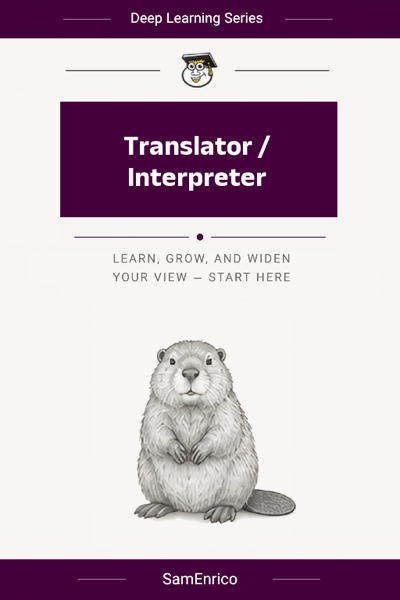
Non-FictionInformativeEducational
Translator / Interpreter eBook
A Coursebook on Translator / Interpreter
A Coursebook on Translator / Interpreter
Formats
Free sample
Chapter 1: The Hidden War...--–- It begins not with a bang, but with a single word. In a cramped courtroom in The Hague, a prosecutor leans toward a witness. The witness, a survivor of atrocities, speaks in a language that only two people in the room understand. The interpreter, seated between them, listens. The witness says something in Bosnian.
The interpreter's hand hovers over the button that will send the words into the headphones of every judge, every lawyer, every journalist in the chamber. One word. One choice. And somewhere in that split second, justice tilts one way or the other. The interpreter does not have the luxury of a draft, a second thought, a revision.
There is no delete key. There is only the next breath and the next word.This is the hidden war of professional language mediation. It is fought every day, in every courtroom, hospital, boardroom, and negotiation chamber across the world, by people whose names never appear in the headlines. They are the translators and interpreters who move silently between languages, carrying not just words but meanings, intentions, risks, and consequences. And yet, ask an average person what a translator or interpreter does, and they will likely say: "They know two languages.
They just say the same thing in the other one."That answer is wrong. Dangerously wrong.The Great Misconception The most damaging myth in the entire field of professional language mediation is also the most common: the belief that bilingualism equals translation competence. If you speak two languages, the myth goes, you can translate between them. It seems logical. It is also catastrophically incorrect.Bilingualism is the ability to communicate in two languages.
Translation and interpreting are the ability to transfer meaning between two languages under specific constraints, with specific quality standards, and for specific purposes. The distinction is not academic hairsplitting. It is the difference between asking a carpenter to perform heart surgery because both use sharp tools, or asking a driver to race in Formula One because both operate vehicles.Consider this: virtually every native English speaker can write a grocery list. Very few can write a novel. Writing a grocery list requires basic literacy.
Writing a novel requires craft, training, and years of deliberate practice. Similarly, holding a conversation in two languages requires basic bilingualism. Translating a legal contract, interpreting a medical diagnosis, or localizing a software interface requires professional competence. The bilingual person navigates their own understanding. The professional navigates the understanding of others.The Silent Crisis The consequences of confusing bilingualism with professional competence are not theoretical.
Every year, in hospitals across the world, untrained bilingual staff members—receptionists, janitors, nurses' aides—are asked to "just help" with interpreting. They mean well. They want to help. But they lack the ethical framework, the cognitive strategies, and the professional boundaries that protect all parties.A 2019 study of medical errors in US hospitals found that the use of untrained interpreters—including family members and bilingual staff—was associated with a significantly higher rate of serious clinical errors compared to the use of professional medical interpreters. The most common errors?
Omission of key symptoms. Addition of false information. Substitution of one symptom for another. And editorialization—the interpreter's own judgment about what matters.One case from the study haunts the researchers who published it. A Spanish-speaking patient complained of "un dolor que me quita el aliento"—literally, "a pain that takes my breath away." The untrained interpreter, a well-meaning receptionist, rendered this as "chest pain." Technically correct.
Clinically incomplete. The patient was having a pulmonary embolism, not a cardiac event. The treatment for a pulmonary embolism is blood thinners. The treatment for chest pain of cardiac origin might include aspirin, which would have made the pulmonary embolism worse. The patient survived, but only because a nurse overheard the Spanish phrase and intervened.
The interpreter, unaware of the clinical stakes, had made a choice that could have killed someone.This is not a story about a bad person. It is a story about a system that confuses bilingualism with professional competence. The receptionist was not malicious. She was just untrained. And the patient nearly paid the price.The Two Branches of a Single Profession Before we go any further, we must establish a distinction that will shape every chapter of this book.
The professional language mediator walks one of two paths: translation or interpreting. They are cousins, not twins. They share a family resemblance but demand fundamentally different skills, personalities, and cognitive architectures.Translation is the transfer of written text from a source language to a target language. It is asynchronous: the translator reads the source text, then produces the target text, with no time pressure beyond the deadline. It is revisable: the translator can draft, revise, edit, and polish.
It is solitary: the translator works alone, with access to dictionaries, corpora, and the internet. The translation is a document. It can be reviewed, corrected, and improved. Errors can be caught before they reach the reader.Interpreting is the transfer of spoken (or signed) language from a source to a target language in real time. It is synchronous: the interpreter listens and speaks (or signs) simultaneously or in quick succession.
It is ephemeral: the interpretation vanishes into the air the moment it is spoken. It is interactive: the interpreter works with and between people, managing turn-taking, clarifying meaning, and navigating the social dynamics of the room. The interpretation is an event. There are no second chances.Within interpreting, there are two primary modes. Consecutive interpreting involves listening to a segment of speech (typically 30 seconds to 5 minutes), taking notes, then rendering the entire segment in the target language while the original speaker pauses.
Simultaneous interpreting involves listening to a speaker and producing the target language interpretation at the same time, typically from a soundproof booth with headphones and a microphone.Each of these paths attracts a different kind of person. The translator tends to be reflective, patient, and comfortable with solitude. The consecutive interpreter tends to be analytical, methodical, and skilled at structured memory. The simultaneous interpreter tends to be quick-thinking, stress-tolerant, and energized by real-time problem-solving. None of these profiles is superior to the others.
But they are different. And knowing which one fits your own cognitive and temperamental profile is the first step to a sustainable career.The Sequential Model: How Translation Actually Works Now that we have distinguished translation from interpreting, let us examine how translation works at its most fundamental level. The most enduring model in translation studies is the Sequential Model, which breaks the translation process into two main phases: comprehension and reformulation.Phase One: Comprehension The translator reads the source text not as a casual reader but as a professional decoder. Casual reading seeks to understand. Professional reading for translation seeks to understand how the text means what it means.
The translator analyzes:Lexical meaning: What do the individual words mean in this specific context? Are there false friends? Idioms? Culture-bound terms?Syntactic structure: How are the sentences built? Where is the subject?
The verb? The object? What is the information structure?Pragmatic meaning: What is implied but not stated? What politeness strategies are at work? What…
This is the end of the free sample. Get the eBook to keep going. Buy now
About this book
Details
- Author
- Hartwell Loraine
- Publisher
- SamEnrico
- Language
- English
- Genre
- Non-Fiction, Informative, Educational
- Released
- 2026-06-02
- Pages (approx.)
- 147
- Available as
- eBook, Audiobook

Read better in the ZLOADR app
Your eBooks on your phone or tablet. Sign in with your SamEnrico account and start reading.
More by Hartwell Loraine
 Delegation for Fitness TrainersHartwell Loraine$11.99
 TM Weekend Retreat GuideHartwell Loraine$11.99
 Retirement Housing New Construction CourseHartwell Loraine$11.99
 Men's Holiday Heart Syndrome GuideHartwell Loraine$11.99
 Innocence Project Pennsylvania CasesHartwell Loraine$11.99
 When the Tigris Ran Red: The Lost Code of Naram-SinHartwell Loraine$11.99
 The Great Banana War: How United Fruit Company Ruled the TropicsHartwell Loraine$11.99
 How to Become a Calcine Furnace LoaderHartwell Loraine$11.99
 Vendor Collaboration PlatformsHartwell Loraine$12.99
 Expense Tracking RetentionHartwell Loraine$12.99
 Understanding Chromosome 14q, Proximal DuplicationHartwell Loraine$17.99
You may also like
 Hong Kong Handover 1997Dunn Johnnie$11.99
 Zumba For Postnatal Recovery CourseNeal Christian$11.99
 Zumba for BeginnersLadner Nikia$11.99
 YouTube Comment Mining GuideHumes Pandora$12.99
 Worry Box MeditationCarlin Rudy$11.99
 Workplace Stress MeditationNguyen Lynn$11.99
 Workplace Stress and Sleep RepairHawley Ivory$11.99
 Workplace Perfectionism CureDelaney Jeffry$11.99
 Workplace Injustice Anger GuideWallen Isabelle$11.99
 Work Addiction and Burnout LinkGreenwood Ester$11.99
 Women in Yoga and WellnessBeattie Galina$11.99
 Women in Stand Up ComedyChun Evangeline$11.99