
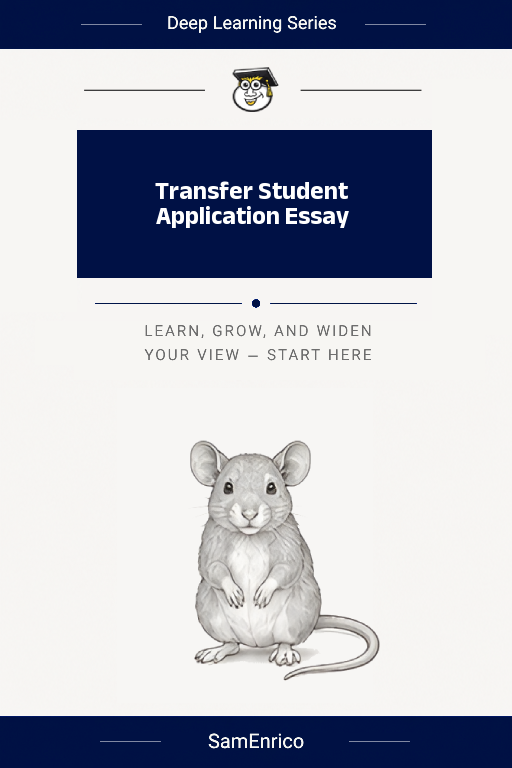
Transfer Student Application Essay eBook
Explain why current school lacks fit without criti
Explain why current school lacks fit without criticizing and show specific research on new college.
Formats
Free sample
Chapter 1: The Permission Paradox–- Every transfer applicant begins in the same place: sitting in a dorm room, library carrel, or coffee shop just off campus, staring at a blank screen, with a single thought looping like a broken record. I shouldn't have to write this essay. I chose this school. I was supposed to be happy here. What will everyone think of me for leaving?That knot in your stomach is not uncertainty about grammar or structure.
It is not fear of the admissions committee. It is something far more fundamental, and far more rarely named. It is the permission paradox: you believe you need permission to leave your current college, but the only person who can grant that permission is you.The transfer essay is not primarily a writing exercise. It is an act of self-authorization. Before you type a single word about research opportunities, class sizes, or geographic fit, you must first give yourself permission to outgrow a place you once chose.
This chapter exists to give you that permission—and to show you why, without it, no essay will ever sound authentic.The Two Transfer Students (And Why Only One Gets Accepted)Let me introduce you to two students. Both are real composites drawn from successful and unsuccessful applications. Both have nearly identical GPAs, extracurricular profiles, and target schools. Both are miserable at their current colleges. Only one gets accepted.Jenna sits down to write her transfer essay and immediately writes what she feels: "My current college is too small.
The social scene is dead. The professors are fine but not inspiring. I chose this school because my parents wanted me to stay close to home, and I've regretted it every day since."She revises this draft seven times. Each revision gets more polished but not more persuasive. Her final essay is grammatically perfect and emotionally flat.
Admissions officers read it and think: This student is running away. She will be dissatisfied wherever she goes.Marcus sits down to write his transfer essay and spends the first hour doing something different. He writes a list of everything his current college gave him: the debate coach who taught him to structure arguments, the three friends who challenged his thinking, the late night in the library when he discovered he actually loved research. Then he writes a second list: what he has tried to do at his current college that he cannot complete. Finally, he writes a third list: specific professors, courses, and programs at his target school that would allow him to finish what he started.His essay opens: "When I presented my third undergraduate research poster last spring, I realized I had done all I could in my current environment." Admissions officers read it and think: This student has grown somewhere.
He is running toward something specific. He will bring his momentum to our campus.Jenna and Marcus have the same facts. The difference is permission. Marcus gave himself permission to outgrow his school. Jenna is still waiting for someone to tell her it is okay to leave.The Three Myths That Keep You Stuck Before you can write a successful transfer essay, you must identify and dismantle the myths that are keeping you from giving yourself permission.
These myths are not your fault. They are embedded in the cultural narrative around college choice—the idea that your first decision must be your final decision, and that changing your mind is a form of failure.Myth #1: Transferring Means You Made a Mistake This is the most destructive myth. Let me be clear: choosing a college that turns out to be the wrong fit is not a mistake. It is information. You could not have known what you needed until you arrived.
College fit is not something you can determine from a brochure, a tour, or even an overnight visit. It reveals itself in October of your first semester, when you realize that the seminar discussions you craved are actually lecture halls, or that the "close faculty mentorship" promised in the viewbook means something very different to you than it does to the admissions office.The students who successfully transfer are not the ones who made no mistakes. They are the ones who learned something from their first college and used that learning to make a better second choice. Your current school gave you data. Now use it.Reframe: I did not fail to choose correctly.
I succeeded in learning what I need.Myth #2: Good Students Stay. Transfer Students Are Quitters.This myth confuses persistence with purpose. Persistence is valuable when you are pursuing a goal that remains achievable. Persistence becomes self-destruction when you are pursuing a goal that no longer serves you. Staying at a college that cannot offer you the major you need, the research opportunities you have earned, or the community you require is not virtue.
It is sunk cost fallacy.Admissions officers at transfer-receiving schools are not looking for students who "stuck it out" at a bad fit. They are looking for students who had the self-awareness to recognize a mismatch and the courage to act on that recognition. Every successful transfer essay is a testament to courage, not to quitting.Reframe: Staying somewhere that limits me is not loyalty. It is waste.Myth #3: I Have to Prove My Current School Was Terrible to Justify Leaving This myth produces the single most common fatal error in transfer essays: the complaint catalog. Students believe that if they can just convince the admissions committee that their current school is genuinely awful—underfunded, poorly taught, socially dead—then the committee will nod sympathetically and offer admission.The opposite is true.
Admissions officers read thousands of transfer essays. The ones that list complaints read as bitter, entitled, and blame-shifting. Worse, they raise a red flag: If this student trashes their current school, what will they say about ours in a year?You do not need to prove your current school is terrible. You need to prove that you have outgrown it. Those are different arguments.
One looks backward with resentment. The other looks forward with purpose.Reframe: My current school served its purpose. Now I need a different environment to serve my next purpose.The Permission Ritual: A Practical Exercise Before you read another chapter of this book, I want you to do something that will feel uncomfortable. I want you to give yourself explicit, written permission to transfer.Take out a piece of paper or open a blank document. Write the following sentence and complete it honestly:"I am giving myself permission to leave [Current School Name] because I have learned that I need [specific thing your current school cannot provide], and I am no longer willing to pretend that wanting that thing makes me weak, ungrateful, or broken."Now write a second sentence:"I am giving myself permission to apply to [Target School Name] because I believe that [specific resource at that school] will help me become the [professional or personal identity] I want to be."Keep this page.
Read it every morning while you work on your application. When you feel the old doubts creeping back—maybe I should just stick it out, maybe I'm…
This is the end of the free sample. Get the eBook to keep going. Buy now
About this book
Details
- Author
- Robles Carisa
- Publisher
- SamEnrico
- Language
- English
- Genre
- essays, Student's Shortcut
- Released
- 2026-05-30
- Pages (approx.)
- 148
- Available as
- eBook, Audiobook

Read better in the ZLOADR app
Your eBooks on your phone or tablet. Sign in with your SamEnrico account and start reading.
More by Robles Carisa
 Mentorship Relationship BlueprintRobles Carisa$11.99
 Press Release For MergersRobles Carisa$11.99
 Mexican Father Border CrossingRobles Carisa$11.99
 Yips Treatment Self Hypnosis GuideRobles Carisa$11.99
 Stimulant Overdose Recognition GuideRobles Carisa$11.99
 Knee Pain Meditation GuideRobles Carisa$11.99
 Yes And Parenting GuideRobles Carisa$11.99
 Circadian Rhythm Myth BusterRobles Carisa$11.99
 Touchstone Object PrepRobles Carisa$11.99
 The Red Revolution: How a Color Changed the WorldRobles Carisa$11.99
 The Last Dance of the PhoenixRobles Carisa$11.99
 The Bone Setters of Renaissance Florence: Healing Hands of the Medici CourtRobles Carisa$11.99
You may also like
 YouTube Video Essay DepthLeon Lala$11.99
 TOEFL Independent Essay GuideMintz Alex$11.99
 Music Theory Essay GuideWilkinson Maisha$11.99
 Expository Essay AI PromptsApplegate Dalia$11.99
 Exam Essay MemorizationMcgovern Johna$11.99
 Compare Contrast Essay PromptsOntiveros Marx$11.99
 College Application Essay GuideSisson Aimee$11.99College Application Essay GuideSisson Aimee$11.99
 The 100 Word Essay ChallengeAli Luciana$11.99
 Journalism Essay PromptsThatcher Williemae$11.99
 Finance Essay PromptsShrader Lamont$11.99
 Cause Effect Essay GPT GuideBland Jacelyn$11.99