
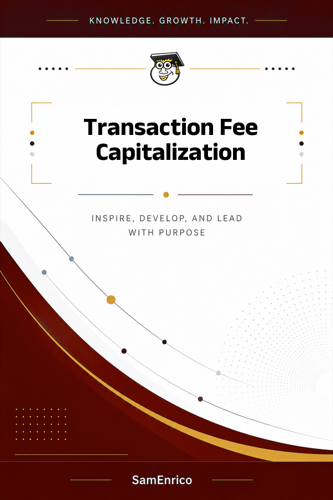
Transaction Fee Capitalization
Capitalize debt financing fees into loan balance.
by Leyva Elene
Capitalize debt financing fees into loan balance.
Formats
About this book
Free sample
Chapter 1: The $50,000 Mistake--Every year, millions of business owners, real estate investors, and corporate finance professionals sign loan documents without realizing they are leaving tens of thousands of dollars on the table. The mistake is not in the interest rate they negotiate or the lender they choose. The mistake is invisible to most borrowers because it hides in plain sight on the closing statement, buried among origination fees, legal costs, and underwriting charges. The mistake is treating those fees as an immediate expense rather than capitalizing them into the loan balance.This chapter will show you exactly how that mistake happens, why it costs you real money, and how a simple accounting decision can transform a $50,000 expense into a $10,000 annual adjustment that protects your profitability, preserves your borrowing capacity, and aligns your financial statements with economic reality. By the time you finish this chapter, you will never look at a loan fee the same way again.The Scenario That Changes Everything Imagine two identical businesses.
Let us call them Company A and Company B. Both are successful manufacturing firms with annual revenue of $5 million. Both need to borrow $1 million to purchase new equipment that will increase production capacity. Both receive identical loan offers from the same bank: a five‑year term loan at 6% interest with $50,000 in upfront fees covering origination, legal documentation, credit reports, and underwriting.The two companies sign the exact same loan documents on the exact same day. They each receive $950,000 in net proceeds after the lender deducts the $50,000 in fees.
They each owe the lender $1 million in principal plus five years of interest at 6%.But here is where the paths diverge. Company A follows the default approach that most small and medium‑size businesses use: it treats the $50,000 in fees as an immediate expense on its income statement. Company B, guided by a sharper understanding of accounting rules, capitalizes the $50,000 fee as an asset and amortizes it over the five‑year life of the loan.The financial statements of these two companies tell very different stories. In Year 1, Company A reports $50,000 of additional expense that Company…
This is the end of the free sample. Get the eBook to keep going. Buy now
Contents
- Chapter 1
- Chapter 2
- Chapter 3
- Chapter 4
- Chapter 5
- Chapter 6
- Chapter 7
- Chapter 8
- Chapter 9
- Chapter 10
- Chapter 11
- Chapter 12
Details
- Author
- Leyva Elene
- Publisher
- SamEnrico
- Language
- English
- Genre
- Non-Fiction, Capital & Valuation Register, Fee Capitalization
- Released
- 2026-06-09
- Pages (approx.)
- 152
- Available as
- eBook, Audiobook

Read better in the ZLOADR app
Your eBooks on your phone or tablet. Sign in with your SamEnrico account and start reading.
More by Leyva Elene
 NVC In Romantic Relationships GuideLeyva Elene$11.99
 Latin America Logistics OutlookLeyva Elene$11.99
 Assertiveness for ESL SpeakersLeyva Elene$11.99
 The Construction Zone Patience PrimerLeyva Elene$11.99
 The Burning of the Phoenix: A Kidnapping Survivor’s Fight for Justice in the Wild WestLeyva Elene$11.99
 Understanding Singleton Merten SyndromeLeyva Elene$17.99
 How to Become a Dust Collector-treaterLeyva Elene$11.99
 Middle East Payment Terms GuideLeyva Elene$12.99
 B2B Pricing Fear BusterLeyva Elene$12.99