
Non-FictionSelf-HelpAltered States
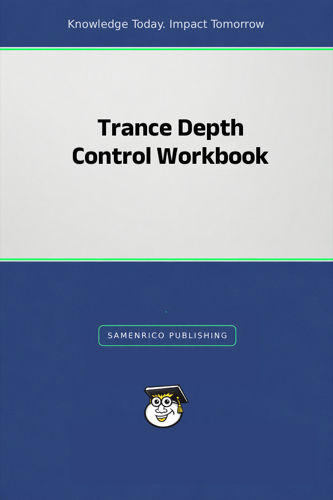
Trance Depth Control Workbook eBook
Teaches rating and deepening trance levels from li
by Shell Debby
Teaches rating and deepening trance levels from light to somnambulistic states.
Formats
Free sample
Chapter 1: The Depth Illusion--–- Close your eyes for a moment. No, really – pause reading and close them. Now, try very hard to fall asleep. Try with all your might. Command your mind to drift off.
Count each breath with forceful intention. Notice what happens. If you are like most people, the more you tried, the more awake you became. Your heart rate may have increased slightly. Your jaw may have tightened.
Your thoughts, instead of fading, multiplied like startled insects. This is the first and most important lesson of this entire workbook: effort is the enemy of trance. What you just experienced is not a failure of will. It is proof of a universal law that governs every hypnotic interaction, every meditation session, and every attempt to change your own mind. Welcome to the Law of Reversed Effect – the principle that trying to do something guarantees you will do the opposite.This chapter dismantles the most pervasive myth in all of hypnosis: the belief that trance equals sleep, unconsciousness, or some exotic altered state reserved for stage performers and Zen masters.
Nothing could be further from the truth. Trance is not a destination you arrive at after a long journey. It is not a switch that flips from "off" to "on." And it is certainly not something that happens to you against your will. Trance is a natural, continuous, and measurable spectrum of human consciousness that you move along dozens of times every single day. You have been in light trance while driving a familiar road and arriving home with no memory of the last ten miles.
You have been in medium trance while watching an absorbing film, losing awareness of the room around you. And if you have ever been so lost in a book that you did not hear someone call your name, you have experienced a slice of what this workbook will teach you to recognize, measure, and deepen at will.The problem is not that trance is rare or difficult. The problem is that most people – including many practicing hypnotists – have no reliable way to know how deep they or their subject actually are. They guess. They rely on vague feelings.
They ask questions like "Do you feel relaxed?" which tells them nothing useful because a subject at Level 2 will say yes, and a subject at Level 8 will also say yes. This workbook exists to solve that single problem: calibration. By the time you finish these twelve chapters, you will not need to ask how deep someone is. You will know from observable signs, from behavioral tests, and from your own internal kinesthetic feedback. You will move from guessing to knowing, from hoping to controlling, from light trance to somnambulism on command.The Spectrum You Already Inhabit Before we talk about going deeper, we must first understand where you are right now.
Let us establish the language that will govern every exercise and every technique in this book. The 0–10 Trance Depth Scale is not a scientific absolute – no EEG machine can draw a clean line between Level 4 and Level 5 – but it is a practical, teachable, and reliable framework that has been used by clinical hypnotherapists for decades. Think of it like the Richter scale for earthquakes: the boundaries between magnitudes are somewhat arbitrary, but the progression is real and measurable.Level 0: Full Waking Alertness. This is the state you are in when you are reading a dense contract, taking a test, or having an argument. Your sympathetic nervous system is engaged.
Your critical factor – that internal editor that evaluates whether a suggestion makes logical sense – is fully operational. At Level 0, you will reject any suggestion that contradicts your beliefs. This is not a problem; it is a survival mechanism.Levels 1–2: Light Relaxation. Your body begins to soften. Your breathing shifts from chest to diaphragm.
Your eyelids may feel heavy, but you can still open them easily. Your mind remains clear, even sharp. Most people spend their entire meditation practice bouncing between Level 1 and Level 2 without ever going deeper. This is useful for stress reduction but useless for therapeutic change.Level 3: Eye Catalepsy. This is the first unambiguous sign of trance.
Your subject's eyes will not open when asked – not because they are asleep, but because the suggestion of eye closure has become more compelling than the command to open. The eyelids feel "stuck." At Level 3, the critical factor is still present but softened. Simple suggestions like "relax more deeply" will take effect.Levels 4–5: Light Somnambulism. The body feels disconnected. Glove anesthesia – numbness in one hand – becomes possible.
Partial amnesia may occur spontaneously. At this depth, most therapeutic work for anxiety, mild phobias, and habit change can be performed effectively.Levels 6–7: Deep Somnambulism. Full anesthesia can be transferred from one body part to another. Positive and negative hallucinations become possible. The subject can open their eyes without waking.
Time distortion becomes dramatic. This is the working depth for pain management and surgical hypnosis.Levels 8–10: The Esdaile State. Named after the Scottish surgeon James Esdaile, who performed hundreds of painless major surgeries using only hypnosis, this is the deepest practical trance state. The subject appears comatose – no spontaneous movement, no response to external stimuli except the hypnotist's voice, complete systemic anesthesia. Time perception collapses entirely.
At Level 10, the subconscious mind is fully accessible, and the critical factor is completely bypassed.Here is what you must understand about this scale: it is not a ladder you climb one rung at a time. With proper technique, a subject can jump from Level 2 to Level 7 in less than ninety seconds. With poor technique, they can bounce between Level 1 and Level 3 for an hour without progress. The difference is not the subject's "hypnotizability" – which is largely a myth – but the practitioner's skill in deepening. And deepening is what this workbook is about.The Law of Reversed Effect (Read This Twice)In the 1920s, the German psychologist Narcissus Ach discovered something counterintuitive about human performance.
When he asked subjects to perform simple tasks – tying a knot, solving a puzzle – telling them to "try harder" usually made them slower and more error-prone. When he asked them to relax and let the task happen, their performance improved. He called this the Law of Reversed Effect: the conscious effort to perform an involuntary or automatic process will inhibit that process.Hypnosis is an involuntary process. Trance is not something you do; it is something that happens when you stop interfering. This is why the most common induction mistake is talking too much, pushing too hard, and asking too many questions.
Every time you say "go deeper now," you are actually creating a tiny obstacle. The subject's conscious mind hears the command, tries to comply, and in the trying, moves away from trance.Let me give you an example from outside hypnosis. Have you ever tried to fall asleep on the night before an important event? You lie in bed, commanding yourself to sleep. You count sheep.
You try to blank your mind. And the result is that you lie awake for hours, increasingly frustrated. The moment you give up and decide to read a book or watch television, sleep arrives. That is the Law of…
This is the end of the free sample. Get the eBook to keep going. Buy now
About this book
Details
- Author
- Shell Debby
- Publisher
- SamEnrico
- Language
- English
- Genre
- Non-Fiction, Self-Help, Altered States
- Released
- 2026-06-09
- Pages (approx.)
- 142
- Available as
- eBook, Audiobook

Read better in the ZLOADR app
Your eBooks on your phone or tablet. Sign in with your SamEnrico account and start reading.
More by Shell Debby
 Cardio For Couch To ActiveShell Debby$11.99
 Negotiation Pattern MemoryShell Debby$11.99
 The Anger Log MethodShell Debby$11.99
 Lab Research Stress ManagementShell Debby$11.99
 The Silk Road's Golden Ledger: How a Merchant Dynasty Shaped the WorldShell Debby$11.99
 The Phoenix Code: How the Beatles Regained Their CrownShell Debby$11.99
 How to Start a Process Pressure Vessel Business (Beginners Guide)Shell Debby$11.99
 Intermodal Logistics GuideShell Debby$12.99
 Bookkeeping Pricing PsychologyShell Debby$12.99
 Understanding Encephalo Cranio Cutaneous LipomatosisShell Debby$17.99
 Fire Door Inspection (Basic Visual)Shell Debby$11.99
You may also like
 Hong Kong Handover 1997Dunn Johnnie$11.99
 Zumba For Postnatal Recovery CourseNeal Christian$11.99
 Zumba for BeginnersLadner Nikia$11.99
 YouTube Comment Mining GuideHumes Pandora$12.99
 Worry Box MeditationCarlin Rudy$11.99
 Workplace Stress MeditationNguyen Lynn$11.99
 Workplace Stress and Sleep RepairHawley Ivory$11.99
 Workplace Perfectionism CureDelaney Jeffry$11.99
 Workplace Injustice Anger GuideWallen Isabelle$11.99
 Work Addiction and Burnout LinkGreenwood Ester$11.99
 Women in Yoga and WellnessBeattie Galina$11.99
 Women in Stand Up ComedyChun Evangeline$11.99