
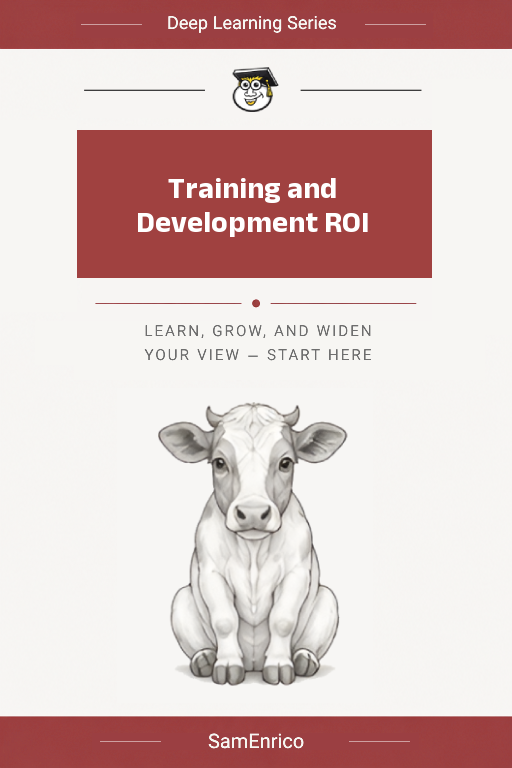
Non-FictionProfessional's Cheat SheetTraining
Training and Development ROI eBook
Show ROI from training investments and skill devel
Show ROI from training investments and skill development in promotion case.
Formats
Free sample
Chapter 1: The Smile Sheet Lie--The email arrived on a Wednesday morning, three weeks before the end of the fiscal year. Sarah, the Director of Learning and Development at a mid-sized healthcare company, had been in her role for eighteen months. She had launched eight programs. She had trained over four hundred employees. She had received glowing feedback on every single course.The email was from the CFO.
Subject line: "Training budget review."She opened it. Her stomach dropped."Sarah, as part of our annual planning, we need to review the training budget for next year. Please prepare a brief presentation addressing the following questions: What business results have our training programs produced? How do we know? What is the return on investment?
Please include specific metrics."Sarah stared at the screen. She had smile sheets. She had completion certificates. She had attendance records. She had post-training surveys showing that participants rated the instructor 4.8 out of 5.She did not have a single number that answered any of the CFO's questions.She spent the next two weeks scrambling.
She pulled together case studies. She gathered testimonials. She created charts showing how many people had been trained. She stood in front of the executive team and delivered her presentation with confidence.The CFO listened patiently. Then he asked one question: "If I cut this budget by fifty percent, which business outcomes would suffer?
And how much?"Sarah could not answer.The budget was cut by forty percent.This chapter is about making sure that does not happen to you. It is about the fundamental crisis facing Learning and Development today: the demand for accountability. It is about why traditional metrics—smile sheets, completion rates, attendance numbers—are not just inadequate but actively misleading. And it is about the five levels of evaluation that will transform you from a cost center begging for scraps into a strategic partner that executives fight to fund.The $300 Billion Question Let us start with a staggering number. Global spending on corporate training exceeds three hundred billion dollars annually.
That is more than the GDP of Finland. That is more than the combined market capitalization of most stock exchanges. That is a sum so large it is almost impossible to comprehend.And yet, the vast majority of that spending is justified with metrics that would embarrass a lemonade stand.A typical training program is evaluated using a "Level 1" reaction form—the smile sheet. Participants are asked to rate the instructor, the materials, the facilities, and the relevance of the content. Scores are averaged.
Anything above 4.5 is considered a success. The training is deemed effective. The budget is renewed.This is not evaluation. This is theater.Consider what a smile sheet actually measures. It measures whether participants enjoyed the donuts.
It measures whether the hotel ballroom had comfortable chairs. It measures whether the instructor told engaging stories. It measures whether the participant had a good day.It does not measure whether anyone learned anything. It does not measure whether anyone applied what they learned. It does not measure whether the business improved as a result.
It does not measure whether the benefits exceeded the costs.Worse, research has shown that smile sheet scores correlate poorly with learning transfer. The courses that participants rate highest are often the ones that produce the least behavioral change. A fun, engaging instructor with entertaining anecdotes produces high smile-sheet scores but may produce zero application. A challenging, demanding program that pushes participants out of their comfort zone may receive mediocre reaction scores but produce significant impact.The smile sheet is not just a poor measure of success. It is an active deceiver.The Accountability Gap How did we get here?
How did a three-hundred-billion-dollar industry end up justifying itself with donut ratings?The answer is historical. For decades, training budgets were small enough to fly under the radar. A company might spend fifty thousand dollars a year on workshops and seminars. No one paid much attention. If employees said they liked the training, that was good enough.But training has grown up.
It is no longer a niche function. It is a strategic imperative. Companies invest in leadership development, technical upskilling, sales enablement, diversity and inclusion, compliance training, and digital transformation. These are not small expenses. They are significant line items on the corporate income statement.And with significant expense comes significant scrutiny.The CFO who ignored a fifty-thousand-dollar training budget will not ignore a five-million-dollar training budget.
The CEO who nodded along to smile sheets will demand evidence of business impact. The board that approved training spending without question will now ask: "What did we get for our money?"This is the accountability gap. It is the chasm between what training professionals are used to measuring (activity) and what business leaders actually want to know (outcomes).Activity metrics answer questions like: How many people attended? How many hours of training were delivered? What was the average satisfaction score?
These metrics are easy to collect. They make training professionals feel productive. They tell executives nothing.Outcome metrics answer questions like: What changed? What improved? How much did it save?
What was the return? These metrics are harder to collect. They require planning, data, and rigor. They tell executives exactly what they need to know.Bridge the gap, and you become indispensable. Leave it unbridged, and you become a target.The Five Levels of Evaluation The solution to the accountability gap is a framework that has been developed, tested, and refined over more than forty years.
It is called the Phillips ROI Methodology, and it is the most widely used evaluation system in the world, applied in over sixty countries across thousands of organizations.The framework consists of five levels of evaluation. Each level answers a different question. Each level builds on the one before it.Level 1: Reaction and Planned Action This level asks: Did participants like the program? Did they find it relevant? And crucially—do they intend to apply what they learned?The third question is the key.
The Phillips model distinguishes itself from other frameworks by adding "planned action" to the traditional reaction measure. Asking participants what they plan to do differently as a result of training provides early indicators of whether transfer will occur.If a participant says "I plan to use the new sales script with my next three prospects," that is a leading indicator of application. If a participant says "I enjoyed the course" but cannot name a single action they will take, that is a red flag.Level 2: Learning This level asks: Did participants acquire the intended knowledge, skills, or attitudes?This is measured through pre- and post-training assessments. For technical skills, this might be a coding test or a simulation. For soft skills, this might be a role-play or a case study analysis.
For leadership skills, this might be a 360-degree feedback assessment.The key is to measure the specific learning objectives defined before training. If the objective was "participants will be able to conduct a performance feedback conversation using the SBI model," then the assessment should require participants to demonstrate that skill.Level 3: Application and Implementation This level asks: Did participants apply what they learned on the job?This…
This is the end of the free sample. Get the eBook to keep going. Buy now
About this book
Details
- Author
- Winston Gilda
- Publisher
- SamEnrico
- Language
- English
- Genre
- Non-Fiction, Professional's Cheat Sheet, Training
- Released
- 2026-05-29
- Pages (approx.)
- 128
- Available as
- eBook, Audiobook

Read better in the ZLOADR app
Your eBooks on your phone or tablet. Sign in with your SamEnrico account and start reading.
More by Winston Gilda
 Thunberg Family Climate Activism GuideWinston Gilda$11.99
 Cognitive Restructuring for FailureWinston Gilda$11.99
 The Caregiver Wandering Prevention GuideWinston Gilda$11.99
 EQ Anger Management GuideWinston Gilda$11.99
 MIND Diet Cognitive Protection PlanWinston Gilda$11.99
 Last Dance in the ColosseumWinston Gilda$11.99
 The Last Broadcast: The RMS Titanic's Forgotten Wireless OperatorsWinston Gilda$11.99
 Prompt Engineering for Risk AnalystsWinston Gilda$12.99
 Understanding Focal Agyria PachygyriaWinston Gilda$17.99
 How to Start a Printing and Writing Paper Ready for Use Business (Beginners Guide)Winston Gilda$11.99
 Touch-up Paint ApplicationWinston Gilda$11.99
You may also like
 Hong Kong Handover 1997Dunn Johnnie$11.99
 Zumba For Postnatal Recovery CourseNeal Christian$11.99
 Zumba for BeginnersLadner Nikia$11.99
 YouTube Comment Mining GuideHumes Pandora$12.99
 Worry Box MeditationCarlin Rudy$11.99
 Workplace Stress MeditationNguyen Lynn$11.99
 Workplace Stress and Sleep RepairHawley Ivory$11.99
 Workplace Perfectionism CureDelaney Jeffry$11.99
 Workplace Injustice Anger GuideWallen Isabelle$11.99
 Work Addiction and Burnout LinkGreenwood Ester$11.99
 Women in Yoga and WellnessBeattie Galina$11.99
 Women in Stand Up ComedyChun Evangeline$11.99