
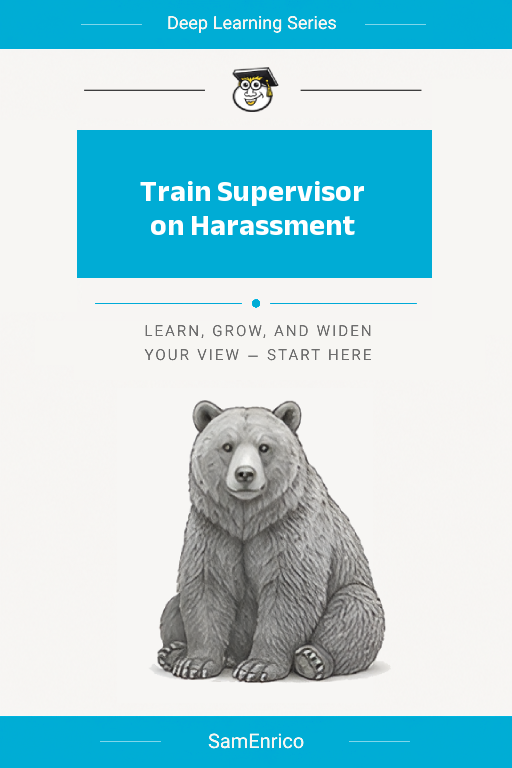
Non-FictionBusiness BriefHarassment Liability
Train Supervisor on Harassment eBook
Train first time supervisor on reporting harassmen
by Curry Molly
Train first time supervisor on reporting harassment complaints. Supervisor knowledge creates automatic employer liability for workplace harassment.
Formats
Free sample
Chapter 1: The Pipes of Liability--–- The phone rang at 2:17 AM. Sarah Chen, a first-time shift supervisor at a Midwest logistics center, almost didn’t answer. She was exhausted. Her team had been short-staffed all week, and she had just fallen asleep after a fourteen-hour day. But something made her pick up.
On the other end was Marcus, one of her best forklift operators. His voice was shaking.“Sarah, I’m sorry to call so late. But I need to tell you something about Dave. He’s been… he’s been sending me messages. For months.
About my girlfriend. About what he wants to do to her. I told him to stop. He won’t. I can’t sleep.
I can’t focus. I don’t know what to do.”Sarah’s stomach dropped. Dave was the lead operator, a fifteen-year veteran. He trained Marcus. He was also the unofficial “face” of the night shift, the guy everyone went to when machines broke down.
Sarah had seen Dave tease Marcus before—calling him “Romeo” and making jokes about his girlfriend. She thought it was just locker-room banter. Now she realized it was something else.“Please, Sarah,” Marcus said. “Don’t tell anyone. I don’t want to cause trouble.
I just needed someone to know.”What Sarah did next would determine whether her company paid $2.7 million in a jury verdict, whether Marcus would stay or quit, whether Dave would get help or escalate, and whether Sarah herself would be promoted or fired. She did not know any of this at 2:17 AM. She only knew she wanted to be a good supervisor. A nice person. Someone Marcus could trust.She told him, “I’ll handle it.
Don’t worry. I’ll talk to Dave tomorrow. Quietly.”That was the $2.7 million mistake.The Good Supervisor’s Trap Every year, thousands of first-time supervisors make the same choice Sarah made. They choose kindness over compliance. They choose quiet over clarity.
They choose the path of least immediate conflict—and in doing so, they create the greatest possible long-term liability for themselves and their employers.This is what we call the Good Supervisor’s Trap. It is the single most dangerous dynamic in workplace harassment law, and almost no one talks about it.The Good Supervisor’s Trap operates on a simple, seductive logic:An employee reports a concern, often with the plea “don’t tell anyone.”The supervisor wants to protect the employee and maintain trust.The supervisor decides to “handle it privately” to avoid embarrassing anyone or causing “drama.”The supervisor says nothing to HR, documents nothing, and attempts a quiet conversation with the accused.Either the harassment continues, or the victim feels betrayed when nothing changes, or the accused retaliates against the victim for “telling.”By the time HR finds out—often months later during an exit interview or a lawsuit—the evidence is cold, witnesses have scattered, and the company’s legal defenses have evaporated.Sarah Chen lived this trap. The morning after Marcus’s call, she pulled Dave aside before the shift change. She said, “Hey, I think you might be coming on a little strong with Marcus. Maybe dial it back, okay?” Dave shrugged, said “Sure, no problem,” and walked away.For two weeks, nothing happened.
Sarah assumed she had fixed it. Then Marcus called again. This time, Dave had cornered him in the parking lot. “You told her, didn’t you? You’re dead, Romeo.” Marcus quit the next day.
He filed a complaint with the EEOC a week later. During the investigation, Sarah’s initial conversation with Dave was unearthed through witness interviews. The company’s lawyers asked her: “Did you report this to HR?” She said no. “Did you document the conversation?” No. “Did you separate the parties?” No.
“Did you tell Marcus you couldn’t keep his confidence?” She shook her head.The jury awarded Marcus 2.7millionforhostileworkenvironmentandconstructivedischarge.Thecompany’sinsurercoveredmostofit,butthedeductibleandincreasedpremiumscostthecompanynearly2.7 million for hostile work environment and constructive discharge. The company’s insurer covered most of it, but the deductible and increased premiums cost the company nearly 2.7millionforhostileworkenvironmentandconstructivedischarge.Thecompany’sinsurercoveredmostofit,butthedeductibleandincreasedpremiumscostthecompanynearly400,000. Sarah was terminated for failing to follow reporting procedures. In her exit interview, she said, “I was just trying to be a good supervisor.”That is the trap. And this book is the key to escaping it.Why You Are the Pipes (Not the Plumber)To understand why Sarah’s seemingly kind choice was legally catastrophic, you need to understand a fundamental principle of harassment law: constructive notice.Under federal law and the laws of virtually every state, an employer is legally deemed to know anything its supervisors know.
This is called “imputed knowledge.” Your brain, in other words, is a pipe. What flows through it—what you see, what you hear, what you reasonably should have seen or heard—flows directly into the company’s legal bloodstream. The moment you know about potential harassment, the company knows.This matters because the company’s primary defense in any harassment lawsuit is: “We had no idea this was happening. If we had known, we would have stopped it immediately.” Your knowledge destroys that defense. Once you know, the company cannot claim ignorance.
And if the company cannot claim ignorance, it becomes strictly liable for any harassment that continues after you knew.Let that sink in. Strictly liable means the company is automatically responsible, regardless of whether it did anything wrong. The only question becomes: how much will the jury award?This is why the Good Supervisor’s Trap is so dangerous. When Sarah chose to “handle it quietly,” she did not protect Marcus. She did not protect Dave.
She did not protect herself. She created a situation where the company had knowledge (because she knew) but no record of that knowledge (because she didn’t report it). The harassment continued. When Marcus finally sued, the company had no defense. Sarah had unknowingly destroyed it.Key distinction: You are not the plumber.
A plumber fixes leaks. You are the pipe. Your role is to detect the leak and immediately send water—information—to HR, legal, or the ethics hotline. You do not fix the leak yourself. You do not diagnose the cause.
You do not decide whether the leak is “serious enough.” You transmit. That is your job. That is your legal duty.The Two Tiers of Supervisor Authority Not every supervisor carries the same legal weight. The Supreme Court’s decision in Vance v. Ball State University (2013) created an important distinction that every supervisor needs to understand.
This book uses a Two-Tier Framework to clarify your role and your risk.Tier 1: Statutory Supervisor You are a Tier 1 supervisor if you have the power to take tangible employment actions: hiring, firing, demoting, promoting, transferring, or disciplining employees. This includes most managers, directors, department heads, and anyone with signature authority over personnel decisions.If you are Tier 1, you trigger strict vicarious liability. That means if you engage in harassment yourself, or if you know about harassment and fail to take prompt remedial action (which always means reporting to HR immediately), the company is automatically liable. No defenses. No excuses.
The only question is damages.In practical terms, this means Tier 1 supervisors must be hyper-vigilant. Your failure to report is…
This is the end of the free sample. Get the eBook to keep going. Buy now
About this book
Details
- Author
- Curry Molly
- Publisher
- SamEnrico
- Language
- English
- Genre
- Non-Fiction, Business Brief, Harassment Liability
- Released
- 2026-05-30
- Pages (approx.)
- 155
- Available as
- eBook, Audiobook

Read better in the ZLOADR app
Your eBooks on your phone or tablet. Sign in with your SamEnrico account and start reading.
More by Curry Molly
 Comparison Culture for Single PeopleCurry Molly$11.99
 Sequoia Stroll GuideCurry Molly$11.99
 The MBSR Audio GuideCurry Molly$11.99
 Facial Expression Wrinkle Training ManualCurry Molly$11.99
 Effortless Meditation MethodCurry Molly$11.99
 Breath for ExecutivesCurry Molly$11.99
 Rockefeller Personal LifeCurry Molly$11.99
 Arthritis X Ray ImagingCurry Molly$11.99
 Local Support Group FinderCurry Molly$11.99
 The Last Broadcast: The Fall of Saigon Through the Eyes of a ReporterCurry Molly$11.99
 The Bloodied Path to Unity: Ying Zheng's War of ConquestCurry Molly$11.99
 How to Start a Hobby in Collecting ClocksCurry Molly$11.99
You may also like
 Hong Kong Handover 1997Dunn Johnnie$11.99
 Zumba For Postnatal Recovery CourseNeal Christian$11.99
 Zumba for BeginnersLadner Nikia$11.99
 YouTube Comment Mining GuideHumes Pandora$12.99
 Worry Box MeditationCarlin Rudy$11.99
 Workplace Stress MeditationNguyen Lynn$11.99
 Workplace Stress and Sleep RepairHawley Ivory$11.99
 Workplace Perfectionism CureDelaney Jeffry$11.99
 Workplace Injustice Anger GuideWallen Isabelle$11.99
 Work Addiction and Burnout LinkGreenwood Ester$11.99
 Women in Yoga and WellnessBeattie Galina$11.99
 Women in Stand Up ComedyChun Evangeline$11.99