
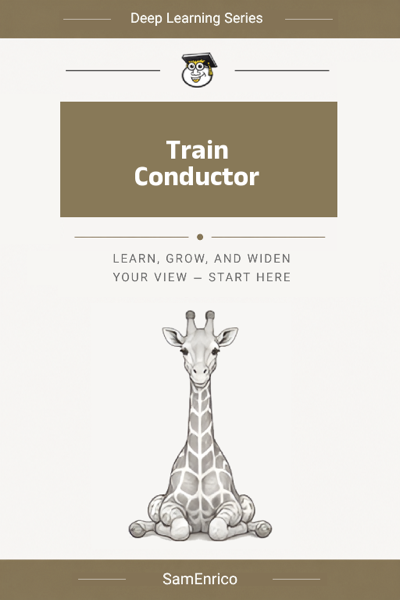
Non-FictionInformativeEducational
Train Conductor eBook
A Coursebook on Train Conductor
A Coursebook on Train Conductor
Formats
Free sample
Chapter 1: The Silent Captain...--The locomotive’s horn shattered the morning silence of a small Wisconsin town as a mile-long freight train rumbled across the rural crossing. Inside the lead locomotive, two men sat side by side, separated by less than three feet of metal and glass. One of them – the engineer – had his hand on the throttle, controlling 18,000 horsepower of diesel-electric fury. The other – the conductor – held no throttle, no brake lever, no steering wheel. Yet when that train moved, it moved because he said so.
When it stopped, it stopped because he ordered it. And if something went wrong in the next five seconds, the conductor’s voice on the radio would matter more than the engineer’s hands on the controls.This is the reality that most people never see. Ask a random stranger on the street, “Who runs a train?” and they will almost certainly say “the engineer.” Hollywood has reinforced this image for a century: the grizzled man in the striped cap, leaning out the cab window, hand on the throttle, eyes on the tracks. It makes for a compelling visual. It is also wrong.The engineer is a pilot.
The conductor is a captain. The difference is not semantic; it is legal, operational, and often life-saving.Before we go any further, let us establish something that will underpin every page of this book: the hierarchy of command on a train is not what you think it is. The engineer controls the locomotive’s motion – the throttle, the dynamic brakes, the speed. But the conductor controls everything else: when the train departs, whether it is safe to move, how the crew is deployed, how emergencies are handled, and ultimately, who is held accountable if something goes wrong. This authority is not informal tradition; it is written into federal regulations, railroad operating rules, and the collective bargaining agreements that have governed rail labor for over a century.So why does the conductor sit in the shadows of public perception?
Partly because the role has changed dramatically over time. Partly because the best conductors are invisible – when they do their jobs perfectly, nothing goes wrong, and no one notices. And partly because the story of the conductor is a story of a profession that transformed from brute physical labor into sophisticated systems management, a transformation that mirrors the evolution of work itself in the industrial age.This book is that story. It is also a guide, a manual, and a call to respect an occupation that keeps the backbone of modern commerce – and the lifeline of passenger travel – moving safely. Whether you are an aspiring conductor studying for your first certification exam, a rail enthusiast who wants to understand what really happens in the cab, or a manager seeking to understand the frontline realities of railroad operations, this chapter – and those that follow – will give you a view of the rails that few ever see.But before we dive into modern procedures, before we explore air brakes and track warrants and hazardous materials, we have to start where every conductor’s story starts: with the question of who this person is, where the job came from, and why it matters more today than ever before.The Birth of the Conductor: America’s First Middle Manager To understand the conductor, we must travel back to the 1830s, when railroads were new, dangerous, and wildly disorganized.
The first trains were little more than steam engines pulling a few cars on wooden rails. There was no standard system for signaling, no formal timetable discipline, and certainly no concept of a “conductor” as we know it. The locomotive engineer was the de facto leader of the train, simply because he was the only one who understood the machinery.That changed quickly – and violently.As railroads expanded in the 1840s and 1850s, collisions became horrifyingly common. Two trains on the same track, heading toward each other, with no reliable way to communicate, no system for knowing who had right-of-way, and no single person responsible for operational decisions. The result was predictable: wrecks that killed passengers, crew, and bystanders.
The American public, enamored with rail travel but terrified of its dangers, began demanding accountability.The railroad industry’s answer was the conductor.The earliest known use of the title “conductor” on an American railroad appears in an 1841 operating rulebook for the Western Railroad of Massachusetts. The role was simple at first: the conductor was responsible for the train’s paperwork – waybills, passenger manifests, cargo lists – and for ensuring that the train departed on time. But within a decade, the role expanded dramatically. By the 1850s, conductors were also responsible for supervising brakemen (hence the term “head brakeman”), managing passenger behavior, collecting fares, and most critically, making operational decisions when the engineer could not see what was ahead.Consider what this meant in practice. A train in 1860 had no radio, no cell phone, no GPS, no signal system that extended more than a few hundred feet from a station.
The engineer sat in a cab with limited forward visibility, especially at night or in foul weather. He could not see around curves, could not see behind the train, and could not see the condition of cars behind the locomotive. The conductor, however, could walk the length of the train, could post brakemen at strategic points, and could make decisions based on information the engineer simply did not have.Thus emerged the fundamental division of authority that persists to this day: the engineer manages the locomotive; the conductor manages the train.This division was codified in the General Rules and Regulations of most major railroads by the 1870s. The conductor was explicitly designated as the “superior officer” of the train, with authority over all crew members including the engineer. The engineer could refuse an order if it would cause an immediate safety hazard – a provision called “right of refusal” – but otherwise, the conductor’s word was final.This was revolutionary.
In an era of rigid hierarchy, railroads created a role that was explicitly supervisory but not managerial, technical but not clerical, accountable but not desk-bound. The conductor was America’s first true middle manager, and the model spread from railroads to factories, shipping lines, and eventually to corporate America itself.The Head Brakeman: Muscle and Courage The evolution of the conductor’s title from “head brakeman” is not a footnote; it is a window into the physical brutality of early railroading. Before the invention of the automatic air brake in 1869 (which we will explore in depth in Chapter 3), stopping a train required brute human force. Each car had its own brake – a simple lever that pressed a wooden brake shoe against the wheel. To stop the train, brakemen had to run along the tops of moving cars, leaping from car to car, and manually apply the brakes in sequence.This was the conductor’s original frontline crew.The “head brakeman” – later renamed the conductor – was the brakeman responsible for the forward cars, coordinating with the rear brakeman to apply brakes in a sequence that would stop the train smoothly without snapping the couplings between cars.
The work was astonishingly dangerous. Brakemen fell between cars, were crushed by couplings, slipped off icy roofs, and were struck…
This is the end of the free sample. Get the eBook to keep going. Buy now
About this book
Details
- Author
- Bravo Berenice
- Publisher
- SamEnrico
- Language
- English
- Genre
- Non-Fiction, Informative, Educational
- Released
- 2026-05-09
- Pages (approx.)
- 142
- Available as
- eBook, Audiobook

Read better in the ZLOADR app
Your eBooks on your phone or tablet. Sign in with your SamEnrico account and start reading.
More by Bravo Berenice
 The MMORPG Addiction GuideBravo Berenice$11.99
 Hedgehog Anti Submarine GuideBravo Berenice$11.99
 Self Esteem During DisabilityBravo Berenice$11.99
 Metta For SchizophreniaBravo Berenice$11.99
 The Triple Negative Breast GuideBravo Berenice$11.99
 The Ballad of Billy the Runner: How a Colonial Journalist Changed Australian SportsBravo Berenice$11.99
 Understanding Spastic Paraplegia Familial Autosomal Recessive FormBravo Berenice$17.99
 How to Start a Civic Trust Business (Beginners Guide)Bravo Berenice$11.99
 Import Pricing Inflation GuideBravo Berenice$12.99
 HARO Mobile App StrategyBravo Berenice$12.99
You may also like
 Hong Kong Handover 1997Dunn Johnnie$11.99
 Zumba For Postnatal Recovery CourseNeal Christian$11.99
 Zumba for BeginnersLadner Nikia$11.99
 YouTube Comment Mining GuideHumes Pandora$12.99
 Worry Box MeditationCarlin Rudy$11.99
 Workplace Stress MeditationNguyen Lynn$11.99
 Workplace Stress and Sleep RepairHawley Ivory$11.99
 Workplace Perfectionism CureDelaney Jeffry$11.99
 Workplace Injustice Anger GuideWallen Isabelle$11.99
 Work Addiction and Burnout LinkGreenwood Ester$11.99
 Women in Yoga and WellnessBeattie Galina$11.99
 Women in Stand Up ComedyChun Evangeline$11.99