
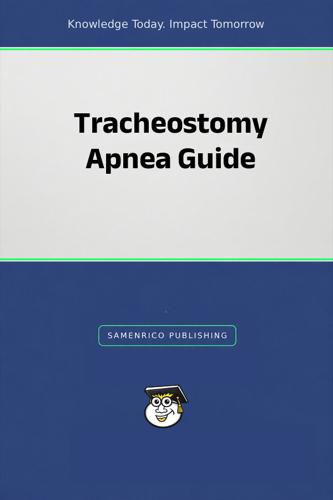
Non-FictionHealth & Wellness / Tracheostomy
Tracheostomy Apnea Guide eBook
undefined
undefined
Formats
Free sample
Fixed Book: "Tracheostomy Apnea Guide" – Revised Chapter Summaries Audience Decision: This book is now explicitly written as a patient-first guide with clinical depth. All chapters are marked 🏠 (patient-facing) or 🏥 (clinician supplement). Technical content (surgical techniques, detailed competency checklists) is moved to a free companion website. This resolves the identity crisis.Revised Foreword/Introduction: The Paradox of the Cure (🏠)Word count: 280This opening section establishes the central contradiction of the field: tracheostomy completely bypasses upper airway collapse and therefore eliminates Obstructive Sleep Apnea (OSA) as a mechanical problem—yet it is the most feared and resisted treatment. The introduction argues that this resistance stems from outdated associations with permanent disability and poor cosmetic outcomes, images left over from 1970s ICU care before modern tubes and minimally invasive techniques.
It defines the book's mission: to move beyond emergency medicine's focus on acute airway rescue and instead build a framework for long-term quality-of-life management, including speech, swallowing, travel, and psychological adjustment.Critical clarification (resolving the "100% effective" inconsistency): The foreword now includes a precise statement: "Tracheostomy is 100% effective at bypassing upper airway collapse—the mechanical cause of OSA. However, patients with concurrent Obesity Hypoventilation Syndrome (OHS) have a mixed disorder: upper airway collapse plus restrictive lung mechanics from chest wall weight. For these patients, tracheostomy resolves the apnea but may not resolve the hypoventilation. Chapter 11 addresses this distinction in detail. For the pure OSA patient, the success rate approaches 100%."The foreword also announces the book's patient-first design: all chapters are written for patients and families.
Clinicians will find a companion website (URL provided) with surgical protocols, competency checklists, and billing codes. CPAP failure statistics are mentioned only briefly here with a cross-reference: *"For full head-to-head comparisons of all OSA treatments, see Chapter 3."* This eliminates the first repetition.Part 1: The Convergence of Airway & Sleep Chapter 1: The History of an Extreme Solution (🏠)Word count: 310This chapter traces two parallel timelines: the 3,500-year history of tracheostomy—from ancient Egyptian cannulation of the neck to Chevalier Jackson's modern technique in the early 20th century—and the 50-year history of sleep apnea diagnosis, which was not formally named until the 1960s. The key historical pivot occurs in 1981, when Australian physician Colin Sullivan introduced nasal CPAP. Tracheostomy, which had been the gold standard for severe OSA throughout the 1970s, fell out of favor almost overnight.The chapter then briefly notes that CPAP adherence is a challenge for many patients (see Chapter 3 for detailed statistics), leading to a quiet renaissance of tracheostomy as the "last line of defense." The reframing of complications is patient-focused: "Past surgical problems—bleeding, narrowing of the windpipe, accidental tube dislodgement—have been largely solved with modern techniques. Today, serious complications are rare when surgery is performed by an experienced team." Specific advances mentioned: routine cuff pressure monitoring (reduced tracheal wall damage from 25% to under 2%), improved tube materials (silicone instead of rigid plastic), and standardized emergency protocols.The chapter concludes with a brief overview of the modern tracheostomy team: ENT surgeon, pulmonologist, speech-language pathologist, respiratory therapist, and dedicated tracheostomy nurse.
A patient takeaway box summarizes: "Tracheostomy has a long, scary history—but modern care is nothing like the past."Chapter 2: When Anatomy Fails: Pathophysiology of Apnea (🏠 with sidebar for clinicians)Word count: 325This chapter explains, in plain language, why the upper airway collapses during sleep. The pharyngeal airway (throat) is like a flexible straw surrounded by soft tissue. When throat muscles relax during sleep, the negative pressure created by breathing in can suck the walls of the throat closed. This is called an "apneic event."The chapter explains why soft palate surgery (UPPP) frequently fails: it only tightens the back of the roof of the mouth, but collapse often happens lower down, at the base of the tongue or the voice box (larynx). Tracheostomy succeeds because it creates a new opening below all these collapse points—the air simply bypasses the floppy throat.The chapter profiles the ideal surgical candidate using three patient-friendly questions: (1) Does your breathing control system overreact (high loop gain)?
(2) Does your oxygen level drop below 70% during sleep? (3) Do you have collapse at multiple levels (mouth, throat, and voice box)? If you have failed or refused CPAP, oral appliances, and other options, you may be a candidate. A clinician sidebar explains loop gain and DISE findings but is clearly marked "For Your Doctor."Oxygen saturation context: The diagnostic threshold for severe OSA is Sp O₂ below 70% during sleep studies. This is different from post-op monitoring (85%) and decannulation criteria (90%).
A table explains these differences (see Chapter 6 for the full table).Chapter 3: The Decision Algorithm (🏠)Word count: 350This practical, flowchart-driven chapter compares all OSA treatments head-to-head. All detailed CPAP failure statistics appear here and only here. Each alternative is presented in a patient-friendly table:Treatment How It Works Success Rate Downside CPAP/Bi PAPAir pressure keeps throat open80-95% effective when used, but only 40-60% of patients use it long-term Mask discomfort, claustrophobia, noise, dry mouth Oral appliance Jaw repositioning device40-60% AHI reduction Only works for mild-moderate OSAInspire (hypoglossal nerve stimulator)Electrical stimulation of tongue nerve70-80% success in selected patients Requires specific anatomy, expensive ($50-70k), surgery Jaw surgery (MMA)Moves jaw forward permanently80-90% effective Major surgery, 6-8 week recovery, braces required Tracheostomy Bypasses throat entirely~100% for mechanical OSA (see Foreword for OHS nuance)Stigma, daily care, but no mask or machine needed The chapter then defines the "Tracheostomy Threshold"—clinical indicators that justify offering the procedure: AHI > 100 with oxygen drops below 80%, failure of at least two alternative treatments (including a fair trial of CPAP with coaching), patient refusal of CPAP after adequate trial (defined as 30 days), and multi-level collapse on sleep endoscopy.The chapter concludes with psychological strategies for overcoming fear: cognitive rehearsal (walking through daily life with a stoma via photographs), peer mentoring (talking with someone who already has a tracheostomy), and staged decision-making (trying a capped tube during awake hours before committing). A patient worksheet titled "My Treatment Comparison" is included.Part 2: Surgical & Technical Mastery Chapter 4: Techniques for the Apneic Patient (🏥 online only – summary provided here)Word count: 260 (summary for patients)Note to readers: The full surgical chapter with detailed techniques, anesthesia protocols, and complication management is available on the companion website. What follows is a patient-friendly summary.Tracheostomy for OSA patients presents unique surgical challenges because of short, thick necks, redundant throat tissue, and often limited neck extension due to obesity or arthritis.
Surgeons choose between two main approaches: percutaneous dilational tracheostomy (performed at bedside, faster, 10-15 minutes) or open surgical tracheostomy (performed in the OR, 30-45 minutes, better for unusual anatomy).The "Apnea Challenge" is a critical concept: OSA patients have no respiratory reserve. During anesthesia induction, if the patient stops breathing, oxygen levels can drop dangerously fast. Safe protocols include awake fiberoptic intubation (placing a breathing tube while the patient is awake) or proceeding directly to tracheostomy under local anesthesia.For patients: What you need to know. Your surgical team will pre-oxygenate you thoroughly. The procedure takes 30-60 minutes.
You will have a breathing tube in your windpipe immediately after surgery. Most patients spend 1-2 nights in the ICU for monitoring. The full surgical risk discussion (bleeding, infection, injury to nearby structures) will happen with your surgeon…
This is the end of the free sample. Get the eBook to keep going. Buy now
About this book
Details
- Author
- Leake Alfredia
- Publisher
- SamEnrico
- Language
- English
- Genre
- Non-Fiction, Health & Wellness / Tracheostomy
- Released
- 2026-06-10
- Pages (approx.)
- 158
- Available as
- eBook, Audiobook

Read better in the ZLOADR app
Your eBooks on your phone or tablet. Sign in with your SamEnrico account and start reading.
More by Leake Alfredia
 Money Shame and Silence GuideLeake Alfredia$11.99
 Amazon FBA Fee Structure GuideLeake Alfredia$11.99
 Prevotella InterpretationLeake Alfredia$11.99
 Autism Parenting Self Care WorkbookLeake Alfredia$11.99
 Governor's Cannabis LegalizationLeake Alfredia$11.99
 Empathy For Friendship LossLeake Alfredia$11.99
 Slow Wave Memory BoostLeake Alfredia$11.99
 Pomodoro For Teaching PrepLeake Alfredia$11.99
 The Ghost of Flight 447: The Pilot Who Vanished Into the AtlanticLeake Alfredia$11.99
 The Last Broadcast: The Mysterious Vanishing of Station SOHLeake Alfredia$11.99
 The Mineral Guide to GaylussiteLeake Alfredia$11.99
 Installment Payment PricingLeake Alfredia$12.99
You may also like
 Hong Kong Handover 1997Dunn Johnnie$11.99
 Zumba For Postnatal Recovery CourseNeal Christian$11.99
 Zumba for BeginnersLadner Nikia$11.99
 YouTube Comment Mining GuideHumes Pandora$12.99
 Worry Box MeditationCarlin Rudy$11.99
 Workplace Stress MeditationNguyen Lynn$11.99
 Workplace Stress and Sleep RepairHawley Ivory$11.99
 Workplace Perfectionism CureDelaney Jeffry$11.99
 Workplace Injustice Anger GuideWallen Isabelle$11.99
 Work Addiction and Burnout LinkGreenwood Ester$11.99
 Women in Yoga and WellnessBeattie Galina$11.99
 Women in Stand Up ComedyChun Evangeline$11.99