
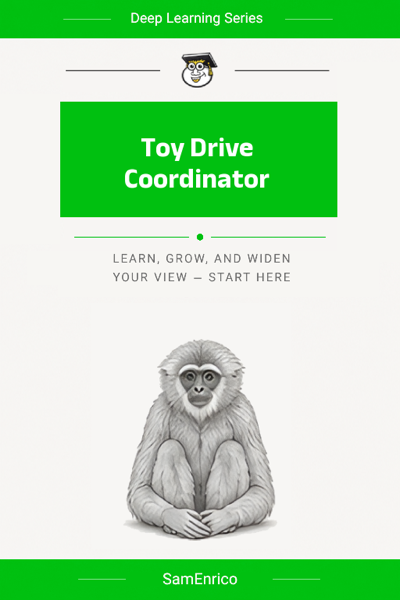
Non-FictionInformativeEducational
Toy Drive Coordinator eBook
A Coursebook on Toy Drive Coordinator
by Neel Nicky
A Coursebook on Toy Drive Coordinator
Formats
Free sample
Chapter 1: The Good Person Trap...--–- Every toy drive starts with a heart in the right place. Every toy drive coordinator begins with the same noble intention: to bring joy to a child who might otherwise wake up to nothing on Christmas morning. And every year, thousands of well-meaning drives fail spectacularly—not because people are cruel or lazy, but because good intentions are not a strategy.This chapter exists because you are about to walk into a trap that has caught nearly every first-time coordinator before you. The trap looks like this: you feel a warm glow of generosity, you put out a collection box, you tell your friends on social media, and you wait for the magic to happen. Then December arrives, and you find yourself standing in a storage unit surrounded by 400 used stuffed animals, seventeen half-broken action figures, and exactly three items suitable for a teenager.
Meanwhile, a local shelter has been calling you for weeks asking if you have anything for their 150 registered children, and you have nothing to give them.This is the Good Person Trap. It is the belief that good intentions alone produce good outcomes. They do not. What produces good outcomes is a clear mission, a specific plan, and the discipline to say no to things that feel generous but do not serve your actual goal. This chapter will pull you out of that trap before you fall in.The Failure Mode of Vague Generosity Let us begin with a story.
In 2019, a church in a mid-sized Midwestern city decided to run a holiday toy drive. The announcement read: “Bring new or gently used toys to the church lobby. Let’s make sure every child in our community has a gift this Christmas.” The congregation responded enthusiastically. Within three weeks, the lobby was overflowing.What was in those boxes? A detailed inventory taken by a frustrated volunteer coordinator revealed the following: 312 stuffed animals (most visibly used, some with stains), 84 puzzles with missing pieces (donated as “gently used,” meaning a previous child had lost half the parts), 17 realistic-looking toy guns (later confiscated by a visiting police officer), 6 baby toys intended for infants under three months old (the drive had no families with infants registered), and exactly 11 items suitable for teenagers (all of which were claimed within the first hour of distribution).The church had registered 200 families.
After sorting, they had usable gifts for approximately 40 children under age 7. The remaining 160 families were told, “We’re sorry, we ran out.” The coordinator quit volunteer work entirely. The church did not run a toy drive the following year.This story is not unusual. It is, in fact, the modal outcome of unplanned toy drives. The problem was not lack of effort.
The problem was lack of specificity. The announcement never asked for anything in particular, so it received everything in general. The coordinator never established who exactly they were serving, so they had no way to know whether a puzzle was appropriate. There was no mission, so there was no filter.The Anatomy of a Mission-Driven Drive A mission-driven drive begins with a single question, and it is not “How many toys can we collect?” That question leads to hoarding. The correct question is: “Which specific children are we serving, and what exactly do they need?”Notice the word “specific.” A drive that serves “children in our community” serves no one well.
A drive that serves “children ages 4–7 registered with the Southside Family Resource Center” serves a real population with real needs. The difference is not semantic. It is operational.A specific mission gives you five things that vague generosity cannot provide:First, it gives you a quantity target. If the Southside Family Resource Center has 150 registered children, you know you need 150 gifts. Not 500.
Not “as many as possible.” One hundred and fifty. This number becomes your north star. Every decision—every bin placed, every dollar spent, every volunteer recruited—is measured against it.Second, it gives you an age distribution. Those 150 children break down into specific age brackets: forty children ages 0–3, sixty children ages 4–7, thirty children ages 8–12, and twenty teenagers ages 13–17. Notice the teenagers.
They are always the smallest group and always the most forgotten. A mission-driven drive does not forget them because the mission statement includes them from the start.Third, it gives you a quality standard. You are not collecting “toys.” You are collecting new, unwrapped, age-appropriate items that meet safety standards. This standard allows you to reject the used stuffed animals, the broken puzzles, the realistic weapons. You are not being ungrateful.
You are being faithful to your mission.Fourth, it gives you a distribution method. If you are serving families already registered with a resource center, you have a built-in channel. You do not need to figure out how to find “children in need.” The partner agency has already done that work. Your job is to support their existing relationships, not invent new ones.Fifth, it gives you a feedback loop. After the drive, you can ask the resource center: did these toys work?
What did we miss? What should we do differently next year? Vague drives have no one to ask. Mission-driven drives improve every single year because they have a partner who tells them the truth.SMART Goals for Toy Drives (With Teeth)You have probably encountered SMART goals before. Specific, Measurable, Achievable, Relevant, Time-bound.
In corporate settings, these can feel like bureaucratic box-checking. In toy drives, they are survival tools.Let us rewrite the church’s failed announcement as a SMART goal:“Collect 150 new, unwrapped toys for the 150 children (ages 0–17) registered with the Southside Family Resource Center, distributed by age as follows: 40 toys for ages 0–3, 60 toys for ages 4–7, 30 toys for ages 8–12, and 20 gifts for teens (target gift cards at $15 each), to be delivered to the Resource Center by December 15.”This goal is specific (it names the partner, the age brackets, and the exact counts). It is measurable (you can count toys by bin and know whether you have reached 150). It is achievable (150 toys is a realistic target for a mid-sized congregation). It is relevant (it serves an actual registered population).
It is time-bound (December 15).Now compare this to the original announcement: “Bring new or gently used toys.” The difference is not subtle. The SMART goal tells every potential donor exactly what to buy, how many are needed, and for whom. It also tells you, the coordinator, exactly when to stop. A drive without a SMART goal never knows when it is done. It just keeps collecting until someone gets tired.Setting the Budget Before the First Toy Arrives Here is where most coordinators make their second mistake.
They assume that a toy drive costs nothing to run. After all, the toys are donated. The volunteers are free. What could possibly cost money?What costs money: the bins you place at collection sites ($15–30 each, depending on size and durability). The flyers you print to advertise the drive ($50–200 depending on quantity and color).
The storage unit or warehouse space if you are collecting more than 500 toys (often $100–300 for a month). The snacks and coffee for volunteers during the sorting party (budget $5–10 per volunteer). The postage…
This is the end of the free sample. Get the eBook to keep going. Buy now
About this book
Details
- Author
- Neel Nicky
- Publisher
- SamEnrico
- Language
- English
- Genre
- Non-Fiction, Informative, Educational
- Released
- 2026-06-02
- Pages (approx.)
- 146
- Available as
- eBook, Audiobook

Read better in the ZLOADR app
Your eBooks on your phone or tablet. Sign in with your SamEnrico account and start reading.
More by Neel Nicky
 MBSR For Relationship Conflict HandbookNeel Nicky$11.99
 Cognitive Restructuring Work StressNeel Nicky$11.99
 PCOS Ultrasound FindingsNeel Nicky$11.99
 The Andrea Ghez Supermassive Black HoleNeel Nicky$11.99
 Seed Visualization Growth CalmNeel Nicky$11.99
 The Frost and the Fury: Peter the Great's Siege of Narva (1700)Neel Nicky$11.99
 Understanding Osteopathia Striata Pigmentary Dermopathy White ForelockNeel Nicky$17.99
 Tutoring Chinese College Students OnlineNeel Nicky$12.99
 Terms of Service Liability LimitationNeel Nicky$12.99
 How to Start a Christmas Card Printing Business (Beginners Guide)Neel Nicky$11.99
You may also like
 Hong Kong Handover 1997Dunn Johnnie$11.99
 Zumba For Postnatal Recovery CourseNeal Christian$11.99
 Zumba for BeginnersLadner Nikia$11.99
 YouTube Comment Mining GuideHumes Pandora$12.99
 Worry Box MeditationCarlin Rudy$11.99
 Workplace Stress MeditationNguyen Lynn$11.99
 Workplace Stress and Sleep RepairHawley Ivory$11.99
 Workplace Perfectionism CureDelaney Jeffry$11.99
 Workplace Injustice Anger GuideWallen Isabelle$11.99
 Work Addiction and Burnout LinkGreenwood Ester$11.99
 Women in Yoga and WellnessBeattie Galina$11.99
 Women in Stand Up ComedyChun Evangeline$11.99