
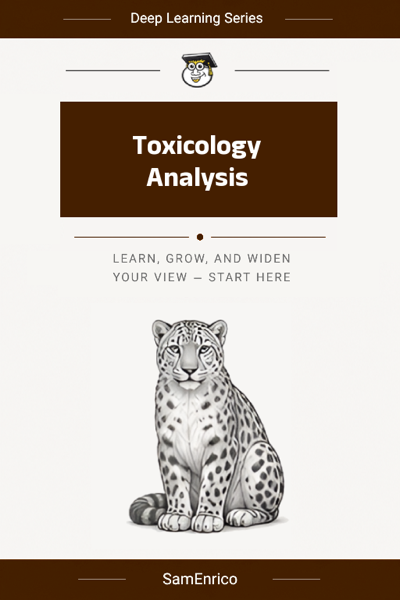
Non-FictionInformativeEducational
Toxicology Analysis Audiobook
A Coursebook on Toxicology Analysis
A Coursebook on Toxicology Analysis
Formats
Free sample
Chapter 1: The Poison Question...--– In a quiet London sushi bar on November 1, 2006, former Russian intelligence officer Alexander Litvinenko sipped tea with two associates. Hours later, he began vomiting. Within days, his hair fell out, his bone marrow failed, and he died a slow, agonizing death. The poison was polonium-210, a rare radioactive isotope that emits alpha particles—radiation that cannot penetrate skin but destroys every cell it touches from within. The analytical toxicologists who solved this case did not rely on a single test, a single instrument, or a single sample type.
They measured polonium in urine, detected its decay products in multiple biological matrices, traced its path through London using radiation signatures on airplane seats and hotel rooms, and ultimately proved that a tiny amount of a nearly undetectable substance had killed a man. This case exemplifies the central argument of this book: toxicology analysis is not merely a collection of laboratory techniques. It is a systematic investigative discipline that bridges analytical chemistry, pharmacology, and forensic science to answer a single, deceptively simple question: Is there a poison in this person, and if so, what is it doing to them?The question sounds straightforward, but its answer requires navigating a labyrinth of biological complexity, chemical diversity, and legal scrutiny. Consider what an analytical toxicologist must account for before running a single test. The human body contains approximately 37 trillion cells, each bathed in a complex fluid of proteins, lipids, salts, and metabolites.
Any foreign chemical—a drug, a pesticide, a heavy metal, or a natural toxin—enters this environment and immediately begins interacting with it. The toxicant may bind to proteins, rendering it invisible to certain detection methods. It may be metabolized by the liver into a completely different compound, sometimes more toxic than the original. It may distribute into fat tissue, leaving the bloodstream almost entirely. Or it may be excreted within hours, vanishing before the patient even arrives at the hospital.
The analytical toxicologist must predict these behaviors, choose the right biological matrix (blood, urine, hair, vitreous fluid, or tissue), select an appropriate analytical method, and then interpret the resulting number—not as an abstract concentration but as a clinically or forensically meaningful value.This chapter establishes the foundational framework for the entire book. It defines analytical toxicology, distinguishes its three primary sub-disciplines, introduces the core conceptual model that will guide every subsequent chapter, and illustrates these principles through…
This is the end of the free sample. Get the Audiobook to keep going. Buy now
About this book
Details
- Author
- Cousins Loise
- Publisher
- SamEnrico
- Language
- English
- Genre
- Non-Fiction, Informative, Educational
- Released
- 2026-05-07
- Pages (approx.)
- 160
- Available as
- eBook, Audiobook

Listen in the VoxFlicks app
Audiobooks and audio dramas wherever you go. Sign in with your SamEnrico account and press play.
More by Cousins Loise
 Looking Good Feeling GoodCousins Loise$11.99
 U Boat Ace Biography GuideCousins Loise$11.99
 The Teen Gambling Prevention GuideCousins Loise$11.99
 Loving Kindness For Self HarmCousins Loise$11.99
 The Listening for Legal ProfessionalsCousins Loise$11.99
 The Timbuktu Codex: When Africa's Wisdom Shaped the WorldCousins Loise$11.99
 How to Start a Acids (wholesale) Business (Beginners Guide)Cousins Loise$11.99
 Understanding Spastic Paraparesis, InfantileCousins Loise$17.99
 Startup Founder HARO GuideCousins Loise$12.99
 D2C Pricing Inflation GuideCousins Loise$12.99
You may also like
 Hong Kong Handover 1997Dunn Johnnie$11.99
 Zumba For Postnatal Recovery CourseNeal Christian$11.99
 Zumba for BeginnersLadner Nikia$11.99
 YouTube Comment Mining GuideHumes Pandora$12.99
 Worry Box MeditationCarlin Rudy$11.99
 Workplace Stress MeditationNguyen Lynn$11.99
 Workplace Stress and Sleep RepairHawley Ivory$11.99
 Workplace Perfectionism CureDelaney Jeffry$11.99
 Workplace Injustice Anger GuideWallen Isabelle$11.99
 Work Addiction and Burnout LinkGreenwood Ester$11.99
 Women in Yoga and WellnessBeattie Galina$11.99
 Women in Stand Up ComedyChun Evangeline$11.99