
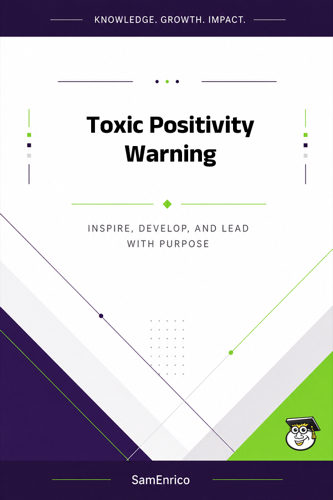
Non-FictionSelf-HelpToxic Positivity
Toxic Positivity Warning eBook
Rejecting 'just be grateful' advice and honoring r
by Bock Cheryll
Rejecting 'just be grateful' advice and honoring real stress.
Formats
Free sample
Chapter 1: The Gratitude Trap--–- It usually starts with a well-meaning friend, a loving parent, or an inspirational quote on a pastel background shared by someone who has never had to sit in the dark with their own despair. You are exhausted, overwhelmed, or grieving, and you finally muster the courage to say it out loud: “I’m really struggling.” And the response comes quickly, wrapped in a smile, delivered with sincerity: “Just be grateful for what you have. It could be so much worse.”In that moment, something inside you closes. Not because the advice is cruel—it is not intended to be. But because it lands like a door slamming shut on a room you just pried open.
You were not asking for a solution. You were asking to be seen. Instead, you were told to count your blessings, as if the very act of naming your pain was an act of ingratitude. And so you learn the first and most damaging lesson of toxic positivity: your real stress is an inconvenience to others. So you smile, nod, and bury it deeper.This chapter is called The Gratitude Trap because that is exactly what it is.
Gratitude, in its healthy form, is a profound and beautiful practice. It can anchor us, remind us of what remains when so much has been lost, and connect us to the present moment. But gratitude can also be weaponized. When it is deployed as a shield against discomfort—yours or someone else’s—it stops being a practice of appreciation and becomes a tool of emotional suppression. The trap is this: you are told that to feel your pain is to be ungrateful.
And because you do not want to be a bad person, you swallow the pain and perform happiness instead.The paradox of our era is staggering. We have more self-help books, wellness influencers, and gratitude journals than ever before. The global self-improvement industry is worth over forty billion dollars, and a significant portion of that revenue comes from products designed to help you “think positive.” And yet, according to the World Health Organization, rates of anxiety and depression rose by twenty-five percent during the first year of the pandemic alone. Burnout has become so normalized that we have invented corporate jargon for it. Young people report record levels of loneliness and hopelessness.
We are, by any measure, a generation in distress—wrapped in the clothing of relentless optimism.Why? Because we have been sold a lie. The lie is that negative emotions are failures. That stress is a character flaw. That if you are not grateful enough, happy enough, or positive enough, you are simply not trying hard enough.
This lie has a name: toxic positivity.Defining the Villain: What Toxic Positivity Actually Is Before we go any further, let us establish a clear, working definition that will serve as the foundation for every chapter that follows. This book will use this definition consistently, and every time we return to it, we will be building on what you learn here.Toxic positivity is the belief that people should maintain a positive mindset no matter how dire or painful their circumstances, and that any negative emotion is inherently a failure.Notice what this definition does not say. It does not say that optimism is bad. It does not say that looking for silver linings is harmful. It does not say that gratitude has no place in a difficult life.
What it says is that the demand for constant positivity—regardless of reality—is toxic. And it says that when you judge yourself or others for feeling sad, angry, or afraid, you are not practicing virtue. You are practicing emotional bypassing.Let me be very specific about the difference.Healthy optimism sounds like this: “This is really hard. I am struggling right now. But I have gotten through hard things before, and I believe I can find a way forward.” Notice that healthy optimism never denies the difficulty.
It acknowledges the pain and then, from that place of honesty, reaches toward hope.Toxic positivity sounds like this: “Don’t focus on the negative. Just be grateful. Happiness is a choice. Good vibes only.” Notice what is missing: any acknowledgment of the pain. The pain is not processed; it is skipped.
It is treated as an inconvenience, a distraction, or a moral failing.The difference is not in the presence or absence of hope. It is in the presence or absence of honesty.Over the course of this book, we will use this definition as our North Star. In Chapter 2, we will examine the specific phrases and cultural patterns that disguise toxic positivity as kindness. In Chapter 3, we will look at the neuroscience of why suppression backfires. And in Part IV, we will return to gratitude—but we will reclaim it, not as a weapon against ourselves, but as a companion to our grief.
For now, simply hold this definition. You will need it.The Paradox of the Happiness Obsession We live in a culture that is obsessed with happiness. This is not an accident. The pursuit of happiness is written into the founding documents of some nations. It is the plot of countless films, the promise of thousands of products, and the implicit guarantee of most self-help programs.
But here is the paradox that opens this book: the more we chase happiness, the more anxious and depressed we become.Why would that be?One reason is that the chase itself implies lack. When you are constantly striving to be happy, you are constantly telling yourself that you are not happy enough right now. The gap between where you are and where you “should” be becomes a source of chronic stress. This is what psychologists call the hedonic treadmill: no matter how much you achieve or acquire, you adapt quickly and return to a baseline level of contentment—so the chase never ends.But there is a darker reason. When a culture decides that happiness is mandatory, sadness becomes suspicious.
Grief becomes a problem to be solved rather than a process to be endured. Anger becomes something to be suppressed rather than a signal that something is wrong. And stress—normal, human, inevitable stress—becomes evidence that you are doing something wrong.Consider the research. A landmark study from Yale University found that students who believed negative emotions were “bad” or “unhelpful” had significantly higher rates of depression and anxiety than students who viewed all emotions as natural and informative. The difference was not in how much stress they experienced—both groups faced similar challenges.
The difference was in how they judged themselves for feeling stressed. The students who thought they “should” be happy were the ones who suffered most.This is the gratitude trap in action. You feel overwhelmed, and instead of saying, “Of course I feel overwhelmed—this is an overwhelming situation,” you say, “I should be grateful. Others have it worse. What is wrong with me?” That final question is the poison.
It turns legitimate stress into shame. And shame, unlike stress, is not a useful signal. It is a dead end.Gratitude Guilt: The Specific Wound This Book Heals…
This is the end of the free sample. Get the eBook to keep going. Buy now
About this book
Details
- Author
- Bock Cheryll
- Publisher
- SamEnrico
- Language
- English
- Genre
- Non-Fiction, Self-Help, Toxic Positivity
- Released
- 2026-06-09
- Pages (approx.)
- 137
- Available as
- eBook, Audiobook

Read better in the ZLOADR app
Your eBooks on your phone or tablet. Sign in with your SamEnrico account and start reading.
More by Bock Cheryll
 Networking Memory StrategiesBock Cheryll$11.99
 Food Addiction in Men WorkbookBock Cheryll$11.99
 PhD Dissertation Stress GuideBock Cheryll$11.99
 Adrenal Fatigue and Thyroid LinkBock Cheryll$11.99
 Echoes of the Coral Sea: The Ancient Mariners of the Great Barrier ReefBock Cheryll$11.99
 Neon Shadows: The Forgotten Rebellion of Tokyo’s UndergroundBock Cheryll$11.99
 DraftspersonBock Cheryll$11.99
 Voiceover Character WorkBock Cheryll$12.99
 Children's Data Breach GuideBock Cheryll$12.99
 Understanding Ectrodactyly Cardiopathy DysmorphismBock Cheryll$17.99
 How to Become a Racing Secretary And HandicapperBock Cheryll$11.99
You may also like
 Hong Kong Handover 1997Dunn Johnnie$11.99
 Zumba For Postnatal Recovery CourseNeal Christian$11.99
 Zumba for BeginnersLadner Nikia$11.99
 YouTube Comment Mining GuideHumes Pandora$12.99
 Worry Box MeditationCarlin Rudy$11.99
 Workplace Stress MeditationNguyen Lynn$11.99
 Workplace Stress and Sleep RepairHawley Ivory$11.99
 Workplace Perfectionism CureDelaney Jeffry$11.99
 Workplace Injustice Anger GuideWallen Isabelle$11.99
 Work Addiction and Burnout LinkGreenwood Ester$11.99
 Women in Yoga and WellnessBeattie Galina$11.99
 Women in Stand Up ComedyChun Evangeline$11.99