
Non-FictionInformativeEducational
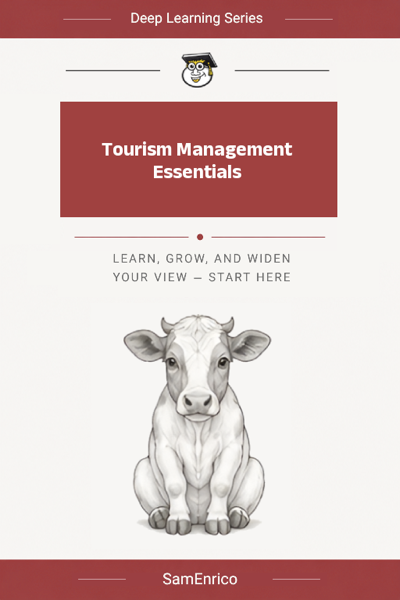
Tourism Management Essentials eBook
A Coursebook on Tourism Management Essentials
A Coursebook on Tourism Management Essentials
Formats
Free sample
Chapter 1: The Hidden Machine--–- Most people wake up never thinking about tourism. They book flights, check into hotels, take photos at landmarks, and return home with souvenirs and stories. But they never see the machinery. They never notice the invisible architecture of supply chains, distribution systems, policy frameworks, and human decisions that made their trip possible. Tourism, for the average traveler, is magic.
For the manager, it is engineering.This chapter dismantles the magic. It reveals tourism for what it truly is: not a collection of disconnected businesses—airlines, hotels, tour operators, restaurants, attractions—but a single, integrated, dynamic system. A system so vast that before the pandemic it employed one out of every ten workers on planet Earth. A system so powerful that it moves 1.4 billion people across international borders annually. A system so fragile that a virus, a wildfire, or a currency fluctuation can collapse destinations overnight.Welcome to the hidden machine.
By the end of this chapter, you will never look at a vacation the same way again. You will see the system.What Is Tourism, Really?Before we can manage tourism, we must define it. And defining tourism is surprisingly controversial. The United Nations World Tourism Organization (UNWTO) offers the most widely accepted definition: tourism comprises the activities of persons traveling to and staying in places outside their usual environment for not more than one consecutive year for leisure, business, or other purposes. This definition contains three critical thresholds.First, "outside their usual environment" excludes routine commuting and local errands.
Driving twenty minutes to work is not tourism. Driving two hours to a beach for the weekend is. Second, "not more than one consecutive year" distinguishes tourists from migrants or expatriates. Third, "for leisure, business, or other purposes" includes conferences, medical travel, religious pilgrimages, and visiting friends and relatives—not just vacations.But this definition, while useful for statistical purposes, misses something essential. Tourism is not merely movement.
It is an economic transaction, a social encounter, a psychological experience, and an environmental intervention all at once. When a tourist takes a photograph in a sacred temple, that is culture. When a hotel hires local staff, that is economics. When a cruise ship dumps waste into the ocean, that is ecology. When a family shares a meal with strangers in a foreign country, that is sociology.
Tourism managers must hold all these dimensions simultaneously.The UNWTO further distinguishes between three categories of travelers. Tourists stay at least one night in collective or private accommodation. Excursionists (or same-day visitors) do not. Travelers is the broadest category, including all persons moving between geographic locations for any purpose. A business executive flying London to New York for a one-day meeting is an excursionist.
A family staying three nights in Paris is tourists. A migrant worker relocating permanently is a traveler but not a tourist. These distinctions matter for taxation, infrastructure planning, and marketing.Tourism also takes multiple forms that managers must recognize. Domestic tourism involves residents of a country traveling within that same country. It is the largest segment by volume in most nations, representing 70-80 percent of all tourism trips globally.
Inbound tourism involves non-residents traveling into a country. Outbound tourism involves residents traveling to another country. Destinations obsessed with international arrivals often neglect domestic markets—a mistake exposed bitterly during the COVID-19 pandemic when borders closed but local roads remained open.Beyond these core categories, niche tourism segments have proliferated: adventure tourism (risk and physical challenge), cultural tourism (heritage and arts), culinary tourism (food and drink as primary motivation), medical tourism (surgery and treatment across borders), dark tourism (sites of death and disaster), ecotourism (nature-based and conservation-focused), and voluntourism (vacation combined with volunteer work). Each niche has distinct management requirements, marketing channels, and ethical considerations.The Tourism System: How the Machine Works Tourism is not an industry in the traditional sense. Steel manufacturing involves a relatively linear chain: raw materials, smelting, rolling, fabrication, distribution.
Tourism is radial. It connects transportation, accommodation, food services, entertainment, retail, finance, and construction—none of which exist solely for tourism but all of which are shaped by it.The most useful framework for understanding this complexity is Leiper's Tourism System Model, developed by Australian geographer Neil Leiper in 1979 and still taught in every tourism management program globally. Leiper proposed that tourism consists of three geographical elements connected by two flows.The three geographical elements are the generating region, the transit route, and the destination region. The generating region is where tourists originate—their home city, their source market. This is where demand is created, where travel agents and tour operators sell products, where marketing expenditures are concentrated.
The destination region is where tourism activity actually occurs—the beach, the national park, the historic city. This is where supply is consumed, where hotels fill rooms, where attractions sell tickets. The transit route is everything in between: airports, highways, train lines, cruise ship channels, and the vehicles that traverse them.Between these regions flow two things. First, tourists move physically from generating region to destination region and back again. Second, information and payments move in both directions—booking confirmations, marketing messages, money from tourists to businesses and from businesses to intermediaries.The power of Leiper's model is that it reveals dependencies.
A destination cannot thrive without accessible transit routes. A transit route without generating regions is an empty road. A generating region without destinations worth visiting produces no travel at all. When one element fails—an airline strike, a visa restriction, a hotel closure—the entire system feels the shock.Supply: Everything the Tourist Consumes Tourism supply is notoriously fragmented. A single two-week package holiday might involve: an international airline (seat), a transfer bus (transport), a hotel (accommodation), a restaurant (food), a tour guide (service), a museum (attraction), a souvenir shop (retail), and travel insurance (finance).
No single business provides all these elements. Tourism managers must coordinate across organizational boundaries.The components of tourism supply fall into five categories.Attractions are the primary motivation for travel. They can be natural (mountains, beaches, waterfalls, wildlife), cultural (museums, temples, festivals, historic districts), or built (theme parks, casinos, stadiums, conference centers). Attractions generate the "pull" that draws tourists from generating regions. Without attractions, the tourism system has no purpose.Accommodation provides the place where tourists sleep.
This category includes hotels (from budget to luxury), motels (roadside convenience), resorts (self-contained destinations), hostels (budget shared rooms), bed and breakfasts (homestay intimacy), vacation rentals (Airbnb-style apartments), camping grounds (outdoor experience), and timeshares (partial ownership). Accommodation is the largest single category of tourism expenditure for most trips.Transport moves tourists between and within regions. Air transport dominates long-distance travel, accounting for approximately 60 percent of international tourist arrivals. Rail transport excels at medium distances and scenic journeys. Road transport (private cars, rental vehicles, coaches) provides flexibility for domestic and regional tourism.
Water transport includes ferries (short crossings), river cruises (inland navigation), and ocean cruises (floating resorts).Tourism infrastructure supports the entire system but is not consumed directly by tourists. Airports, seaports, highways, railways, water supply systems, electrical grids, sewage treatment plants, telecommunications networks, and waste management facilities all enable tourism but are typically provided by government or public-private partnerships.Hospitality services encompass everything else…
This is the end of the free sample. Get the eBook to keep going. Buy now
About this book
Details
- Author
- Magana Earleen
- Publisher
- SamEnrico
- Language
- English
- Genre
- Non-Fiction, Informative, Educational
- Released
- 2026-05-11
- Pages (approx.)
- 146
- Available as
- eBook, Audiobook

Read better in the ZLOADR app
Your eBooks on your phone or tablet. Sign in with your SamEnrico account and start reading.
More by Magana Earleen
 Visualization Enhanced Hypnosis GuideMagana Earleen$11.99
 Drug Dependency Housing Stability GuideMagana Earleen$11.99
 Building Relationship With ExecutivesMagana Earleen$11.99
 The Side Hustle Stress FixMagana Earleen$11.99
 Sexual Symbolism DreamsMagana Earleen$11.99
 Anapanasati Retreat GuideMagana Earleen$11.99
 Press Release Exclusive GuideMagana Earleen$11.99
 Sudanese Lost Boys ReunionMagana Earleen$11.99
 Flying Anxiety Meditation GuideMagana Earleen$11.99
 Wings Over the World: The Arctic’s Great Migration MysteryMagana Earleen$11.99
 The Silent Revolution: The Untold Story of Senator Edward BrookeMagana Earleen$11.99
 The Siege of Lichfield: Cavaliers vs. Parliamentarians in the Heart of EnglandMagana Earleen$11.99
You may also like
 Hong Kong Handover 1997Dunn Johnnie$11.99
 Zumba For Postnatal Recovery CourseNeal Christian$11.99
 Zumba for BeginnersLadner Nikia$11.99
 YouTube Comment Mining GuideHumes Pandora$12.99
 Worry Box MeditationCarlin Rudy$11.99
 Workplace Stress MeditationNguyen Lynn$11.99
 Workplace Stress and Sleep RepairHawley Ivory$11.99
 Workplace Perfectionism CureDelaney Jeffry$11.99
 Workplace Injustice Anger GuideWallen Isabelle$11.99
 Work Addiction and Burnout LinkGreenwood Ester$11.99
 Women in Yoga and WellnessBeattie Galina$11.99
 Women in Stand Up ComedyChun Evangeline$11.99