
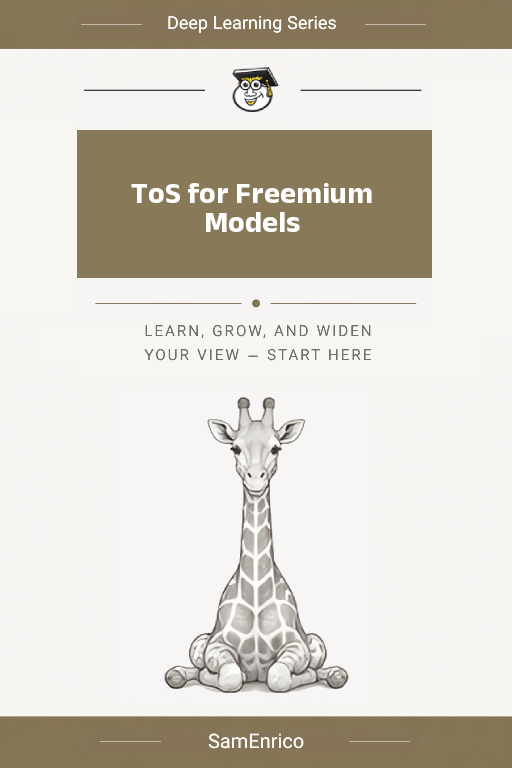
Non-FictionFirst 30 DaysFreemium
ToS for Freemium Models eBook
Define free tier limits, feature restrictions, and
Define free tier limits, feature restrictions, and upgrade paths clearly in your terms.
Formats
Free sample
Chapter 1: The Silent Growth Killer–- It was 3:47 AM when Sarah Chen, CEO of a promising AI-driven project management startup, stared at her dashboard in disbelief. Two million free users. A gorgeous product. Rave reviews on Product Hunt. And a conversion rate of just 1.8 percent.Her investors were furious.
Her head of product had been fired. Her CTO was threatening to quit. And the board had just given her ninety days to turn things around or they would replace her.The problem, everyone assumed, was the product.It wasn't.Three weeks later, after a forensic audit of every customer touchpoint, a junior product manager named Alex found the culprit. It wasn't buried in the onboarding flow, the pricing page, or the feature set. It was hiding in plain sight, in a document that almost no one had ever read carefully: Section 14.3 of the Terms of Service.That single paragraph, written by a well-meaning but inexperienced lawyer two years earlier, had used the phrase "fair and reasonable use" without ever defining what that meant.
Free users, terrified of being charged arbitrarily for "unreasonable" behavior, had self-limited their own usage before ever hitting any real technical cap. They never discovered the product's core value because they were too afraid to use it.Sarah rewrote the To S that week. Within ninety days, conversion tripled.This book exists because Sarah's story is not an anomaly. It is the rule.The Great Misunderstanding Most founders, product managers, and even general counsel treat the Terms of Service as a necessary evil—a legal firewall designed to prevent lawsuits and nothing more. They copy boilerplate from competitors, change the company name, and never think about it again.
This is a catastrophic mistake.The To S for a freemium product is not a legal document. It is a behavioral document that happens to have legal consequences.Let me say that again because it is the single most important idea in this entire book: Your freemium Terms of Service is a growth lever, not a legal shield.Every clause, every definition, every number you put in that document either helps convert free users into paying customers or actively prevents them from converting. There is no neutral ground. Ambiguity is not safety—it is friction. Vague language is not flexibility—it is fear.
And fear, as Sarah learned, is the enemy of conversion.Why This Chapter Matters for Your Book Before we dive into the mechanics of drafting specific clauses (that begins in Chapter 2), we need to completely reframe how you think about the To S itself. This chapter establishes the foundational mindset that will guide every decision in the subsequent eleven chapters. If you skip this chapter, the templates and clauses later in the book will work—but they will work like a car with no steering wheel. You will move, but you will not know where you are going.The top ten books on freemium strategy—from Eric Seufert's Freemium Economics to Madhavan Ramanujam's Monetizing Innovation—all agree on one thing: pricing and packaging are the most underleveraged growth tools in Saa S. But none of them go deep enough into the legal container that holds those packages together.
That container is your To S.This book synthesizes those ten books into a single, actionable framework for legal drafting that drives conversion. And it starts here, with the single most important diagnostic tool you will ever use.The 5% Rule In 2019, the venture capital firm a16z published an internal benchmarking study that sent shockwaves through their portfolio. They had analyzed hundreds of B2B Saa S companies and found a striking pattern: freemium conversion rates almost never exceeded 5 percent unless something specific was true about the To S.The median conversion rate across all freemium products was 3 percent. The top quartile achieved 5 to 8 percent. The bottom quartile languished below 1.5 percent.But here is what made the study revolutionary: when a16z compared the top quartile to the bottom quartile, they found almost no correlation with product quality, pricing, or even marketing spend.
What they found instead was a correlation with limit clarity.Companies that defined their free tier limits in precise, specific, verifiable terms—"10,000 API calls per month," not "reasonable usage"; "1 GB of storage," not "standard storage"—had conversion rates nearly three times higher than companies that used vague language.The reason is simple but profound: users cannot upgrade past a limit they do not understand.If your To S says "fair use," a free user has no idea how close they are to a violation. So they never push the boundaries. They never discover the product's full value. And they never reach the point where upgrading makes economic sense.The 5% Rule, therefore, is this: if your free-to-paid conversion rate is below 5 percent, the problem is almost never your pricing or your product. The problem is structural friction in how your limits are defined and communicated.
And that friction lives almost entirely in your Terms of Service.The Psychology of Legal Ambiguity To understand why ambiguous To S language kills conversion, you need to understand a concept from behavioral economics called ambiguity aversion.In a famous 1961 experiment, the economist Daniel Ellsberg (yes, that Ellsberg) presented subjects with two urns. Urn A contained 50 red balls and 50 black balls. Urn B contained 100 balls, but the ratio of red to black was unknown—it could be 99 red and 1 black, or 1 red and 99 black, or anything in between.Subjects were asked to bet on drawing a red ball from either urn. Which would they choose?Overwhelmingly, subjects chose Urn A, the one with known probabilities, even though Urn B could have had a higher chance of red. The mere possibility of a worse outcome—even when the average outcome was identical—caused people to avoid the ambiguous option.This is ambiguity aversion.
And it is exactly what happens when free users read vague terms like "fair use," "excessive consumption," or "unreasonable load."The user does not know where the line is. They do not know if their usage pattern is "fair." They do not know if they will be charged, throttled, or terminated without warning. So they do the rational thing: they self-limit. They use the product less. They never discover the features that would make them want to pay.Your ambiguous To S is not protecting you from abuse.
It is protecting you from conversion.The Slack Case Study: From Hoarding to Conversion No company illustrates the power of precise limit language better than Slack.When Slack launched its freemium tier in 2014, it had a simple limit: free teams could store up to 10,000 total messages. That was it. No time limit, no recency window, just a hard cap on cumulative message count.The result was a disaster for conversion.Users responded to the 10,000-message cap by hoarding. They deleted old messages to stay under the limit. They created multiple free teams to spread messages across accounts.
They treated the limit as a ceiling to be managed, not a trigger to upgrade. Conversion rates stagnated below 3 percent.Slack's product team eventually realized the problem: the cumulative cap incentivized the exact opposite behavior of what they wanted. They did not want users…
This is the end of the free sample. Get the eBook to keep going. Buy now
About this book
Details
- Author
- Maestas Ciera
- Publisher
- SamEnrico
- Language
- English
- Genre
- Non-Fiction, First 30 Days, Freemium
- Released
- 2026-05-30
- Pages (approx.)
- 150
- Available as
- eBook, Audiobook

Read better in the ZLOADR app
Your eBooks on your phone or tablet. Sign in with your SamEnrico account and start reading.
More by Maestas Ciera
 Neurobiology of Recurring DreamsMaestas Ciera$11.99
 Loneliness Swimming MastersMaestas Ciera$11.99
 Jefferson DeclarationMaestas Ciera$11.99
 Pancreatic Cancer HopeMaestas Ciera$11.99
 Senior Joy Finding GuideMaestas Ciera$11.99
 Declining Social InvitationsMaestas Ciera$11.99
 Construction Tech Capital GuideMaestas Ciera$11.99
 Preventing Legal BurnoutMaestas Ciera$11.99
 Hypnosis JournalMaestas Ciera$11.99
 The Velvet Heist: How a 19th-Century Socialite Outsmarted the British EmpireMaestas Ciera$11.99
 The Scholastic Citadels: How Western Universities Shaped the Modern WorldMaestas Ciera$11.99
 The Outback Odyssey: How Australia's Pioneers Tamed the WildernessMaestas Ciera$11.99
You may also like
 Hong Kong Handover 1997Dunn Johnnie$11.99
 Zumba For Postnatal Recovery CourseNeal Christian$11.99
 Zumba for BeginnersLadner Nikia$11.99
 YouTube Comment Mining GuideHumes Pandora$12.99
 Worry Box MeditationCarlin Rudy$11.99
 Workplace Stress MeditationNguyen Lynn$11.99
 Workplace Stress and Sleep RepairHawley Ivory$11.99
 Workplace Perfectionism CureDelaney Jeffry$11.99
 Workplace Injustice Anger GuideWallen Isabelle$11.99
 Work Addiction and Burnout LinkGreenwood Ester$11.99
 Women in Yoga and WellnessBeattie Galina$11.99
 Women in Stand Up ComedyChun Evangeline$11.99