
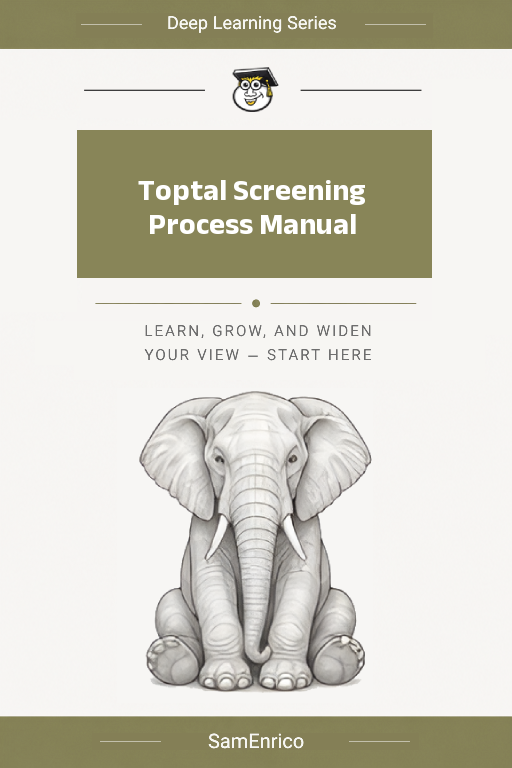
Non-FictionFirst 30 DaysPlatform SelectionElite Freelance Guide
Toptal Screening Process Manual eBook
Pass the five-step vetting for elite developers an
by Dang Gidget
Pass the five-step vetting for elite developers and designers. Includes portfolio reviews, live coding prep, and communication tests for top 3% freelancers.
Formats
Free sample
Chapter 1: The 97% Illusion--–- You have spent the last decade mastering your craft. You have shipped production code that serves millions of users. You have led teams, architected systems, and rescued failing projects from the brink of disaster. You are, by any reasonable measure, an elite software engineer or designer. And you are about to fail the Toptal screening process.Not because you lack skill.
Not because you are not smart enough. But because everything you have learned about succeeding in traditional technical interviews has wired your brain for exactly the wrong behaviors. The same confidence that makes you effective in a full-time role becomes arrogance in a freelancer screening. The same deep focus that allows you to solve complex problems becomes silence that screeners interpret as poor communication. The same perfectionism that produces elegant code becomes over-engineering that signals an inability to ship quickly under client pressure.This chapter dismantles the most dangerous belief applicants bring to the Toptal screening: I am a senior engineer or designer with ten or more years of experience, so I should pass.
That belief has destroyed more promising applications than any technical deficiency ever could. By the time you finish reading this chapter, you will understand why the vast majority of elite talent fails, what Toptal is actually screening for, and how to rewire your approach to pass the five-step vetting process that admits only three percent of applicants.The 3% Acceptance Rate: What the Numbers Actually Mean Toptal publishes its acceptance rate proudly: approximately three percent of applicants pass the full screening process. To put that number in perspective, Harvard University accepts approximately four percent of undergraduate applicants. Stanford Graduate School of Business accepts approximately six percent. The Marine Corps Officer Candidates School has a graduation rate of approximately seventy percent.
Toptal is more selective than all of them.But raw selectivity tells only part of the story. The more revealing statistic is the contrast between Toptal's screening and standard technical interviews at top technology companies. At Google, Facebook, Amazon, or Microsoft, a senior engineer with ten years of experience and a clean track record has an eighty to ninety percent chance of passing a technical interview loop. Those companies are looking for competence, cultural fit, and problem-solving ability. Toptal is looking for something entirely different.The difference lies in the nature of freelance work versus full-time employment.
When Google hires an engineer, that engineer will have onboarding, mentorship, code review processes, and a team structure to catch mistakes. When a Toptal freelancer is placed with a client, there is no safety net. The client expects you to deliver working software on time, communicate clearly, handle ambiguity, and manage scope—all while representing the Toptal brand. The screening is designed to simulate exactly those conditions, not to test whether you can invert a binary tree on a whiteboard.This explains why the acceptance rate is so low and why so many otherwise excellent engineers fail. The screening is not a test of intelligence or technical depth.
It is a test of reliability under pressure. And reliability looks very different from the skills that make you successful in a full-time role.The Three Pillars of Screening: Why Communication Beats Code After analyzing hundreds of failed applications, first-hand accounts from successful freelancers, and leaked internal rubrics from former screeners, a clear pattern emerges. Toptal evaluates candidates across three dimensions, and the weighting of these dimensions is the opposite of what most experienced engineers expect.Pillar One: Communication Hygiene (50% of your score)This is the single most important factor in passing the screening. Communication hygiene encompasses everything from how quickly you respond to messages, to how clearly you articulate your thinking, to how you handle disagreement. Screeners are not looking for perfect grammar or a broad vocabulary.
They are looking for signals that you can collaborate effectively with a remote client who may be stressed, vague, or technically inexperienced.Communication hygiene includes your pacing (not too fast, not too slow), your ability to verbalize your thought process while coding, your tone when receiving feedback, and your responsiveness to clarifying questions. A candidate who solves the problem perfectly but communicates poorly will fail. A candidate who solves the problem adequately but communicates exceptionally well will pass. This weighting shocks most senior engineers, who have been trained to value output over process.Pillar Two: Process Adherence (30% of your score)Process adherence means following instructions exactly, respecting time limits, and delivering what was asked for—nothing more and nothing less. This pillar is where the "gold plating" trap catches many applicants.
When a screener asks for a specific implementation, they want exactly that implementation. Adding extra features, writing excessive documentation, or polishing beyond the requirements signals that you cannot follow a client's specifications. In the freelance world, scope creep is the enemy of profitability. Clients do not want a freelancer who adds unrequested features; they want a freelancer who delivers exactly what was agreed upon, on time and on budget.Process adherence also includes logistical reliability. Showing up on time, having a stable internet connection, being visible on camera, and responding to messages within a reasonable window are all scored.
These small behaviors may seem trivial, but they are the most reliable predictors of long-term freelancer success. A genius who is late is useless to a client with a deadline.Pillar Three: Raw Technical Skill (20% of your score)Technical skill matters, but only up to a threshold. You need to be competent enough to solve the problems presented. You do not need to be the best engineer the screener has ever seen. In fact, trying to demonstrate exceptional technical prowess often backfires because it leads to over-engineering, arguing about problem constraints, or spending too much time optimizing when a simpler solution would suffice.The technical bar is high—you cannot pass without solid skills—but it is not the differentiator that most applicants believe it to be.
The difference between passing and failing almost always comes down to communication and process, not to whether you found the optimal algorithm.Why Senior Talent Fails: Three Common Patterns The analysis of failed applications reveals three patterns that disproportionately affect senior engineers and designers. These patterns are so common that they have become predictable to Toptal screeners, who are trained to spot them within the first five minutes of an interview.Pattern One: Arguing with the Screener The senior engineer has spent years defending their technical decisions to product managers, junior developers, and skeptical stakeholders. In a workplace, this assertiveness is valuable. In a Toptal screening, it is fatal.When a screener suggests a suboptimal approach or asks a clarifying question that seems trivial, the senior engineer's instinct is to explain why their approach is better. This behavior is scored as a risk factor for poor client management.
A freelancer who argues with a screener will argue with a client, and Toptal cannot afford to place that freelancer with a paying customer.Consider the case study that appears repeatedly in Toptal post-mortems: a fifteen-year backend architect with impeccable credentials fails the live coding round. He solves the problem correctly, efficiently, and with elegant code. But twice during the session, when the screener asked…
This is the end of the free sample. Get the eBook to keep going. Buy now
About this book
Details
- Author
- Dang Gidget
- Publisher
- SamEnrico
- Language
- English
- Genre
- Non-Fiction, First 30 Days, Platform Selection, Elite Freelance Guide
- Released
- 2026-06-01
- Pages (approx.)
- 146
- Available as
- eBook, Audiobook

Read better in the ZLOADR app
Your eBooks on your phone or tablet. Sign in with your SamEnrico account and start reading.
More by Dang Gidget
 The Step Parent Self Care GuideDang Gidget$11.99
 Self Esteem Single Again GuideDang Gidget$11.99
 Healing Dream Indicators GuideDang Gidget$11.99
 Blood Sugar Energy StabilityDang Gidget$11.99
 The Vanishing Point: When Earth’s Magnetic Poles Switched PlacesDang Gidget$11.99
 The Enzyme Hunters: Japan's Race to Decipher Life's Molecular Code (1970s-1990s)Dang Gidget$11.99
 Understanding Hereditary Sensory Neuropathy Type IiDang Gidget$17.99
 Client Solution AnalystDang Gidget$11.99
 Cloud Telecom Outlook 2026Dang Gidget$12.99
 How to Start a Bricks Made of Concrete Business (Beginners Guide)Dang Gidget$11.99
You may also like
 Hong Kong Handover 1997Dunn Johnnie$11.99
 Zumba For Postnatal Recovery CourseNeal Christian$11.99
 Zumba for BeginnersLadner Nikia$11.99
 YouTube Comment Mining GuideHumes Pandora$12.99
 Worry Box MeditationCarlin Rudy$11.99
 Workplace Stress MeditationNguyen Lynn$11.99
 Workplace Stress and Sleep RepairHawley Ivory$11.99
 Workplace Perfectionism CureDelaney Jeffry$11.99
 Workplace Injustice Anger GuideWallen Isabelle$11.99
 Work Addiction and Burnout LinkGreenwood Ester$11.99
 Women in Yoga and WellnessBeattie Galina$11.99
 Women in Stand Up ComedyChun Evangeline$11.99